
2 Standards compliance
2-1 Standards Compliance
Summary of legislation
Applicable legislation
- Land Transport Rule: Vehicle Standards Compliance 2002
- Land Transport Rules as specified in Tables of vehicle class standards requirements
- Transport (Vehicle Standards) Regulations 1990
- New Zealand Gazette notices as specified in Tables of vehicle class standards requirements.
Compliance with approved standards
1. A vehicle of group L or class MA, MB, MC, MD1 or NA must comply with approved standards as specified in Tables of vehicle class standards requirements and Lists of approved standards.
Reasons for rejection
Compliance with approved standards
1. A vehicle of group L or class MA, MB, MC, MD1 or NA did not comply, or cannot be demonstrated to have complied, with approved standards as specified in Tables of vehicle class standards requirements and Lists of approved standards.
Note 1
The following standards markings may assist in determining compliance with approved standards.

Note 2
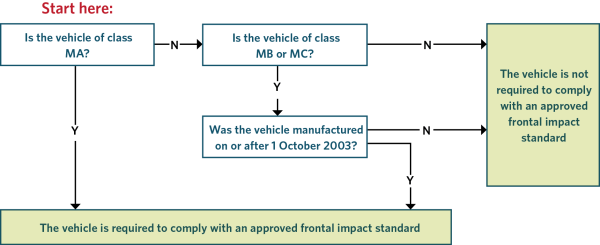
The following flowchart may assist in determining whether a vehicle is required to comply with an approved frontal impact standard.
Vehicle noise emissions
Vehicle noise emissions must meet one of these standards and not exceed the maximum noise limits in Table 2-1-5.
Fuel consumption, test cycle, CO2 and battery efficiency information
For a vehicle where fuel consumption, CO2 and battery information is required for entry certification by the Land Transport Rule: Vehicle Efficiency and Emissions Data 2022, this data must be entered using MIAMI.
The original homologation values for the documented test cycle should be supplied. Conversions and mapping to supply ‘normalised’ values as required by the Rule will be done by MIAMI. This is mandatory where the fuel type is petrol, diesel, LPG, CNG, petrol hybrid or diesel hybrid and the vehicle class is MA, MB, MC, MD1, MD2 and NA and the vehicle has a gross vehicle mass of not more than 3,500kg.
List of approved standards
Door retention systems
Door retention systems must meet one of these standards (or a more recent version):
- Council Directive 70/387/EEC of 26 July 1971 on the approximation of the laws of the Member States relating to the doors of motor vehicles and their trailers
- UN/ECE Regulation No. 11, Uniform provisions concerning the approval of vehicles with regard to door latches and door retention components
(E/ECE324-E/ECE/TRANS/505/Add.10) - Federal Motor Vehicle Safety Standard No. 206, Door Locks and Door Retention Components – Passenger Cars, Multipurpose Passenger Vehicles, and Trucks
- Australian Design Rule 2, Side Door Latches and Hinges
- Technical Standard for Door Retention Systems (Japan).
- Japan article 25.
Interior impact systems
Interior impact systems must meet these two standards (or more recent versions):
- Council Directive of 17 December 1973 on the approximation of the laws of the Member States relating to the interior fittings of motor vehicles (interior parts of the passenger compartment other than the interior rear-view mirrors, layout of controls, the roof or sliding roof, the backrest and rear part of the seats) (74/60/EEC)
- Council Directive of 1 March 1971 on the approximation of the laws of the Member States relating to the rear-view mirrors of motor vehicles (71/127/EEC)
OR this standard (or a more recent version):
- UN/ECE Regulation No. 21, Uniform provisions concerning the approval of vehicles with regard to their interior fittings
(E/ECE324-E/ECE/TRANS/505/Rev.1/Add.20)
OR this standard (or a more recent version):
- Federal Motor Vehicle Safety Standard No. 201, Occupant Protection in Interior Impact – Passenger Cars
OR these three standards (or more recent versions):
- Australian Design Rule 11, Internal Sun Visors
- Australian Design Rule 21, Instrument Panel
- Australian Design Rule 42, General Safety Requirements (section on external or internal protrusions)
OR these four standards (or more recent versions):
- Technical Standard for Instrument Panel Impact Absorption (Japan)
- Technical Standard for Sunvisor Impact Absorption and Interpretation of the Technical Standard for Sunvisor Impact Absorption (Japan)
- Technical Standard for Seatback Impact Absorption (Japan)
- Technical Standard for Impact Reduction of Inside Rearview Mirrors (Japan).
- Japan article 20.
Note: A motor vehicle doesn’t have to comply with these standards for the interior fittings if the vehicle complies with a version of one of the approved frontal impact vehicle standards, whether or not that vehicle is required by that rule to so comply.
Frontal impact systems
Frontal impact systems must meet one of these standards (or a more recent version):
- UN/ECE Regulation No. 94, Uniform provisions concerning the approval of vehicles with regard to the protection of the occupants in the event of a frontal collision
(E/ECE/324-E/ECE/TRANS/505/Rev.1/Add.93) - Federal Motor Vehicle Safety Standard No. 208, Occupant Crash Protection in Passenger Cars, Multipurpose Passenger Vehicles, Trucks and Buses
- Australian Design Rule 69, Full Frontal Impact Occupant Protection
- Australian Design Rule 73, Offset Frontal Impact Protection
- Technical Standard for Occupant Protection in Frontal Collision (Japan)
- Japan article 18
- Technical requirements of: Directive 96/79/EC* of the European Parliament and of the Council of 16 December 1996 on the protection of occupants of motor vehicles in the event of a frontal impact [which, for the purpose of occupant protection in the event of a frontal impact, amends the Council Directive of 6 February 1970 on the approximation of the laws of the Member States relating to the type-approval of motor vehicles and their trailers (70/156/EEC)]
Light-vehicle brakes
Light-vehicle brakes must meet one of these standards (or a more recent version):
- Council Directive of 26 July 1971 on the approximation of the laws of the Member States relating to the braking devices of certain categories of motor vehicles and of their trailers (71/320/EEC)
- Council Directive of 5 April 1993 on the braking of two- or three-wheel motor vehicles (93/14/EEC)
- UN/ECE Regulation No. 13, Uniform provisions concerning the approval of vehicles of categories M, N and O with regard to braking
(E/ECE324-E/ECE/TRANS/505/Rev.1/Add.12) - UN/ECE Regulation No. 13-H, Uniform provisions concerning the approval of passenger cars with regard to braking
(E/ECE324-E/ECE/TRANS/505/Rev.2/Add.12H) - UN/ECE Regulation No. 78, Uniform provisions concerning the approval of vehicles of category L with regard to braking
(E/ECE/324-E/ECE/TRANS/505/Rev.1/Add.77) - Federal Motor Vehicle Safety Standard No. 105, Hydraulic Brake Systems
- Federal Motor Vehicle Safety Standard No. 122, Motorcycle Brake Systems
- Federal Motor Vehicle Safety Standard No. 135, Passenger Car Brake Systems
- Australian Design Rule 31, Hydraulic Brake Systems for Passenger Cars
- Australian Design Rule 33, Brake Systems for Motorcycles and Mopeds
- Australian Design Rule 33/01, Brake Systems for Motorcycles and Mopeds
- Australian Design Rule 35, Commercial Vehicle Brake Systems
- Technical Standard for Passenger Motor Vehicle Braking Systems (Japan)
- Technical Standard for Two Wheeled Vehicle Brake Systems (Japan)
- Japan article 12.
Tyres
New tyres must meet one of these standards (or a more recent version):
- Council Directive 91/23/EEC of 31 March 1992 relating to tyres for motor vehicles and their trailers and to their fitting
- UN/ECE Regulation No. 30, Uniform provisions concerning the approval of pneumatic tyres for motor vehicles and their trailers
(E/ECE324-E/ECE/TRANS/505/Rev.1/Add.29) - UN/ECE Regulation No. 54, Uniform provisions concerning the approval of pneumatic tyres for commercial vehicles and their trailers
(E/ECE324-E/ECE/TRANS/505/Rev.1/Add.53) - Federal Motor Vehicle Safety Standard No. 109, New Pneumatic Tires – Passenger Cars
- Federal Motor Vehicle Safety Standard No. 119, New Pneumatic Tires for Vehicles Other Than Passenger Cars
- The Standards of the Japan Automobile Tire Manufacturers’ Association, Inc.
- Japan Industrial Standard D4230, Tires for Automobiles
- Japan article 9
- Australian Design Rule 23, Passenger Car Tyres
- Australian Design Rule 71, Temporary-Use Spare Tyres
- Australian Design Rule 42/05, Temporary-Use Spare Tyres.
Seats and seat anchorages
Seats and seat anchorages must meet one of these standards (or a more recent version):
- UN/ECE Regulation No. 17, Uniform provisions concerning the approval of vehicles with regard to the seats, their anchorages and any head restraints (E/ECE324-E/ECE/TRANS/505/Rev.1/Add.16)
- Council Directive of 22 July 1974 on the approximation of the laws of the Member States relating to the interior fittings of motor vehicles (strength of seats and their anchorages)
(74/408/EEC) - Federal Motor Vehicle Safety Standard No. 207, Seating Systems – Passenger Cars, Multipurpose Passenger Vehicles, Trucks, and Buses
- Technical Standard for Seats and Seat Anchorages (Japan)
- Japan article 22
- Australian Design Rule 3/02, Seats and Seat Anchorages.
Head restraints (if fitted)
If they are fitted, head restraints must meet one of these standards (or a more recent version):
- Council Directive of 16 October 1978 on the approximation of the laws of the Member States relating to head restraints of seats of motor vehicles (78/932/EEC)
- Council Directive of 22 July 1974 on the approximation of the laws of the Member States relating to the interior fittings of motor vehicles (strength of seats and their anchorages) as amended by Commission Directive 96/37/EC of 17 June 1996 (74/408/EEC)
- UN/ECE Regulation No. 17, Uniform provisions concerning the approval of vehicles with regard to the seats, their anchorages and any head restraints (E/ECE324-E/ECE/TRANS/505/Rev.1/Add.16)
- UN/ECE Regulation No. 25, Uniform provisions concerning the approval of head restraints (headrests), whether or not incorporated in vehicle seats
(E/ECE324-E/ECE/TRANS/505/Rev.1/Add.24) - Federal Motor Vehicle Safety Standard No. 202, Head Restraints – Passenger Cars
- Australian Design Rule 22, Head Restraints
- Technical Standard for Head Restraints (Japan)
- Japan article 22-4.
External projections
Must meet one of these standards (or a more recent version):
- Council Directive of 17 September 1974 on the approximation of the laws of the Member States relating to the external projections of motor vehicles (74/483/EEC)
- Council Directive 92/114/EEC of 17 December 1992 relating to the external projections forward of the cab's rear panel of motor vehicles of category N
- UN/ECE Regulation No. 26, Uniform provisions concerning the approval of vehicles with regard to their external projections
(E/ECE324-E/ECE/TRANS/505/Rev.1/Add.25) - UN/ECE Regulation No. 61, Uniform provisions concerning the approval of commercial vehicles with regard to their external projections forward of the cab’s rear panel
(E/ECE324-E/ECE/TRANS/505/Rev.1/Add.60) - Australian Design Rule 42, General Safety Requirements (section on external and internal protrusions)
- Australian Design Rule 92, Vehicle Standard (Australian Design Rule 92/00 – External Projections) 2018
- Technical Standard for Impact Reduction of Outside Rearview Mirrors (Japan) AND, if spoiler fitted, Structural Standard for Air Spoilers (Japan)
- Japan article 18.
Steering systems
Must meet these two standards (or more recent versions):
- Council Directive of 4 June 1974 on the approximation of the laws of the Member States relating to the interior fittings of motor vehicles (the behaviour of the steering mechanism in the event of an impact) (74/297/EEC)
- Council Directive of 8 June 1970 on the approximation of the laws of the Member States relating to the steering equipment for motor vehicles and their trailers (70/311/EEC)
OR these two standards (or more recent versions):
- UN/ECE Regulation No. 12, Uniform provisions concerning the approval of vehicles with regard to the protection of the driver against the steering mechanism in the event of impact
(E/ECE324-E/ECE/TRANS/505/Add.11) - UN/ECE Regulation No. 79, Uniform provisions concerning the approval of vehicles with regard to steering equipment
(E/ECE324-E/ECE/TRANS/505/Rev.1/Add.78)
OR these two standards (or more recent versions):
- Federal Motor Vehicle Safety Standard No. 203, Impact Protection for the Driver from the Steering Control System – Passenger Cars
- Federal Motor Vehicle Safety Standard No 204, Steering Control Rearward Displacement – Passenger Cars, Multipurpose Passenger Vehicles, Trucks and Buses
OR this standard (or a more recent version):
- Australian Design Rule 10, Steering Column
OR this standard (or a more recent version):
- Technical Standard for Steering System Impact (Japan)
- Japan article 11.
Note: A motor vehicle need not comply with these standards for the steering systems if the vehicle complies with a version of one of the approved frontal impact vehicle standards, whether or not that vehicle is required by that rule to so comply.
Glazing
Glazing must meet one of these standards (or a more recent version):
- UN/ECE Regulation No. 43, Uniform provisions concerning the approval of safety glazing and glazing materials
(E/ECE324-E/ECE/TRANS/505/Rev.1/Add.42) - Council Directive of 31 March 1992 on safety glazing and glazing materials on motor vehicles and their trailers (92/22/EEC)
- British Standard 857: 1967, Specification for Safety Glass for Land Transport
- British Standard 5282: 1975, Specification for Road Vehicle Safety Glass
- British Standard AU 178a: 1992, Specification for Road Vehicle Safety Glass
- Federal Motor Vehicle Safety Standard No. 205, Glazing Materials
- American National Standard for Safety Glazing Materials for Glazing Motor Vehicles and Motor Vehicle Equipment Operating on Land Highways – Safety Code (ANSI/SAE Z26.1-1990)
- Technical Standard for Window Glass, Jisha Circular No. 899 of 1 October 1983
- Japanese Industrial Standard R 3211–1992, Safety Glass for Road Vehicles
- Japan article 29
- New Zealand Standard 5443:1987, Safety Glass for Land Vehicles
- Australian Standard 2080–1983, Safety Glass for Land Vehicles
- Australian/New Zealand Standard 2080:1995, Safety Glass for Land Vehicles
- Australian Design Rule 8/00, Safety Glazing Material
- South African Standard SABS 1191/1193–1978, Standard Specifications for Safety Glass for Vehicles
- Allgemeine Bauartgenehmigung (ABG), issued by the German Kraftfahrt-Bundesamt for glazing directly behind, or to the left or right of the rear of, the driver’s seatback in its rearmost and upright position that is marked in accordance with the ABG
Rear-view mirrors
Rear-view mirrors must meet one of these standards (or a more recent version):
- Regulation No. 46, Uniform provisions concerning the approval of rear-view mirrors, and of motor vehicles with regard to the installation of rear-view mirrors
(E/ECE324-E/ECE/TRANS/505/Rev.1/Add.45) - Council Directive of 1 March 1971 on the approximation of the laws of the Member States relating to the rear-view mirrors of motor vehicles (71/127/EEC)
- Federal Motor Vehicle Safety Standard No. 111, Rearview Mirrors
- Technical Standard for Installation Position of Outside Rear-view Mirrors, Jisha Circular No. 187 of March 18, 1983
- Installation Position of Outside Rear-View Mirrors, Jisha Circular No. 186 of March 18, 1983
- Japan article 44
- Australian Design Rule 14/00, Rear Vision Mirrors.
Lighting
All lighting and signalling components must meet one of the standards listed in Table 2-1-6.
All installations of lighting and signalling equipment must meet one of the standards listed in Table 2-1-7.
Seatbelts
Seatbelts must meet one of these standards (or a more recent version):
- Council Directive 77/541/EEC of 28 June 1977 on the approximation of the laws of the Member States relating to safety belts and restraint systems on motor vehicles
- UN/ECE Regulation No. 16, Uniform provisions concerning the approval of safety belts and restraint systems for adult occupants of power-driven vehicles
(E/ECE324-E/ECE/TRANS/505/Rev.1/Add.15) - Federal Motor Vehicle Safety Standard No. 209, Seat Belt Assemblies
- Australian Design Rule 4, Seat Belts
- Technical Standard for Seat Belt Assemblies (Japan)
- Japanese Industrial Standard D 4604-1988, Seat Belts for Automobiles
- Japan article 22-3
- New Zealand Standard 5401:1982, Specification for Seat Belt Assemblies for Motor Vehicles
- New Zealand Standard 1662:1969, Specification for Seat Belt Assemblies for Motor Vehicles
- Australian Standard/New Zealand Standard 2596:1995, Seat Belt Assemblies for Motor Vehicles
- Australian Standard E35.1:1970, Seat Belt Assemblies for Motor Vehicles
- Australian Standard E35.2:1970, Seat Belt Assemblies (Including Retractors) for Motor Vehicles
- South African Bureau of Standards 1080-1983, Standard Specification for Restraining Devices (Safety Belts) for Occupants of Adult Build in Motor Vehicles (Revised Requirements)
- British Standard AU 160c: 1971, Specification for Seat Belt Assemblies for Motor Vehicles.
Seatbelt anchorages
Note An original equipment seatbelt anchorage is an anchorage that was installed by the vehicle manufacturer at the time the vehicle was manufactured, and was fitted with a seatbelt by the vehicle manufacturer at the time the vehicle was manufactured.
A retrofitted seatbelt anchorage includes a seatbelt anchorage that was installed by the vehicle manufacturer at the time the vehicle was manufactured but that was not fitted with a seatbelt at that time.
Seatbelt anchorages must meet one of these standards (or a more recent version):
- Council Directive 76/115/EEC of 18 December 1975 on the approximation of the laws of the Member States relating to anchorages for motor vehicle safety belts
- UN/ECE Regulation No. 14, Uniform provisions concerning the approval of vehicles with regard to safety belt anchorages
(E/ECE324-E/ECE/TRANS/505/Rev.1/Add.13) - Federal Motor Vehicle Safety Standard No. 210, Seat Belt Assembly Anchorages – Passenger Cars, Multipurpose Passenger Vehicles, Trucks and Buses
- Australian Design Rule 5, Anchorages for Seat Belts and Child Restraints
- Technical Standard for Seat Belt Anchorages (Japan)
- Japan article 22-3.
Child restraints
Child restraints must meet one or more of these standards (or a more recent version) and be labelled or otherwise marked in accordance with the requirements of the applicable standard(s):
- Australian Standard/New Zealand Standard 1754 Child Restraint Systems for Use in Motor Vehicles
- British Standard 3254 for adult seat belts, forward-facing child safety seats and child harnesses
- British Standard AU185 for booster cushions
- British Standard AU202, Specification for Rearward-Facing Restraint Systems for Infants, for Use in Road Vehicles
- UN/ECE Regulation No. 44, Uniform provisions concerning the approval of restraining devices for child occupants of power-driven vehicles (‘Child Restraint System’)
(E/ECE324-E/ECE/TRANS/505/Add.43) - Federal Motor Vehicle Safety Standard No. 213, Child Restraint Systems
- Technical Standard for Child Restraints (Japan)
- Japan article 22-5.
Table 2-1-1. Glossary of codes for safety glass
|
L |
= |
laminated glass |
|
LF |
= |
laminated float |
|
LP |
= |
laminated plate |
|
// or /// |
= |
laminated when near the mark |
|
L.76WHP |
= |
laminated, 0.76mm interlayer, suitable for all locations |
|
AS1 |
= |
laminated for use anywhere in the vehicle |
|
A |
= |
the glass in the direction of the arrow complies with the 70% light transmission requirement |
 S or A
  S
STable 2-1-2. Glossary of codes for laminated glass
|
L |
= |
laminated glass |
|
F |
= |
float glass |
|
P |
= |
plate glass |
|
LF |
= |
laminated float |
|
LP |
= |
laminated plate |
|
/ |
= |
toughened, when near the |
|
// or /// |
= |
laminated, when near the |
|
TS |
= |
toughened glass |
|
TP |
= |
toughened plate |
|
T |
= |
toughened or tempered |
|
Z |
= |
zone tempered |
|
WHP |
= |
complies with impact test |
|
DOT |
= |
Department of Transport (USA) |
|
A |
= |
the glass, in the direction of the arrow, complies with the 70% light transmission requirement |
|
ANSI |
= |
American National Standards Institute |
|
FVMSS codes |
||
|
AS1 |
= |
for use anywhere in the vehicle |
|
AS2 |
= |
for use anywhere in the vehicle other than windscreen |
|
AS3 |
= |
for rear and rear side windows only |
|
AS4 and AS5 |
= |
plastic glazing not suitable for driver’s vision |
|
Glazing cut from mother sheet |
||
|
L.76WHP |
= |
laminated, 0.76mm interlayer, suitable for all locations |
|
L.38 |
= |
laminated, 0.38mm interlayer, must not be used for windscreens |
|
PCZ26.1 |
= |
polycarbonate, meets requirements of ANSI Z26, must not be used for windscreens |
 mark
markTable 2-1-3 Applicable exhaust emission standards for new vehicles – class MA, MB, MC, MD1, MD2, NA
| Date of manufacture | Fuel type | Existing or new model vehicles (Note 4) |
Approved vehicle emissions standards |
|---|---|---|---|
| Before 30 April 2024 | Petrol, CNG/LPG | Existing or new | Euro 5, or US 2007, or Japan 05, or ADR 79/04 |
| Diesel | |||
| 30 April 2024 to 30 June 2027 | Petrol, CNG/LPG | Existing or new | Euro 5, or US Tier 2, or Japan 2005 Low Harm, or Japan 2018, or ADR 79/04 |
| Diesel | Existing or new | Euro 5, or US Tier 2, or Japan 09, or ADR 79/04 |
|
| 1 July 2027 to 30 June 2028 | Petrol, CNG/LPG | Existing | Euro 5, or US Tier 2, or Japan 2005 Low Harm, or Japan 2018, or ADR 79/04 |
| New | Euro 6d, or US Tier 3, or Japan 2018 Low Harm, or UNR83/08 |
||
| Diesel | Existing | Euro 5, or US Tier 2, or Japan 09, or ADR 79/04 |
|
| New | Euro 6d, or US Tier 3, or Japan 2018, or UNR83/08 |
||
| From 1 July 2028 | Petrol, CNG/LPG | Existing or new | Euro 6d, or US Tier 3, or Japan 2018 Low Harm, or UNR83/08 |
| Diesel | Existing or new | Euro 6d, or US Tier 3, or Japan 2018, or UNR83/08 |
Abbreviations used in Table 2-1-3
ADR 30/01 means Australian Design Rule 30/01, Diesel Engine Exhaust Smoke Emissions.
ADR 79/02 means Australian Design Rule 79/02, Emission Control for Light Vehicles.
ADR 79/03 means Australian Design Rule 79/03, Emission Control for Light Vehicles.
ADR 79/04 means Australian Design Rule 79/04, Emission Control for Light Vehicles.
ADR 80/02 means Australian Design Rule 80/02, Emission Control for Heavy Vehicles.
ADR 80/03 means Australian Design Rule 80/03, Emission Control for Heavy Vehicles
Euro 4:
a) means:
i. UN/ECE Regulation No. 83, uniform provisions concerning the approval of vehicles with regard to the emission of pollutants according to engine fuel requirements (E/ECE/324E/ECE/TRANS/505/Rev.1/Add.82/Rev.2) incorporating the 05 series of amendments, as per the limit values in row B of the table to clause 5.3.1.4, or
ii. Council Directive 70/220/EEC as amended by Council Directive 98/69/EC as per the limit values in row B of the table to clause 5.3.1.4 of Annex I of 98/69/EC, or
iii. UN/ECE Regulation No. 49 – uniform provisions concerning the approval of compression-ignition (CI) and natural gas (NG) engines as well as positive-ignition (PI) engines fuelled with liquid petroleum gas (LPG) and vehicles equipped with CI and NG engines and PI engines fuelled with LPG, with regard to the emissions of pollutants by the engine (E/ECE/324E/ECE/TRANS/ 505/Rev.1/Add. 48/Rev.3/Amend.1) incorporating the 03 series of amendments, as per the limit values in row B1 or C of Table 1 and/or 2 (as appropriate), in section 5.2.1, or
iv. Council Directive 88/77/EEC of 3 December 1987 on the approximation of the laws of the Member States relating to measures to be taken agai