
8 Brakes
8-1 Service brake and parking brake
|
See also Heavy vehicle brake testing: CoF and entry certification brake test protocol and procedure |
Reasons for rejection
Mandatory equipment
Service brake
1. A heavy vehicle does not have a service brake.
2. A heavy vehicle first registered in New Zealand on or after 1 November 1990 does not have a service brake that is designed to act on each wheel.
3. A vehicle of class NB or NC listed in Table 8-1-2 is not fitted with an anti-lock braking system (ABS).
Parking brake
4. A heavy vehicle does not have a parking brake.
5. A parking brake of a heavy vehicle first registered in New Zealand on or after 1 November 1990 acts on less than 40% of the wheels.
6. The parking brake of a heavy vehicle or combination of vehicles cannot be applied by the driver from the normal driving position using one control only.
7. A class NB or NC vehicle fitted with a transmission/Cardan shaft park brake does not have a warning label, visible to the driver, advising that a transmission/Cardan shaft park brake is fitted to this vehicle (see Figure 8-1-6).
7. (From 27 February 2020) If requested by a vehicle inspector, a 4085D Operator statement of compliance with maintenance requirements for parking brake assemblies form is:
a) not presented, or
b) not complete, or
c) not current.
(see also technical bulletin (CoF) 9 Park brake inspection and 4085D requirements for guidance)
Emergency brake
8. A heavy vehicle does not have an emergency brake.
9. The emergency brake of a heavy vehicle first registered in New Zealand on or after 1 November 1990 that is combined with the service brake or with a parking brake that acts on the transmission does not meet the requirements of Table 8-1-3.
Hoses and other flexible tubing
10. A hose or other flexible tubing forming part of a compressed air or vacuum line does not comply with at least one of the standards in Table 8-1-4 (Note 2).
Compressed air brake systems
11. A heavy vehicle that is fitted with an air brake or a brake that is operated with the assistance of compressed air is not equipped with an air pressure gauge that indicates the pressure in a brake reservoir (Note 3).
12. The service brake circuit of an air-braked class NB or NC vehicle are not fitted with a low-pressure warning device visible and /or audible from the driver’s normal driving position.
13. An air-braked vehicle of class NB or NC listed in Table 8-1-5 does not have towing vehicle protection (Note 4).
14. The air brake of a heavy vehicle first registered in New Zealand on or after 1 March 2007 that has a towing connection to tow an air braked trailer (or a tow connection fitted on or after 1 March 2007) is not capable of being connected to the air brake of the trailer by means of a two-line system.
15. A vehicle that is certified to the New Zealand Heavy-vehicle Brake Specification (HVBNZ) does not have:
a) a drain valve fitted to the lowest point of each brake reservoir, specifically, the reservoirs of the service brake and park brake, and including the so-called ‘wet tank’, or
b) a drain valve fitted to an air-brake reservoir or to the reservoir of auxiliary equipment is not capable of being operated by a person standing beside the vehicle, without the need for a pit or hoist, or
c) an automatic drain valve does not have a means of manual operation.
Note Operation of drain valves must not require the use of tools.
Permitted equipment
16. An air-operated device is supplied air from a service brake reservoir (ie not from a separate reservoir) unless:
a) the operation of the device requires only a small amount of compressed air and it is supplied with compressed air by a hose or pipe with an external diameter not exceeding 8mm, or
b) the device is operated only when the vehicle is stationary, or
c) the vehicle manufacturer allows it.
17. An air-operated device is connected to the air brake system without protection (Note 5).
18. A temporary stop brake:
a) cannot be operated from the driver’s normal driving position, or
b) interferes with the safe operation of the service brake or the parking brake of the vehicle, or
c) when it can be deactivated only by the driver, does not have a label permanently attached displaying the words NOT FOR PARKING, or
d) when it can be deactivated by the control system of the vehicle (eg when the engine is switched off), does not have at least one of the following:
- a label permanently attached displaying the words NOT FOR PARKING
- an audible warning device that operates when the driver’s door is open while the device is activated and the parking brake is not fully applied.
19. A retarder or engine brake fitted on or after 1 March 2007 does not have a control that can be operated from the driver’s normal driving position.
20. A trailer - brake hand control does not:
a) apply the service brakes of the trailer(s), or
b) automatically return to its original position.
Prohibited equipment
21. A heavy vehicle has a device fitted that allows the driver to adjust the service brake force distribution between the axles or between the vehicles that are used in combination.
22. A service brake has more than one control (other than a separate trailer hand brake control or a vehicle converted to dual steering)
Condition
23. Refer to general vehicle pages.
24. A brake is not capable of being easily adjusted.
25. An adjustment indicator rod is:
a) missing, or
b) seized.
26. A brake component has excessive travel or stroke (eg as shown by an adjustment indicator rod or similar device).
27. A brake actuator (including a slack adjuster and associated components):
a) is insecure, or
b) is leaking air, or
c) is cracked, or
d) does not operate, or
e) is excessively worn or corroded, or
f) is not seated correctly.
28. A treadle valve, brake valve, reservoir, compressor or fluid pump:
a) is missing, or
b) is insecure, or
c) is cracked, or
d) is leaking air, or
e) does not operate or operates incorrectly, eg due to corrosion, damage,incorrect fitment or excessive travel, or
f) contains excessive amounts of foreign fluids (eg water or oil).
29. A compressor or pump drive belt is:
a) insecure, or
b) damaged, or
c) significantly deteriorated.
30. A brake lining or brake pad:
a) has obviously been replaced on or after 1 March 2007 without all the linings or pads on the axle being replaced at the same time, or
b) is obviously of a different make, type or grade from another on the same axle.
31. A required service brake reservoir air pressure gauge is not readily visible to the driver (day and night) from the driver’s normal driving position (Note 6).
32. An air brake coupling device fitted to a heavy vehicle first registered in New Zealand on or after 1 March 2007 or fitted to a vehicle on or after that date:
a) is not robust, durable, or suitable for automotive application, or
b) is unable to prevent the incorrect connection of the control and supply lines, or
c) adversely affects the performance of the brake of either the towing or towed vehicle(s), or
d) does not have an effective break-away function, or
e) the coupling is not fitted as close as practicable to:
i. the centre-line of the vehicle, or
ii. the rear of the towing vehicle, or
iii. the towing connection by which the towed and towing vehicles are connected.
33. A brake pipe (including connections) is:
a) leaking, or
b) insecure, or
c) deformed from its original shape, or
d) chafed, or
e) corrosion damaged, eg there are signs of pitting or a noticeable increase in the pipe’s diameter, or
f) damaged so the cross-sectional area is reduced, or
g) fouled by moving parts.
34. A hose or plastic brake pipe (including connections):
a) is leaking, or
b) is insecure, or
c) bulges under pressure, or
d) is twisted or stretched, or
e) is cracked or chafed, eg the reinforcement cords are exposed, or
f) has metal components that are excessively corroded, or
g) fouled by moving parts.
35. A coiled nylon brake hose (suzie coil) does not have:
a) a straight hose section at the connector that is at least 50mm long, or
b) a spring guard adjacent to the end fittings capable of supporting and protecting the brake hose.
- While spring guards can vary in design and length they must remain in good condition, ie not have broken or looped coils.
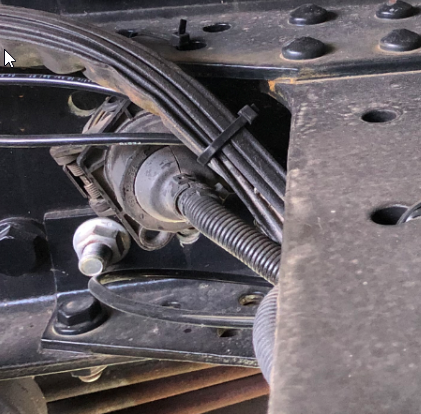
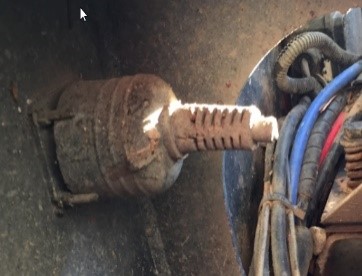
36. An ABS plug or socket (see Figure 8-1-5)
a) is missing, or
b) has damaged, displaced or corroded pins, or
c) is otherwise broken or defective.
- Dismantling of the plug or socket is not required, visual inspection only.
Performance
Service brake (Note 7)
37. The service brake cannot be applied in a controlled and progressive manner.
38. When the service brake is applied and without assistance from the engine or other retarders:
a) the vehicle does not stop within seven metres from a speed of 30km/h (average brake efficiency of 50%) for a vehicle which has a service brake designed to act on at least four wheels, or
b) the vehicle does not stop within nine metres from a speed of 30km/h (average brake efficiency of 40%) for a vehicle first registered in New Zealand before 1 February 1977 which has a service brake designed to act on fewer than four wheels, or
c) the vehicle does not stop within 20m from a speed of 30 km/h (average braking efficiency of 18%) or equivalent efficiency at its maximum speed for a vehicle manufactured before 31 December 1918 and not capable of exceeding a speed of 30km/h.
39. When the service brake is applied:
a) the vehicle vibrates under braking to the extent that the control of the vehicle is adversely affected, or
b) the brake fails to release immediately after the brake pedal has been released, or
c) the directional control is affected (eg swerving to one side, or the brakes on one side apply more slowly than the other side), or
d) the brake balance, at any time above the threshold value, varies by more than 30% between wheels on a common axle.
40. The ABS or brake system warning lamp or self-check system, if fitted, indicates a defect in the ABS or brake system (does not apply to brake pad wear warning systems).
41. An ABS system is inoperative (Note 11).
Parking brake (Note 7)
42. When the parking brake is applied:
a) the vehicle does not stop within 18 m from a speed of 30 km/h (average brake efficiency of 20%), or
b) a vehicle fitted with a transmission/Cardan shaft park brake does not meet the minimum brake force required for its GVM (see Table 8-1-9 for brake force requirements)
c) it does not hold all the wheels on a common axle stationary against attempts to drive the vehicle away.
43. The parking brake is unusually difficult to apply or release.
Compressed air brake systems
44. Reservoir capacity: With the air pressure in the braking system at its maximum operational pressure as specified by the vehicle or brake manufacturer and the compressor stopped, the reserve of compressed air does not provide:
a) for a combination of heavy vehicles equipped with a towing vehicle protection valve (tractor protection valve) on the towing vehicle and an emergency or a breakaway valve on the trailer(s):
i. three full service brake applications with full release of the brakes before the low-pressure warning device operates, or before the emergency valve operates, and
ii. two full applications with full release of the brakes after the low-pressure warning device operates, or
b) For a single class NB or NC vehicle that complies with a Australian Design Rule 35 or European brake standard:
i. three full service brake applications, with full release of the brakes after each application, before the low-pressure warning device operates, and
ii. two full applications, with full release of the brakes, after the low-pressure warning device operates, or
c) For all other vehicles:
i. five full service brake applications, with full release of the brakes after each application, before the low-pressure warning device operates, and
ii. two full applications, with full release of the brakes, after the low-pressure warning device operates.
- A full service-brake application is considered to be made when the brake pedal is fully depressed and there is no further movement of the brake actuators.
45. Compressor capacity: At the maximum governed speed, or where the engine is not governed at a speed determined by the vehicle inspector, the compressor is not capable of raising the air pressure in the braking system to the maximum operating pressure specified by the vehicle or brake manufacturer, in the following times:
a) in not more than three minutes, starting from the pressure at which:
i. the low pressure warning device ceases to operate, or:
ii. the pressure at which the emergency brake operates, and
b) in not more than 90 seconds, starting from the pressure to which the brake system falls from the maximum specified operating pressure as a result of fully applying and releasing the service brakes:
i. five times for a single class NB or NC vehicle, or a heavy vehicle combination without a towing vehicle protection valve (tractor protection valve) and an emergency or breakaway valve on the trailer(s), or
ii. three times for heavy vehicle combinations with a towing vehicle protection valve (tractor protection valve) and an emergency or breakaway valve on the trailer(s).
46. A service brake reservoir air-pressure gauge does not operate correctly.
47. A required low-pressure warning device does not give a continuous signal, visible or audible, that clearly indicates to the driver when the pressure in any of the service brake circuits is below the minimum safe operating pressure unless the parking brake is fully applied or an automatic transmission is in the ‘park’ position (Note 8).
48. A required towing vehicle protection valve does not operate.
49. A required drain valve cannot be operated manually.
- Operation of drain valves must not require the use of tools.
50. A class NB or NC vehicle has more than one air service brake circuit and there is no protection between those circuits (Note 9).
51. On a vehicle that is certified to the New Zealand Heavy-vehicle Brake Specification (HVBNZ) the simultaneous application of the service brake and the spring parking brake results in the compounding of the two individual brake forces on that axle.
Modification and certification.
52. A vehicle in Table 8-1-6:
a) has not been certified as required by that table, or
b) has been modified so that recertification is required.
53. A modification that affects the brake system has not been inspected and certified by a heavy vehicle specialist certifier, unless the vehicle:
a) is exempted from the requirement for heavy vehicle specialist certification (Table 8-1-7), and
b) has been inspected in accordance with the requirements in this manual, including those for equipment, condition and performance.
Note 1 Definitions
Air brake means a brake, the operation of which requires the use of compressed air.
Anti-lock braking system (ABS) means a device that senses that one or more of the wheels is starting to lock-up during braking and regulates the braking forces automatically and effectively to prevent it.
Auxiliary brake means a device, other than a service brake or parking brake, fitted to a vehicle to enable the driver to control its speed, whether or not it is suitable to stop the vehicle.
Dedicated combination means a combination of vehicles certified for use in combination where both vehicles are affixed with a plate clearly and indelibly marked with the VIN or chassis number of the other vehicle.
Emergency brake in relation to any vehicle, or combination of vehicles, means the system that makes it possible to undertake a controlled stop of the vehicle or combination in the event of the failure of the service brake. (Emergency brakes must act as directly as practicable without any interposition of any differential gearing.)
Foundation brake means the basic brake assembly fitted to each axle or road wheel which produces the braking force necessary to bring a vehicle to a stop; and includes the complete drum or disc brake.
Hydraulic brake means a brake that utilises hydraulic pressure to activate the foundation brake, whether its operation is assisted by compressed air, vacuum or any other means.
Modify means to change the vehicle from its original state by altering, substituting, adding or removing any structure, system, component or equipment; but does not include repair.
Parking brake means a brake that is designed for keeping the vehicle stationary, and that is readily applicable and capable of remaining applied for an indefinite period without further attention. (Hydraulic locking devices are not acceptable as parking brakes. The parking brake must be applied by solely mechanical means.)
Repair means to restore a damaged or worn vehicle, its structure, systems, components or equipment; and includes the replacement of damaged or worn structures, systems, components or equipment with equivalent undamaged or new structures, systems, components or equipment.
Reservoir for the purpose of the Heavy-vehicle Brakes Rule, means a device designed and constructed to store fluid, compressed air, compressed gas, or vacuum; and does not include pipes, valves, hoses, or booster cylinders operated by vacuum or compressed air.
Service brake means a brake for intermittent use that is designed for the purpose of slowing down and stopping the vehicle.
Trailer brake hand control means a hand-operated control capable of applying the service brake of the trailer or trailers.
Wheel means a rotating load-carrying member between the tyre and the hub, which usually consists of two major parts, the rim and the wheel disc, which may be manufactured as one part, or permanently attached to each other, or detachable from each other; and includes the tyre fitted to the rim.
Note 2
For in-service inspections standards compliance must be verified when there is reason to believe a hose or flexible tubing does not comply or when it forms part of a brake modification or repair.
Note 3
A vehicle may be fitted with more than one gauge, but only one gauge that indicates the pressure in one service brake reservoir is necessary. A gauge fitted to a supply reservoir (wet tank) cannot be used to indicate the pressure in a service brake reservoir.
Note 4
Towing vehicle protection means a means by which the air brake system of a towing vehicle is protected from loss of air pressure in the event of failure of the trailer’s brake system, or when the trailer becomes disconnected from the towing vehicle.
Note 5
Protection, in this case, means a system to prevent the operation or failure of the device lowering the pressure in any service brake reservoir below the pressure specified by the vehicle manufacturer or brake manufacturer or, if this information is not available, two-thirds of the maximum operational pressure specified by the vehicle manufacturer or brake manufacturer. (Air auxiliaries have to be inspected at Entry certification however they do not have to be tested for in-service inspection provided:
- they have been fitted as standard equipment by the vehicle manufacturer or their approved New Zealand agent, or
- they are connected to an auxiliary take-off point provided by the vehicle manufacturer).
Note 6
A pressure gauge must indicate the pressure in pressure units, or on a coloured scale, or in an equivalent way. The gauge display must be visible, though it may be multi-functional, ie have the ability to display various items including the air pressure.
Note 7
For the purpose of testing the brakes, the vehicle shall be presented with a load of at least 65% of the road legal limit, or be subject to equivalent load simulation (refer to the NZ heavy vehicle brake test protocol).
Note 8
Where the minimum safe operating pressure is not specified by the vehicle or brake manufacturer, the minimum safe operating pressure is taken as 50% of the correctly adjusted cut-out pressure for the compressor or governor.
Note 9
Protection, in this case, means a system to prevent a brake failure that lowers the pressure in one service brake circuit below the minimum safe operating pressure from lowering the pressure in any other service brake circuit below the minimum safe operating pressure or pressure specified by the vehicle manufacturer or brake manufacturer.
Note 10
A supply reservoir (wet tank) is a brake reservoir from which the service brake reservoirs receive compressed air.
Note 11
The ABS system must be cycled, this can be done by shutting down the vehicle engine and returning the ignition to 'on' only, observe ABS warning light operation and listen for a clicking or chuffing sound from the modulator or valve unit.
|
|
Check wheel sensors and pulse rings (if visible) and for trapped wiring or damaged air lines.
Table 8-1-2. Class NB and NC vehicles that must be fitted with an anti-lock braking system1
Class NB and NC vehicles |
|---|
Imported vehicles
– vehicles that comply with European standards3 UNLESS fitted OE with ABS, and – logging vehicles UNLESS fitted OE with ABS, and – vehicles that comply with HVBS(2) or HVBC(2) |
Imported vehicles
– vehicles that comply with European standards3 UNLESS fitted OE with ABS, and – logging vehicles UNLESS fitted OE with ABS |
1 The OE fitting of an anti-lock braking system (ABS) indicates that it was probably required by the standard. The removal of an ABS is a modification and must be HVS certified.
2 GM means gross mass (see definitions in the Introduction)
3 A vehicle that complies with European standards is identified as HVBE on the Certificate of Loading. Refer to Table 3-1-2-1 of the LATIS agent's manual.
Table 8-1-3. Emergency brake requirements for class NB and NC vehicles
All vehicles first registered in New Zealand on or after 1 November 1990 except those in the right hand column | Vehicles first registered in New Zealand 1 November 1990 to 31 December 1994 when the parking brake acts on the transmission and brakes not modified since manufacture |
|---|---|
Full dual-circuit service brake1, and a) one of those circuits activates the brake on all the front wheels and the other circuit activates the brake on all the rear wheels, or b) each circuit activates the brake on at least one-third of the wheels2. | EITHER A full dual-circuit service brake1, and a) one of those circuits activates the brake on all the front wheels and the other circuit activates the brake on all the rear wheels, or b) each circuit activates the brake on at least one-third of the wheels2 OR A dual-line service brake that is fitted with a tandem/dual master cylinder OR A single-line hydraulic service brake that is divided into two independent circuits through and excess flow-prevention valve, and the brake fluid reservoir is fitted with a low-level warning device. |
1 For a hydraulic system, this means a dual or tandem master cylinder.
2 Both circuits together must activate the brake on all the wheels.
Table 8-1-4. Approved vehicle standards for brake hoses and flexible tubing1
All vehicles |
|---|
SAE J844: Nonmetallic Air Brake System Tubing SAE J1394: Metric Nonmetallic Air Brake System Tubing SAE J1402: Automotive Air Brake Hose and Hose Assemblies SAE J1403: Vacuum Brake Hose (supersedes SAE 40 R3) British Standard AU 110: 1965, Specification for rubber hoses and hose assemblies for automotive air pressure brakes systems (withdrawn, revised) British Standard AU 109: 1965, Specification for vacuum brake hose (heavy duty) of oil-resistant rubber (withdrawn) Japan Industrial Standard D2606-80: Rubber hose for automotive air brake system DIN 74324-1: 1996, Air braking systems – Thermoplastic tubing – Requirements and tests DIN 73378: 1996, Polyamide tubing for motor vehicles Federal Motor Vehicle Safety Standard No. 106: Brake hoses SAE 40 R2 (A-E) SAE 70 R3H SAE 40 R3 L SAE 40 R3 H SAE R3 M Nylon tubing of approved makes: Anson Plastics, Nylex, TWL |
1 Hoses and tubing may comply with a more recent version of these standards if the safety performance of the vehicle is not adversely affected.
Refer also Figure 8-1-4.
Table 8-1-5. Air-braked class NB and NC vehicles that must have towing vehicle protection
Air-braked class NB and NC vehicles |
|---|
Operated in a combination with a GM1>39 ≤44 t, and
|
Fitted with a towing connection for towing a heavy trailer, and
|
1GM means gross mass (see definitions in the Introduction).
Table 8-1-6. Heavy vehicle brakes: certification requirements for class NB and NC vehicles
Conditions applying | Requirements |
|---|---|
Operated in a combination with a GM2>39 ≤44 t, and
| Existing applicable certification:
|
Modified3 in New Zealand 1 March 2007–30 June 2008, and
| Applicable certification:
|
Modified3 in New Zealand 1 March 2007–30 June 2008 | Heavy vehicle specialist certification |
Modified3 in New Zealand on or after 1 July 2008, and without towing connection for towing a heavy trailer. | Applicable certification:
|
Modified3 in New Zealand on or after 1 July 2008, and with a towing connection for towing a heavy trailer. When an alteration or modification requires brake certification, the lead HVSC for a project must ensure that brake certification is carried out and that an HVEK LT400 is issued prior to HVSC certification for the finished project. The responsibility for obtaining brake certification cannot be delegated to another certifier or the vehicle owner or any other entity. | Applicable requirements:
|
1 Except that a vehicle that originally complied with one of the approved vehicle standards for brakes and that is modified by fitting an additional axle, removing an axle, replacing an axle with one that is not of the same make and model, or replacing the brake of an axle with one that is not of the same make and model may be modified so as to continue to meet the technical and performance requirements of the approved vehicle standard for brakes with which it originally complied. (A heavy vehicle specialist certifier is required to certify compliance).
2GM means gross mass (see definitions in the Introduction).
3Modified in this case means to change th
8-2 Heavy vehicle brake code
|
See also Heavy vehicle brake testing: CoF and entry certification brake test protocol and procedure |
Reasons for rejection
Mandatory requirement
1. A vehicle that has been certified to the Heavy Vehicle Brake Code does not have a label stating that the vehicle complies with either NZHVBC first or second edition.
2. An NZHVBC label:
a) is missing, or
b) is illegible, or
c) does not match the vehicle, or
d) has obvious signs of tampering, or
e) is not affixed as close as practicable to the vehicle manufacturer’s identification plate.
Mandatory equipment
Service brake
3. Refer to heavy vehicles, section 8-1.
Parking brake
4. A heavy vehicle does not have a parking brake.
5. A vehicle that was first registered in New Zealand on or after 1 November 1990 does not have a park brake that acts on at least half of the wheels.
Emergency brake
6. A vehicle does not have an emergency brake combined with either:
a) the parking brake, or
b) the service brake.
7. A vehicle that was first registered in New Zealand on or after 1 November 1990 does not have an emergency brake that acts on at least half of the wheels.
8. The emergency brake is not operable from the driving seat while keeping at least one hand on the steering control.
Hoses or other flexible tubing
9. Refer to heavy vehicles, section 8-1.
Compressed air brake systems
10. Refer to heavy vehicles, section 8-1.
11. The vehicle is not fitted with air pressure gauges which indicate the pressure in each independent service brake air reservoir.
12. A vehicle equipped with compressed air operated service brakes is not equipped with an audible low pressure warning device.
13. A vehicle does not have a tractor protection valve.
14. Air connections between all towing vehicles and trailers are not of the two line system using a one piece coupling, eg:
a) a duomatic coupling, or
b) a triomatic coupling where an auxiliary air supply (separate from the braking system) is required for a trailer.
15. The coupling housing (eg duomatic or triomatic) is not situated close to the centre line (preferably to the right hand side of the centre, ie driver’s side).
16. The air lines are not installed so that when facing the cover of the female section of the coupling housing:
a) the control (service) line is not on the left side of the housing, and coloured blue or black within 150mm of the coupling or junction, and
b) the supply (emergency) line is not on the right side of the housing, and coloured red or yellow within 150mm of the coupling or junction.
17. A service brake or parking brake reservoir, including any wet tank in an air brake system:
a) is not fitted with a condensate drain valve at the lowest point, or
b) is fitted with an automatic condensate valve that does not have provision for manual operation.
Note Operation of drain valves must not require the use of tools.
Permitted equipment
18. Refer to heavy vehicles, section 8-1.
19. A manually operated push/pull valve that is used to apply the park brakes on the towing vehicle or trailer separately is not adequately guarded to prevent accidental operation during an emergency.
20. A manually operated push/pull valve that is used to apply the combination’s park brakes is not coloured yellow.
Prohibited equipment
21. Refer to heavy vehicles, section 8-1.
Condition
22. Refer to heavy vehicles, section 8-1.
23. A brake lining or brake pad:
a) has been replaced without all the linings or pads on the axle being replaced at the same time, or
b) does not comply with the NZHVBC (Note 1)
24. A service brake reservoir air pressure gauge is not readily visible to the driver (day and night) from the driver’s normal driving position.
Performance
Service brake
25. Refer to heavy vehicles, section 8-1.
Parking brake
26. Refer to heavy vehicles, section 8-1.
Compressed air brake systems
27. Refer to heavy vehicles, section 8-1.
28. An air pressure gauge does not operate correctly.
29. A low pressure warning device does not give a continuous audible signal that clearly indicates to the driver when the pressure in any of the service brake circuits is below the minimum safe operating pressure recommended by the manufacturer unless the park brake is fully applied and the automatic transmission is in the ‘park’ position.
30. A tractor protection valve does not operate.
31. A drain valve is not able to be operated manually.
Note Operation of drain valves must not require the use of tools.
32. The individual brake forces of the service brake and spring parking brake are able to be compounded.
Modification and certification (Note 1)
33. Refer to heavy vehicles, section 8-1.
Note 1
If there is reason to believe that a component does not meet the requirements of the NZHVBC then the vehicle inspector must require the brake maintenance records to be produced.
Summary of legislation
Applicable legislation
- Land Transport Rule: Heavy-vehicle Brakes 2006, including:
- Heavy Vehicle Brake Code, first edition (1991)
- Heavy Vehicle Brake Code, second edition (June 1997).
Mandatory requirement
1. A vehicle that has been certified to the Heavy Vehicle Brake Code (first edition) prior to 31 August 1997 must have a label affixed to the vehicle, adjacent to the vehicle manufacturer’s identification plate stating that the vehicle complies with “NZHVBC, dated 1991”
2. A vehicle that has been certified to the Heavy Vehicle Brake Code (second edition) on or after 31 August 1997 and before 1 July 2008 must have a label of permanent material affixed to the vehicle, as close as practicable to the vehicle manufacturer’s identification plate. The label must include the words “NZHVBC Edition No. 2”.
Mandatory equipment
Service brake
3. Refer to heavy vehicles, section 8-1.
Parking brake
4. A vehicle must have a parking brake.
5. A vehicle that was first registered in New Zealand on or after 1 November 1990 must have a park brake that acts on at least half of the wheels.
Note Spring brakes are the preferred type of park brake.
6. A parking brake must be able to be applied by the driver from the normal driving position.
Emergency brake
7. A vehicle must have an emergency brake which may be combined with the parking brake or the service brake.
8. A vehicle that was first registered in New Zealand on or after 1 November 1990 must have an emergency brake that acts on at least half of the wheels.
9. The emergency brake must be operable from the driving seat while keeping at least one hand on the steering control.
Hoses or other flexible tubing
10. Refer to heavy vehicles, section 8-1.
Compressed air brake systems
11. Refer to heavy vehicles, section 8-1.
12. The service brake air system of vehicles first registered in New Zealand on or after 1 November 1990 must have at least two completely independent brake actuating circuits, each with its own air reservoir.
13. Gauges must be fitted to indicate to the driver the pressure in each independent service brake air reservoir and be visible to the driver from the normal driving position
14. Every vehicle equipped with compressed air operated service brakes and where the prescribed emergency braking performance cannot be achieved without the use of the compressed air, the air reservoirs must be equipped with a low pressure alarm device. The low pressure alarm may be rendered inoperative while the parking brake is applied and the selector is in the park position in vehicles fitted with an automatic transmission.
15. The service brake system of the towing vehicle must incorporate a tractor protection valve to preserve the integrity of the brake system should the trailer’s brake system fail.
16. A pressure test connection must be fitted to the air inlet of the least favourably placed brake chamber (or pneumatic device in the case of part pneumatic brake systems) on each independent circuit of the braking system.
17. Air connections between all towing vehicles and trailers must be of the two line system using a one piece coupling, eg a duomatic coupling, or when an auxiliary air supply (separate from the braking system) is required for a trailer, a triomatic coupling .
18. The coupling housing (eg duomatic or triomatic) must be situated close to the centre line, preferably to the right hand side (ie driver’s side) of centre.
19. The control (service) and supply (emergency) air lines must be installed so that when facing the cover of the female section of the coupling housing:
a) the control (service) line must be on the left side of the housing, and coloured blue or black within 150mm of the coupling or junction, and
b) the supply (emergency) line must be on the right side of the housing, and coloured red or yellow within 150mm of the coupling or junction.
20. Each reservoir in an air brake system must be fitted with a condensate drain valve at the lowest point.
21. Where an automatic condensate valve is fitted, it must have a provision for manual operation.
Permitted equipment
22. Refer to heavy vehicles, section 8-1.
23. A vehicle may be fitted with additional manually operated push/pull valves that are used to apply the park brakes on the towing vehicle or trailer separately provided these valves are adequately guarded to prevent accidental operation during an emergency.
24. A vehicle may be fitted with an additional manually operated push/pull valve that is used to apply the combination’s park brakes provided it is coloured yellow.
Prohibited equipment
24. Refer to heavy vehicles, section 8-1.
Condition
25. Refer to heavy vehicles, section 8-1.
26. Brake linings or brake pads must be replaced as axle sets.
Performance
27. Refer to heavy vehicles, section 8-1.
Service brake
28. Refer to heavy vehicles, section 8-1.
Parking brake
29. Refer to heavy vehicles, section 8-1.
Compressed air brake systems
30. Refer to heavy vehicles, section 8-1.
31. A low pressure alarm device must sound loudly when the brake air reservoir pressures fall below the minimum safe operating pressure recommended by the manufacturer.
32. The low pressure alarm may be rendered inoperative while:
a) the park brake is applied, and
b) the selector is in the park position in vehicles fitted with an automatic transmission.
33. The brake systems must not compound their individual brake forces.
Modification and certification
34. Refer to heavy vehicles, section 8-1.
Page amended 1 November 2019 (see amendment details).
8-3 Interim heavy vehicle braking specification
|
See also Heavy vehicle brake testing: CoF and entry certification brake test protocol and procedure |
Reasons for rejection
Mandatory requirement
Service brake
1. Refer to heavy vehicles, section 8-1.
2. The service brake does not act on each axle.
Parking brake
3. Refer to heavy vehicles, section 8-1.
4. The parking brake does not act on at least half of the vehicle’s axles.
Emergency brake
5. The vehicle does not have an emergency brake.
6. The emergency brake:
a) does not act on at least half of the vehicle’s axles, or
b) is not operable from one control within easy reach of the driver in his normal seating position.
Hoses and other flexible tubing
7. Refer to heavy vehicles, section 8-1.
Compressed air brake systems
8. Refer to heavy vehicles, section 8-1.
9. Air connections between the towing and towed vehicles are not of the two-line type (excluding auxiliaries).
10. Air connections between the towing and towed vehicles that are physically capable of being incorrectly connected are not colour-coded, ie:
a) the control (service) line is not coloured yellow, green or blue, or
b) the supply (emergency) line is not coloured red.
11. The couplings used for the air connections between the towing and towed vehicles:
a) are not mounted on the longitudinal centre-line of the vehicle, or as close to it on the right-hand side, or
b) do not have the control (service) line to the left of the vehicle, ie the curb side, or
c) do not have the supply (emergency) line to the right of the vehicle, ie the driver’s side.
Permitted equipment
12. Refer to heavy vehicles, section 8-1.
Prohibited equipment
13. Refer to heavy vehicles, section 8-1.
Condition
14. Refer to heavy vehicles, section 8-1.
Performance
Service brake
15. Refer to heavy vehicles, section 8-1.
Parking brake
16. Refer to heavy vehicles, section 8-1.
Compressed air brake systems
17. Refer to heavy vehicles, section 8-1.
Modification and certification (Note 1)
18. Refer to heavy vehicles, section 8-1.
Note 1
If there is reason to believe that the vehicle has been modified since it was certified to the Interim Heavy Vehicle Braking Specification then the vehicle inspector must refer to the details shown on the vehicle’s data sheet (form 4067A) issued at the time of certification.
Summary of legislation
Applicable legislation
Mandatory equipment
Service brake
1. Refer to heavy vehicles, section 8-1.
2. The service brake must operate on each axle.
Parking brake
3. Refer to heavy vehicles, section 8-1.
4. The park brake must act on at least half of the axles on each vehicle.
Emergency brake
5. The vehicle must have an emergency brake system, which is substantially independent of the service braking system.
6. The emergency brake must:
a) act on at least half of the axles on each vehicle, and
b) be operable from one control within easy reach of the driver in his normal seating position.
Hoses and other flexible tubing
7. Refer to heavy vehicles, section 8-1.
Compressed air brake systems
8. Refer to heavy vehicles, section 8-1.
9. Air connections between the towing and towed vehicles must be of the two-line type (excluding auxiliaries).
10. Air connections between the towing and towed vehicles that are physically capable of being incorrectly connected shall be colour-coded as follows:
a) the control (service) line must be coloured yellow, green or blue, and
b) the supply (emergency) line must be coloured red.
11. The couplings used for the air connections between the towing and towed vehicles must:
a) be mounted on the longitudinal centre-line of the vehicle, or as close to it on the right-hand side, and
b) have the control (service) line to the left of the vehicle, ie the curb side, and
c) have the supply (emergency) line to the right of the vehicle, ie the driver’s side.
Permitted equipment
12. Refer to heavy vehicles, section 8-1.
Prohibited equipment
13. Refer to heavy vehicles, section 8-1.
Condition
14. Refer to heavy vehicles, section 8-1.
Performance
Service brake
15. Refer to heavy vehicles, section 8-1.
Parking brake
16. Refer to heavy vehicles, section 8-1.
Emergency brake
17. Refer to heavy vehicles, section 8-1.
Compressed air brake systems
18. Refer to heavy vehicles, section 8-1.
Modification and certification
19. Refer to heavy vehicles, section 8-1.