
PRS: Low volume vehicle certification

Introduction

Objectives of vehicle certification

Vehicle certification is about ensuring that vehicles used on New Zealand’s roads meet the roadworthiness requirements defined in New Zealand law – when they enter the fleet and throughout their on-road lives.

Objectives of the Performance Review System (PRS)

The goal of NZ Transport Agency Waka Kotahi (NZTA) is to improve transport for all New Zealanders by improving the integration, safety, responsiveness and sustainability of the transport system. To do this, everyone involved in vehicle certification must apply the requirements set out in law accurately and consistently. For certifiers, this means following the requirements specified in their Vehicle inspection requirements manual (VIRM) and other required documentation.

The PRS is a tool used by NZTA for all certifiers and is intended to:

  • focus on issues important to road safety
  • be open and transparent in reviewing the performance of certifiers
  • provide a level playing field, as it applies equally to all certifiers
  • be easy to understand and use
  • allow certifiers to measure their own performance in exactly the same way as an NZTA Certification Officer during a review
  • allow and encourage certifiers to identify problems and opportunities to improve so they can take early action on their own initiative
  • identify certifiers who perform well so they can be given incentives to maintain their performance and look for ways of continuously improving it
  • identify certifiers who perform poorly so they can be encouraged through more frequent reviews to improve their performance.

How the PRS works

The PRS clearly sets out:
  • what is expected of certifiers
  • the way NZTA will assess certifiers’ performance against these expectations
  • a scoring system that enables certifiers’ performance to be measured.
The PRS is made up of two main parts:

1. General part

This identifies five general categories that are important for all types of certification work.

2. Technical part

The Technical part differs for each type of certification work. For example, modified production or disability adaptation.

The General part measures how well certifiers perform in complying with all legal requirements (including Transport Agency requirements) relating to vehicle certification. It does this by measuring performance in five categories:

1. Technical performance

Do certifiers identify vehicles and components correctly, make correct technical decisions and certify those vehicles and components correctly? Are they competent in all technical aspects of their certification work?

2. Administrative performance

Are certifiers competent in all administrative aspects of their certification work, including the proper use of documents and correct entry of information?

3. Resources

Do certifiers have the right resources for their certification work, eg the right facilities and equipment?

4. Management

Do certifiers properly manage the parts of their operations that support their certification work, eg do they make sure their equipment is properly maintained?

5. Performance improvement

Do certifiers actively identify problems and opportunities to improve and take advantage of them? Do they regularly review their own performance? Are they open to complaints?

Each category is made up of a number of elements that are relevant to the category. For example, the resources category is made up of the following elements:

  • facilities
  • technical equipment
  • administration equipment
  • technical information
  • controlled certification documents
  • certification staff.

In this manual each category has a scoring page associated with it which provides performance descriptions and corresponding scores for each element. Scores range from 0 to 3 and are allocated by matching a certifier’s performance to the corresponding descriptions set out in the scoring pages.

The Technical part also has scoring pages. The scores from these feed into the General part to produce a total score.
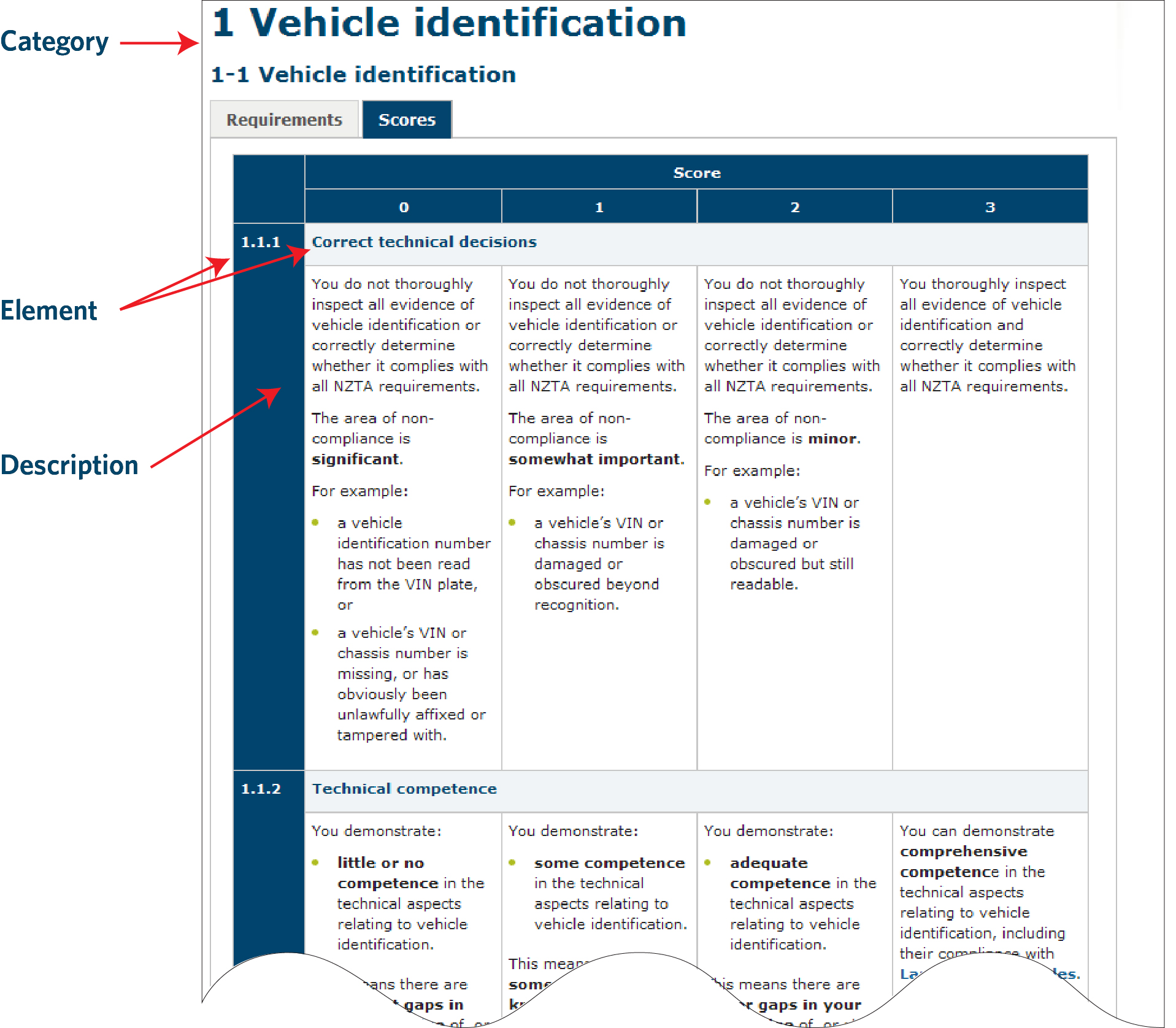
5

Figure 1-1-1. Sample scoring page (detail)

How the parts of the PRS fit together

How NZTA Certification Officers will use the PRS

During performance reviews, our Certification Officers will observe you at work. Reviewers will compare your performance with the descriptions on the PRS scoring sheets, and will score you accordingly. These scores will be combined into an overall PRS score.

We will tell you the result for each area reviewed, and you will be able to use your PRS manual to see how the score was calculated.

There are no hidden measurement or scoring systems. Reviewers are encouraged to help you understand how the system works and how it can be used to help continuous improvement. Success for NZTA will be measured in higher performance scores – not in greater numbers of faults detected.

Use the PRS to improve your performance

We encourage certifiers to use the PRS regularly to assess their own performance and to identify problems and opportunities to improve. Internal Performance Assessment, Improvement and Training records are contained in the Master Records list.

LVV certifiers will be reviewed at least once every three years to give all parties confidence that they are meeting the performance requirements.

We encourage certifiers to use the PRS regularly to review their own performance, and to identify problems and opportunities to improve. This section is called Measuring your performance, and the scoring guidelines section explains how this is done.

Benefits of good performance

NZTA will reward good performance scores by reducing the frequency of planned review visits. It will also reduce the disruption to your business caused by reviews (ie the better your scores, the fewer reviews you have).

Penalties for poor performance

Poor performance scores will reduce the confidence NZTA has in you as a certifier. Such scores will mean more planned review visits so that your performance can be more closely monitored (see PRS Scores and actions table in the Measuring your performance section). Poor performance scores will increase the cost to you in planned review fees and the disruption to your business caused by reviews. We hope this will encourage you to use the results of the PRS to improve your performance.

Enforcement action

The PRS is a powerful tool to enable NZTA to identify persistently poor performers. We are confident that most certifiers will respond positively to the PRS approach and use it to help improve their performance. When certifiers fail to respond positively and continue to perform poorly, this will be identified by PRS reviews. In these cases, NZTA will focus its enforcement and investigation resources on obtaining evidence of poor performance.

The final sanction

Clear evidence of persistently unacceptable performance will lead to disciplinary action. If certifiers fail to respond to warnings and suspension action, evidence gained during reviews will be used to support the case for withdrawal of their authorisation.

Road safety and the maintenance of a fair vehicle certification system demand firm and decisive action by NZTA. When certifiers fail to carry out their responsibilities NZTA will act to remove their authorisation. This will be done in a fair and reasonable manner and decisions will be open to appeal.

Working together in partnership

NZTA aims to work together with certifiers openly and transparently to achieve our joint goals of high standards of certification, leading to an improvement in road safety.

Definitions and abbreviations

Adjusted score

Means the total score that has been adjusted to take into account element scores of 1+ or less, ie where there is poor performance in some areas.

Category

These are the different areas that make up inspection and certification work. There are five categories which are weighted depending on their importance: Technical performance, Administrative performance, Resources, Management and Performance improvement. The five categories make up the General part of the PRS from which a score is derived.

Certifier

Means a vehicle inspector and/or inspecting organisation, depending on the context, and includes a specialist certifier.

Computer system

Means the system where the certifier enters certification .

Controlled document

Means a document you must use and complete as part of your inspection and certification work, such as WoF labels, checksheets, certification plate documentation or certificates.

Description

Means the performance description for each element score against which the certifier’s performance is assessed. There are four descriptions for each element, one each for the scores 0, 1, 2 and 3.

Element

Means a detailed area relating to inspection and certification work, and related elements are grouped together to make up a category.

Element score

Means the score that is assigned to an element.

External document

Means any document supplied by outside parties (eg from vehicle owner or manufacturer) that you rely on in your inspection and certification work, such as exemption notices.

General part

Means the main part of the PRS which consists of the five categories and from which the total score is calculated.

Inspection and certification document

Means a document you use as part of your certification work, such as a checksheet or certification label. It includes controlled, uncontrolled and external documents.

Mystery shopper exercise

Means the Transport Agency arranging for a vehicle with known faults to be presented for inspection to check that the certifier carries out the inspection correctly. The certifier does not know that the vehicle is part of a mystery shopper exercise. This give the Transport Agency information about how inspections are carried out between scheduled reviews.

PRS

Means the Performance Review System.

Random re-inspection

Means a reviewer visiting unannounced between reviews and re-inspecting a vehicle that the certifier has just certified. This gives the Transport Agency information about how the certifier is performing between reviews.

Requirements

Means Transport Agency requirements which are contained in the PRS manual, your VIRM, your agreement/contract with Transport Agency and other information issued by Transport Agency.

Review

Means an assessment of your performance as a certifier, and is usually scheduled in advance depending on the score you achieved at the previous review. Reviews are carried out by Transport Agency reviewers.

Score

This is the result of your review and gives an indication of how well you performed. The higher the score, the better your performance as a certifier.

Self-assessment

Means you assess your own performance using the same criteria as the Transport Agency reviewer does when he carries out a review. The PRS requires you to carry out regular self-assessments.

Technical part

Means the part of the PRS that relates directly to the technical aspects of the inspection and certification work, ie technical decisions, technical competence and inspection equipment. The Technical part scores are transferred to the General part before the total score is calculated.

Total score

This is the score that is calculated when all the element scores have been assigned and the category scores have been weighted, but before it has been adjusted for areas of poor performance.

Uncontrolled document

Any document you develop yourself as part of your inspection and certification work, such as design calculations or technical drawings.

VIRM

Means the Vehicle inspection requirements manual. There are different VIRMs, depending on the type of certification work, and each one has a corresponding PRS manual.

NZTA Means NZ Transport Agency Waka Kotahi

Weighted category score

Means a category score that has been weighted to reflect its importance in the overall inspection and certification work relative to the other categories.

1 Certification outcomes

Requirements

  What NZTA expects of you How NZTA will assess your performance
1.1
Correct certification outcomes

You:

  • consistently identify vehicles and components correctly
  • consistently certify vehicles and components only if they comply with all legal requirements
  • consistently do not certify vehicles and components that do not comply with all legal requirements
  • do not deny certification of vehicles or components if they comply with all legal requirements.

NZTA will:

  • observe you at work
  • inspect vehicles and components after you have certified them
  • inspect your LVV certification forms and form-sets

NZTA may carry out 'mystery shopper' or re-inspection exercises.

1.2
Correct technical decisions

You are consistently correct in determining if the vehicles or components you are asked to certify comply with all legal requirements, taking into account technical information supplied by NZTA and LVVTA.

NZTA will:

  • talk to you
  • observe you at work
  • inspect vehicles and components after you have certified them
  • inspect inspection and certification documents you use and complete.

NZTA may carry out 'mystery shopper' or re-inspection exercises.

1.3
Technical competence

You are competent in all technical aspects of your inspection and certification work.

For example, you must be competent in:

  • the technical assessment of vehicles and components
  • LVVTA and NZTA legal requirements
  • the operation of the equipment that you use.

NZTA will:

Scores

Score
0
1
2
3
1.1
Correct certification outcomes

You regularly do not achieve the correct certification outcomes.
This means you regularly:

  • do not identify vehicles or components correctly
  • certify vehicles or components that do not comply with all legal requirements.
The incorrect certification outcomes are likely to result in a compromise to the safety of vehicle occupants or other road users.

You sometimes do not achieve the correct certification outcomes.
This means you sometimes:

  • do not identify vehicles or components correctly
  • certify vehicles or components that do not comply with all legal requirements, or
  • deny certification of vehicles or components that do comply with all legal requirements.
The incorrect certification outcomes may result in a compromise to the safety of vehicle occupants or other road users.

You usually achieve the correct certification outcomes.
This means you usually:

  • identify vehicles or components correctly, and
  • certify vehicles or components only if they comply with all legal requirements, and
  • do not certify vehicles or components that do not comply with all legal requirements, and
  • do not deny certification of vehicles or components if they comply with all legal requirements.
The incorrect certification outcomes do not compromise the safety of vehicle occupants or other road users.

You consistently achieve the correct certification outcomes.
This means you:

  • consistently certify vehicles or components only if they comply with all legal requirements, and
  • consistently do not certify vehicles or components that do not comply with all legal requirements, and
  • do not deny certification of vehicles or components if they comply with all legal requirements.
1.2
Correct technical decisions
Your score is the average score of your performance in meeting Waka Kotahi expectations for ‘Correct technical decisions’ in the Technical part of the performance review system.
1.3
Technical competence
Your score is the average score of your performance in meeting Waka Kotahi expectations for ‘Technical competence’ in the Technical part of the performance review system.

2 Competence

Requirements

  What NZTA expects of you How NZTA will assess your performance
2.1
Correct certification outcomes

You are consistently correct and accurate in relation to ordering and affixing LVV certification plates (including electronic data plates).

NZTA will:

  • observe you at work
  • inspect information you supply for LVV certification plate production (including electronic data plates).
2.2
Correct entry of certification information

Not applicable to LVV certification.

2.3
Administrative competence

You consistently comply with all legal requirements relating to LVV certification documents. This means you consistently:

  • complete the LVV forms and form-sets fully, accurately and legibly with particular attention to details such as vehicles’ VIN or chassis numbers
  • ensure that all forms and form-sets are signed, if required, by the appropriate person
  • correctly obtain and assess any external documents supplied by outside parties (eg vehicle owners or manufacturers) that you rely on in your certification work, such as such as non-destructive test reports and wheel alignment reports
  • handle all inspection and certification documents appropriately or as required, eg you forward them to LVVTA, hand the F001 and F004 to the vehicle owner, and file your copy of the F001 and F005 (where applicable).

NZTA will:

  • ask questions to check your competence
  • observe you at work
  • inspect your LVV certification documents
  • inspect the records you keep.

Scores

Score
0
1
2
3
2.1
Correct certification outcomes

You regularly do not use LVV certification plates correctly.

This means you regularly:

  • provide inaccurate information when ordering LVV certification plates, or
  • do not affix LVV certification plates to vehicles correctly, or
  • do not return unused LVV certification plates to the LVV System Administrator.

You sometimes do not use LVV certification plates correctly.

This means you sometimes:

  • provide inaccurate information when ordering LVV certification plates, or
  • do not return unused LVV certification plates to the LVV System Administrator within reasonable timeframes.

OR

You occasionally make a more serious mistake such as incorrectly affixing an LVV certification plate.

You usually use LVV certification plates correctly.

This means you consistently affix LVV certification plates correctly, but you make the occasional mistake when ordering LVV certification plates.

You consistently use LVV certification plates correctly.

This means you consistently provide accurate information when ordering LVV certification plates, affix LVV certification plates correctly, and return unused LVV certification plates to the LVV System Administrator promptly.
2.2
Correct entry of certification information
Not applicable.
2.3
Administrative competence

You can demonstrate little or no competence in the administrative aspects of the inspection and certification work carried out by your business.

This means you have significant gaps in your knowledge of, or skills in:

  • the correct use of LVV forms and form-sets and other relevant documents, or
  • using the performance review system.

You can demonstrate some competence in the administrative aspects of the inspection and certification work carried out by your business.

This means you have some gaps in your knowledge of, or skills in:

  • the correct use of LVV forms and form-sets and other relevant documents, or
  • using the performance review system.

You can demonstrate adequate competence in the administrative aspects of the inspection and certification work carried out by your business.

This means you can demonstrate adequate knowledge of, and skills in:

  • the correct use of LVV forms and form-sets and other relevant documents.
However, you have minor gaps in knowledge of, and skills in, using the performance review system.

You can demonstrate comprehensive competence in all administrative aspects of the certification work carried out by your business.

This means you can demonstrate comprehensive knowledge of, and skills in:

  • the correct use of LVV forms and form-sets and other relevant documents, and
  • using the performance review system.

3 Resources

Requirements

  What NZTA expects of you How NZTA will assess your performance
3.1
Facilities

The facilities that you use:

NZTA will inspect one or more of the facilities that you use.
3.2
Technical equipment

You have, or have ready access to all technical equipment as required by section 1.2 of the LVVTA Operating Requirements Schedule

The equipment is complete, up-to-date and in good condition.

NZTA will inspect the technical equipment you use.

3.3
Administrative equipment

Currently no special administration equipment is required by the LVV certifier.

Do not score this section, it is not required.
3.4
Technical information

You have, or have ready access to, all technical information required by NZTA and LVVTA, required by section 2 of the LVVTA Operating Requirements Schedule

The information is complete, up-to-date and in good condition.

NZTA will inspect your technical information.
3.5
Controlled certification documents
You have available blanks of all current LVVTA forms and form-sets you must use and complete as part of your inspection and certification work. NZTA will inspect your forms and form-sets.
3.6
Certification staff

You are doing inspections and certification work and hold current and appropriate NZTA appointments for the certification work you carry out.

You hold current driver licences for the types of vehicle you are required to drive/operate.

You have current public liability and professional indemnity insurance.

NZTA will:

  • talk to you
  • observe you at work
  • inspect your drivers licence
  • inspect your insurance documentation.

Scores

Score
0
1
2
3
3.1
Facilities

The facilities you use do not meet the requirements specified in section 1.1 of the LVVTA Operating Requirements Schedule

This means the facilities are deficient to an extent that they adversely affect your certification decisions or certification outcomes.

Some of the facilities you use meet the requirements specified in section 1.1 of the LVVTA Operating Requirements Schedule, but you do not always use those facilities.

This means there are times when the facilities you use are deficient to an extent that they adversely affect your certification decisions or certification outcomes.

The facilities you use meet the requirements specified in section 1.1 of the LVVTA Operating Requirements Schedule

However, there are some minor aspects of the facilities that could be improved. Minor aspects are those that do not adversely affect your certification decisions or certification outcomes but that, if improved, would make your inspection and certification work easier or more efficient.

For example, there may be areas where lighting could be improved, or where the facilities could be better organised.

The facilities you use meet all requirements specified in section 1.1 of the LVVTA Operating Requirements Schedule

3.2
Technical equipment
Your score here is the average score of your performance in meeting NZTA’s expectations for ‘Technical equipment' in the Technical part of the Performance Review System.
3.3
Administrative equipment

Not applicable

3.4
Technical information
You do not have, or do not have ready access to the technical information required by section 2 of the LVVTA Operating Requirements Schedule

You have, or have ready access to all the technical information required by. The information is complete but not up-to-date.

For example, when you receive an amendment to a manual, you do not update it as promptly as you could.

You have, or have ready access to all the technical information required by section 2 of the LVVTA Operating Requirements Schedule
The information is complete and up-to-date, but not in good condition.

For example, pages from a manual have been taken out at some stage and then put back in the wrong place (ie, the pages are no longer in the right order, making it difficult to find items).

You have, or have ready access to all the technical information required by section 2 of the LVVTA Operating Requirements Schedule

The information is in complete, up-to-date and in good condition.
3.5
Controlled certification documents
You do not have available blanks of most or any of the LVV forms and form-setsyou must use and complete as part of your inspection and certification work.You do not have available blanks of some of the LVV forms and form-sets you must use and complete as part of your inspection and certification work.You have available blanks of most LVV forms and form-setsyou must use and complete as part of your inspection and certification work.You have available blanks of all current LVV forms and form-sets you must use and complete as part of your inspection and certification work.
3.6
Certification staff

You do not have:

  • a current drivers licence for any of the vehicles you are required to drive/operate as part of your work

or

  • a current and adequate professional indemnity insurance policy for your LVV certification work.
  

You hold:

  • current driver licences for the types of vehicles you are required to drive/operate as part of your work
  • a current and adequate professional indemnity insurance policy for your LVV certification work.

4 Management

Requirements

  What NZTA expects of you How NZTA will assess your performance
4.1
Management of competence

You have a coordinated approach to managing your competence in all aspects of your LVV certification work.

This means you:

  • regularly assess your level of competence
  • make sure your competence is maintained at a high level, ie, you are aware of, and competent in dealing with, new technologies, new equipment, and new legal requirements and updates to technical information
  • attend all LVVTA training sessions
You keep an up-to-date Training record, listing any internal and external training you do.

NZTA will:

4.2
Management of facilities

You have a coordinated approach to managing facilities that you use. Your approach ensures the facilities that you use are kept tidy, clean, organised, and in good condition.

NZTA will:

  • talk to you
  • inspect the facilities you use.
4.3
Management of equipment

You have a coordinated approach to managing your equipment. Your approach ensures that equipment is:

  • available in sufficient numbers for the volume of inspection and certification work carried out by you
  • stored as specified by the manufacturer and in locations where it is easily accessible by you
  • actually used by you for its intended purpose
  • maintained as specified by the manufacturer
  • calibrated as specified by the manufacturer, or as required by NZTA or LVVTA.

If required you keep an up-to-date Equipment record for each piece of equipment that requires regular maintenance or calibration.

NZTA will:

  • talk to you
  • inspect your equipment
  • observe you at work
  • look at your inspection and certification volumes (to check that enough equipment is available)
  • inspect where and how your equipment is stored
  • inspect your Equipment Records.
4.4
Management of technical information

You have a coordinated approach to managing your technical information. Your approach ensures that technical information is:

  • updated promptly when you receive updates from NZTA and LVVTA
  • stored so you have easy access
  • maintained in good condition.

Your NZTA Technical information record for this manual or VIRM: In-service certification are up-to-date.

Your LVVTA amendment records are up-to-date.

NZTA will:

  • talk to you
  • inspect your technical information and the locations where you keep it
  • inspect your LVVTA Amendment Record.
4.5
Management of inspection and certification documents

You have a coordinated approach to managing your LVV certification documents. Your approach ensures that:

  • unaffixed LVV certification plates are always kept out of the reach of the public and, outside business hours, are locked in a safe, locker, or strong cupboard or drawer
  • all F001 forms are filed so that they can be easily retrieved.
You keep an up-to-date LVV Certification plate register.

NZTA will:

  • inspect your used and unused LVV certification documents and the locations where you keep them
  • inspect the way you file your LVV certification documents
  • inspect your LVV Certification plate register.
4.6
Management of electronic certification information

You have a coordinated approach to managing your electronic inspection and certification information. Your approach ensures that:

You have backup copies or hardcopies of any electronic information relevant to your inspection and certification work, such as digital photographs or LVV certification plate register.

NZTA will:

  • talk to you
  • observe you at work
  • inspect the backup copies or hardcopies you keep of your electronic certification information.
4.7
Management of certification staff

You have a coordinated approach to managing yourself. Your approach ensures that:

  • certification decisions are made only by yourself and you hold current and appropriate NZTA appointments.

NZTA will:

  • talk to you and any contractors
  • observe you at work.
4.8
Management of time

You allocate enough time for you to carry out your inspection and certification work, allowing for the complexity of the work, the facilities, the available equipment, and your level of skill.

This means you:

  • are comfortable with the time allocated and actually spent on inspection and certification work
  • do not feel under pressure to perform within timeframes that are unreasonably tight.

NZTA will:

  • talk to you
  • observe you at work
  • look at your inspection and certification volumes.

Scores

Score
0
1
2
3
4.1
Management of competence

Your approach to managing your competence in all aspects of your LVV certification work is inadequate.

This means you:

  • do not assess your level of competence, or
  • make little or no effort to ensure your competence is maintained at a high-level, or
  • do not attend any LVVTA training sessions.

Your approach to managing your competence in all aspects of your LVV certification work is barely adequate.

This means you:

  • do not assess your level of competence on a regular basis, or
  • make only limited efforts to maintain your competence at a high level, or
  • do not always attend LVVTA training sessions

OR

You do not keep a Training record .

Your approach to managing your competence in all aspects of your LVV certification work is adequate.

This means you usually:

  • assess your level of competence on a regular basis, or
  • make sure that your competence is maintained at a high level, ie you are aware of, and competent in dealing with, new technologies, new equipment, and new legal requirements and updates to technical information.

However, you do not always:

Your approach to managing your competence in all aspects of your LVV certification work is well coordinated.

This means you consistently:

  • assess your level of competence on a regular basis, or
  • make sure your competence is maintained at a high level, ie, you are aware of, and competent in dealing with, new technologies, new equipment, and new legal requirements and updates to technical information.
You keep an up-to-date Training record , listing any internal and external training you do.
4.2
Management of facilities

Your approach to managing the facilities that you use is inadequate.

This means you make little or no effort to keep the facilities tidy, clean, organised, and maintained in good condition.

Your approach to managing the facilities you use is barely adequate.

This means you:

  • make only limited efforts to keep the facilities tidy, clean, organised, or maintained in good condition.

Your approach to managing facilities you use is adequate.

This means you usually:

  • make sure the facilities are tidy, clean, organised, and maintained in good condition.

Your approach to managing the facilities you use is well coordinated.

This means you consistently:

  • make sure the facilities are tidy, clean, organised, and maintained in good condition.
4.3
Management of equipment

Your approach to managing your equipment is inadequate.

This means little or no equipment is:

  • available in sufficient numbers for the volume of certification work carried out by your business, or
  • stored as specified by the manufacturer or in locations where you have easy access, or
  • used as intended, or
  • maintained or calibrated as specified by the manufacturer.

Your approach to managing your equipment is barely adequate.

This means you make sure equipment is available in sufficient numbers for the volume of certification work carried out by your business.
However, you often do not make sure equipment is:

  • stored as specified by the manufacturer or in locations where you have easy access, or
  • used as intended, or
  • maintained or calibrated as specified by the manufacturer.

OR

You do not keep an Equipment record for some or any equipment that requires regular maintenance or calibration.

Your approach to managing your equipment is adequate.

This means you usually make sure your equipment is:

  • available in sufficient numbers for the volume of certification work carried out by your business, and
  • stored as specified by the manufacturer or in locations where you have easy access, and
  • actually used by you for its intended purpose, and
  • maintained as specified by the manufacturer, and
  • calibrated as specified by the manufacturer, or as required by NZTA.
You keep an Equipment record for each piece of equipment that requires maintenance or calibration, but you do not always keep your Equipment record up-to-date.

Your approach to managing your equipment is well coordinated.

This means you consistently make sure your equipment is:

  • available in sufficient numbers for the volume of certification work carried out by your business, and
  • stored as specified by the manufacturer or in locations where you have easy access, and
  • actually used by you for its intended purpose, and
  • maintained as specified by the manufacturer, and
  • calibrated as specified by the manufacturer, or as required by NZTA.
You keep an up-to-date Equipment record for each piece of equipment that requires maintenance or calibration.
4.4
Management of technical information

Your approach to managing your technical information is inadequate.

This means you make little or no effort to manage your technical information.

For example, some technical information may not have been updated for a considerable time.

Your approach to managing your technical information is barely adequate.

This means although you make some efforts to manage your technical information, you often do not:

  • update technical information promptly when you receive updates from the LVVTA, or
  • store technical information so you have easy access

OR

Your approach to managing your technical information is adequate.

This means you usually make some efforts to make sure your technical information is:

  • updated promptly when you receive updates from the LVVTA, and
  • stored so you have easy access.

However, you do not always:

Your approach to managing your technical information is well coordinated.

This means you consistently make sure your technical information is:

  • updated promptly when you receive updates from the LVVTA, and
  • stored so you have easy access, and
  • maintained in good condition

You keep an up-to-date LVVTA amendment record and Technical information record for this manual and VIRM: In-service certification

4.5
Management of inspection and certification documents

Your approach to managing your LVV certification documents is inadequate.

  • This means you do not keep unaffixed LVV certification plates out of reach of the public, and
  • locked in a safe, locker, or strong cupboard or drawer outside business hours

OR

You do not file F001 and F005 forms in a safe place where they can be easily retrieved.

Your approach to managing your LVV certification documents is barely adequate.

This means although you make some efforts to manage your LVV certification documents, you often do not:

  • keep unaffixed LVV certification plates out of reach of the public, or
  • lock unaffixed LVV certification plates in a safe, locker, or strong cupboard or drawer outside business hours, or
  • file F001 and F005 forms so that they can be easily retrieved

OR

You do not keep a Certification plate register.

Your approach to managing your LVV certification documents is adequate.

This means you usually make sure that:

  • unaffixed LVV certification plates are kept safe at all times and out of reach of the public, and
  • unaffixed LVV certification plates are locked in a safe, locker, or strong cupboard or drawer outside of business hours, and
  • all F001 and F005 forms are filed so that they can be easily retrieved.

However, you do not always keep your Certification plate register up-to-date.

Your approach to managing your LVV certification documents is well coordinated.

This means you consistently make sure that:

  • unaffixed LVV certification plates are always kept out of the reach of the public and, outside business hours, are locked in a safe, locker, or strong cupboard or drawer
  • all F001 and F005 are filed so that they can be easily retrieved.

You keep an up-to-date Certification plate register.

4.6
Management of electronic certification information

Not applicable

4.7
Management of certification staff

Your approach to managing your staff is inadequate.

This means you make little or no effort to make sure that:

  • certification decisions are made only by you and you hold a current Waka Kotahi appointment, or
  • you make certification decisions where you do not hold the current applicable category, or
  • you do not currently hold the correct class of drivers licence for the class of vehicle you are certifying.
  

Your approach to managing your staff is well coordinated.

This means you consistently make sure that:

  • certification decisions are made only by you and you hold a current Waka Kotahi appointment, or
  • you make certification decisions only where you hold the current applicable category, or
  • you currently hold the correct class of drivers licence for the class of vehicle you are certifying.
4.8
Management of time

You do not allocate enough time for you to carry out your certification work.

You:

  • are not comfortable with the time allocated and actually spent on certification work, or
  • feel under pressure to perform within timeframes that are unreasonably tight.

You do not always allocate enough time to carry out your certification work.

You feel timeframes are too tight to carry out the certification work properly.

You generally allocate enough time to carry out your certification work, allowing for the complexity of the work, your facilities, the available equipment, and your level skill.

You sometimes feel timeframes are too tight to carry out the certification work properly.

You allocate enough time to carry out your certification work, allowing for the complexity of your work, your facilities, the available equipment, and your level of skill.

This means you:

  • are comfortable with the time allocated and actually spent on certification work, and
  • do not feel under pressure to perform within timeframes that are unreasonably tight.

5 Performance improvement

Requirements

What NZTA expects of you How NZTA will assess your performance
5.1
Commitment to continuous improvement
  • You are committed to improving your LVV certification work.

This means that you actively:

  • identify problems and opportunities to improve
  • assess the cause of problems and prioritise problems and opportunities
  • address problems and opportunities according to priorities and available resources.
You complete an Improvement record where you have scored a 1+ or less in any category at your last NZTA review.

NZTA will:

  • assess your commitment to continuous improvement
  • inspect your PRS Improvement record or LVVTA Self-revision form to check that any problems or opportunities to improve identified during self-reviews are recorded and followed-up.
5.2
Regular self-reviews

You regularly carry out self-reviews to assess how well you meet the NZTA and LVVTA expectations as set out in the performance review system.

This means you carry out a self-assessment at least once a year and within two months before a scheduled NZTA review.

You record each self-review by completing a PRS or an LVVTA Self-revision form, (a master copy is filed in your PRS records folder).

You record any problems or opportunities to improve that you identify during your self-review in your LVVTA Self-review form for follow-up.

NZTA will:

  • inspect your or LVVTA Self-review forms
  • inspect your LVVTA Self-review form to check that any problems or opportunities to improve identified during self-reviews are followed-up.
5.3
Correct handling of complaints

You are open to complaints and regard them as opportunities to improve.

This means you:

  • handle complaints in accordance with LVV ORS requirements
  • keep a Complaints record , in which all written complaints that have not been able to be resolved at the time of the complaint, are recorded
  • record any problems or opportunities to improve that you identify in the investigation of complaints in your Training/Improvement records for follow-up.

NZTA will:

  • inspect your Complaints record to check that any complaints against you, including any complaints raised with NZTA, have been recorded and handled in accordance with LVV ORS requirements
  • inspect your Improvement record to check that any problems or opportunities to improve identified in the investigation of complaints have been recorded for follow-up and addressed
  • inspect your Training record to check that any training opportunities that have been identified in the investigation of complaints have been recorded and addressed.
5.4
Commitment to the Performance Review System

You are committed to making the performance review system work for you. This means you:

  • actively use the system for improving your LVV certification work
  • are open about your problems and achievements
  • fully co-operate during regular performance reviews.

NZTA will:

  • talk to you
  • assess your level of co-operation during reviews.

Scores

Score
0
1
2
3
5.1
Commitment to continuous improvement

You show little or no commitment to improving your LVV certification work.

This means you do not make efforts to assess the cause of problems and actively work towards resolving them. You are often not even aware of the problems you have.

You show some commitment to improving your LVV certification work.
This means you:

  • are aware of what causes some of the problems and what you need to do to address them, and
  • carry out occasional self-reviews to assess how well you meet the NZTA’s expectations

However, although you work around the problems, you regularly do not:

  • identify them in your PRS Improvement record (where you have scored a 1+ or less in any category at your last NZTA review), or
  • work actively to address them properly.

You show an adequate level of commitment to improving your LVV certification work.
This means you:

  • actively identify and prioritise problems and opportunities to improve; and
  • assess the cause of problems and identify what you need to do to address them.

However, you do not always:

  • address the problems and opportunities as promptly as you could, or
  • record all problems and opportunities in your PRS Improvement record and you complete an Improvement record where you have scored a 1+ or less at your last NZTA review.
  • You are fully committed to improving your LVV certification work.
  • This means you:
  • actively identify and prioritise problems and opportunities to improve; and
  • assess the cause of problems, and
  • address problems and opportunities according to available resources, and
  • record all problems and opportunities in your PRS Improvement record and you complete an Improvement record where you have scored a 1+ or less at your last NZTA review.
5.2
Regular self-reviews

You do not regularly assess how well you meet NZTA’s expectations as set out in the performance review system.

This means there is no evidence of you carrying out self-reviews.

You sometimes assess how well you meet NZTA’s expectations as set out in the performance review system.
This means you carry out some self-reviews but you do not:

  • carry our self-reviews regularly (ie, at least once a year and before scheduled performance reviews), or
  • record self-reviews on a LVVTA Self-review form.

You regularly assess how well you meet NZTA’s expectations as set out in the performance review system.
This means you carry out self-reviews at least once a year (or more often as appropriate to the number of LVV certifications you do).
However, you do not always:

  • carry out self-reviews before scheduled performance reviews, or
  • record self-reviews on a LVVTA Self-review form, or
  • record problems or opportunities to and follow up actions that you identify during self-reviews in your PRS Improvement record or LVVTA Self-revision form.

You regularly assess how well you meet NZTA’s expectations as set out in the performance review system.
This means you:

  • carry out self-reviews at least once a year (or more often as appropriate to the number of LVV certifications you do); and
  • carry out self-reviews before scheduled performance reviews, and
  • record each self-review in a PRS Self-assessment record or LVVTA Self-revision form, and
  • record problems or opportunities and follow up actions in your PRS Improvement record or LVVTA Self-review form
5.3
Correct handling of complaints

You are not open to complaints and your handling of complaints is inadequate.

This means you:

  • seldom handle complaints in accordance with Section 6 of the LVV ORS and as stated on the F004 or
  • do not keep records of complaints.

You are not open to complaints and your handling of complaints is barely adequate.

  • This means you:
  • regularly do not handle complaints in accordance with Section 6 of the LVV ORS and as stated on the F004 or
  • regularly fail to record complaints in your Complaints record.

You are open to complaints and your handling of complaints is adequate.

This means you:

  • communicate your complaints policy to your customers, including information on how to lodge a complaint and your customers' right to complain to NZTA, and
  • usually handle complaints in accordance with Section 6 of the LVV ORS and as stated on the F004
  • you do not always record complaints in your Complaints record.

You are open to complaints, handle them correctly and regard them as opportunities to improve.

This means you:

  • communicate your complaints policy to your customers, including information on how to lodge a complaint and your customers' right to complain to NZTA, and
  • handle complaints in accordance with Section 6 of the LVV ORS and as stated on the F004 and
  • keep a Complaints record in which you record all verbal and written complaints.
5.4
Commitment to the Performance Review System

You show little or no commitment to making the performance review system work in and for your business.
This means you do not:

  • use the system for improving your LVV certification work, or
  • share your problems and achievements with NZTA, or
  • co-operate during NZTA performance reviews.

You show some commitment to making the performance review system work in and for your business. There is little evidence that you make the performance review system work for your business by actively using it to improve your LVV certification work.
This means:

  • you make some efforts to use the system in your business, but mostly to satisfy NZTA, and
  • there is a basic level of co-operation during NZTA performance reviews but there is a reluctance to share problems with NZTA.

You show an adequate level of commitment to making the performance review system work in and for your business.
This means you:

  • actively use most aspects of the system for improving your LVV certification work, although you do not use the system to its full extent, and
  • show a good level of co-operation during NZTA performance reviews.

However, you are often reluctant to share problems with NZTA.

You are fully committed to making the performance review system work in and for your business.
This means you:

    • actively use the system for improving your LVV certification work, and
  • are open about your problems and achievements, and
  • fully co-operate during NZTA performance reviews.

Technical part

1 1A Modified production – limited

Requirements

What NZTA expects of you

How NZTA will assess your performance

1.1

Correct technical decisions

You thoroughly inspect all modifications and correctly determine if the modifications comply with all legal requirements, taking into account technical information provided by NZTA and the LVVTA such as Low Volume Vehicle Code, Standards, Survey Sheets, Information Sheets, and LVVTA Member Association Technical Manuals.

NZTA will:

  • talk to you
  • observe you at work
  • inspect the modifications on vehicles while you are certifying the vehicles, or after you have certified the vehicles
  • inspect inspection and certification documents you use and complete.

1.2

Technical competence

You are competent in all technical aspects relating to Category 1A Modified production – limited modifications. This means you are competent in:

  • the assessment of Category 1A Modified production – limited modifications, including:
    • the identification of any modifications such as non-OE components and systems
    • the identification of the source of any non-OE components and systems
    • the identification and assessment of material types, manufacturing and machining processes (where applicable)
    • the assessment of the suitability of the modifications and their effect on other components and systems
  • legal requirements (including NZTA requirements) relating to Category 1A Modified production – limited modifications
  • NZTA and LVVTA guidelines relating to Category 1A Modified production – limited modifications
  • the operation of the equipment you use for assessing Category 1A Modified production – limited modifications.

NZTA will:

  • talk to you
  • ask questions to check your competence relating to any of the modifications, and your assessment of the modifications
  • observe you at work
  • inspect inspection and certification documents you use and complete
  • inspect your Training record.

NZTA may administer a short test on Category 1A Modified production – limited modifications, and the assessment of Category 1A Modified production – limited modifications.

1.3

Technical equipment
 

You have, or have access to:

  • a graduated lightboard or commercial quality beamsetter
  • a 35% VLT tint sample or a light transmission measuring device
  • a stop-watch or other device capable of measuring average deceleration
  • a jack or other suitable equipment to lift wheels off the ground
  • an industrial quality hand-held inspection lamp
  • a steel test bar for steering and suspension
  • graduated tyre tread depth gauge
  • a steel ruler and tape measure
  • an H-point indicator (eg LVVTA h-frame or h-point template)
  • an inspection mirror
  • a protractor or other device used to measure angles
  • head sphere ball
  • duct o  similar adhesive tape
  • a string-line
  • a vernier calliper
  • a selection of hand tools, including those required for anchorage bolt and trim removal, steering wheel and universal joint attachment, as applicable.

The equipment is in good condition and working order.

NZTA will inspect your technical equipment.

Scores

Score

0

1

2

3

1.1

Correct technical decisions

You do not thoroughly inspect all modifications or correctly determine if the modifications comply with all legal requirements.

The area of non-compliance is likely to compromise the safety of the vehicle occupants or other road users.

For example:

  • a non-OE engine mount is poorly designed or manufactured, and failure of the mount could cause the engine to contact or bind against a steering component, or
  • a non-OE accelerator system is poorly designed or manufactured, and could result in binding or jamming over-centre at the full-open position, or
  • a drive-shaft is designed or manufactured in such a way as to have insufficient engagement into the gearbox or differential, or a drive-shaft safety-loop is not fitted where one is required, or
  • a front disc brake adaptation incorporates a wheel cylinder size that is incompatible with the master cylinder or rear wheel cylinders, resulting in an imbalanced brake system, or
  • an aftermarket steering wheel is incompatible with the steering column hub assembly, or is not attached using a vibration-proof fastening system, or
  • there is insufficient distance between moving suspension components and bump-stops to allow full and unrestricted suspension travel during normal operation when the vehicle is fully laden, or
  • a non-OE wheel is attached by fasteners that provide insufficient thread engagement.

You do not thoroughly inspect all modifications or correctly determine if the modifications comply with all legal requirements.

The area of non-compliance may compromise the safety of the vehicle occupants or other road users.

For example:

  • a non-OE engine mount is poorly designed or manufactured, but failure of the mount would not cause the engine to contact or bind against a steering component, or
  • a non-OE accelerator system is well designed and manufactured, but is fitted with a single accelerator return spring, or
  • a drive-shaft’s universal joints are incorrectly phased or misaligned, or
  • a braking system in a vehicle that has undergone an engine conversion meets the specified requirements for one-off brake performance, but is unable to meet the specified brake fade-resistance requirements, or
  • an aftermarket steering wheel is fitted that is not of an impact energy absorbing design and does not incorporate a collapsible hub, or
  • a suspension coil spring is not sufficiently contained, and could dislodge at full suspension extension, or
  • a non-OE wheel is outside of the specified offset requirements.

You do not thoroughly inspect all modifications or correctly determine if the modifications comply with all legal requirements.

The area of non-compliance is unlikely to compromise the safety of the vehicle occupants or other road users.

For example:

  • an engine mount rubber is worn or damaged, or
  • a non-OE accelerator system is well designed and manufactured, and is fitted with dual accelerator return springs, but is unusually stiff to depress, or
  • a drive-shaft universal joint has minor wea , or a drive-shaft is slightly out of balance, or
  • a non-OE park-brake system is attached without the use of vibration-proof fasteners, or
  • a modified or non-OE steering system operates safely, but the geometry is causing excessive tyre wear, or
  • non-critical components such as a chassis or sub-frame section extends slightly below the specified scrub-line requirements, or
  • a non-OE wheel and tyre fitment has resulted in a speedometer inaccuracy.

You thoroughly inspect all modifications and correctly determine if the modifications comply with all legal requirements.

1.2

Technical competence

You demonstrate:

  • little or no competence in the technical aspects relating to Category 1A Modified production – limited modifications, or
  • a level of competence that is likely to compromise the safety of the vehicle occupants or other road users.

This means there are significant gaps in your knowledge of, and skills in:

  • the assessment of Category 1A Modified production – limited modifications, including:
    • the identification of any modifications such as non-OE components and systems
    • the identification of the source of any non-OE components and systems
    • the identification and assessment of material types, manufacturing and machining processes (where applicable)
    • the assessment of the suitability of the modifications and their effect on other components and systems
  • legal requirements (including NZTA requirements) relating to Category 1A Modified production – limited modifications
  • NZTA and LVVTA guidelines relating to Category 1A Modified production – limited modifications
  • the operation of the equipment you use for assessing Category 1A Modified production – limited modifications.

You demonstrate:

  • some competence in the technical aspects relating to Category 1A Modified production – limited modifications, or
  • a level of competence that may compromise the safety of the vehicle occupants or other road users.

This means there are some gaps in your knowledge of, and skills in:

  • the assessment of Category 1A Modified production – limited modifications, including:
    • the identification of any modifications such as non-OE components and systems
    • the identification of the source of any non-OE components and systems
    • the identification and assessment of material types, manufacturing and machining processes (where applicable)
    • the assessment of the suitability of the modifications and their effect on other components and systems
  • legal requirements (including NZTA requirements) relating to Category 1A Modified production – limited modifications
  • NZTA and LVVTA guidelines relating to Category 1A Modified production – limited modifications
  • the operation of the equipment you use for assessing Category 1A Modified production – limited modifications.

You demonstrate:

  • adequate competence in the technical aspects relating to Category 1A Modified production – limited modifications; or
  • a level of competence that is unlikely to compromise the safety of the vehicle occupants or other road users.

This means there are minor gaps in your knowledge of, and skills in:

  • the assessment of Category 1A Modified production – limited modifications, including:
    • the identification of any modifications such as non-OE components and systems
    • the identification of the source of any non-OE components and systems
    • the identification and assessment of material types, manufacturing and machining processes (where applicable)
    • the assessment of the suitability of the modifications and their effect on other components and systems
  • legal requirements (including NZTA requirements) relating to Category 1A Modified production – limited modifications
  • NZTA and LVVTA guidelines relating to Category 1A Modified production – limited modifications
  • the operation of the equipment you use for assessing Category 1A Modified production – limited modifications.

You demonstrate comprehensive competence in all technical aspects relating to Category 1A Modified production – limited modifications.

This means you demonstrate comprehensive knowledge of, and skills in:

  • the assessment of Category 1A Modified production – limited modifications, including:
  • the assessment of Category 1A Modified production – limited modifications, including:
    • the identification of any modifications such as non-OE components and systems
    • the identification of the source of any non-OE components and systems
    • the identification and assessment of material types, manufacturing and machining processes (where applicable)
    • the assessment of the suitability of the modifications and their effect on other components and systems
  • legal requirements (including NZTA requirements) relating to Category 1A Modified production – limited modifications
  • NZTA and LVVTA guidelines relating to Category 1A Modified production – limited modifications
  • the operation of the equipment you use for assessing Category 1A Modified production – limited modifications.

1.3

Technical equipment

Not all of the specified equipment is available. Where equipment is available, some or all of it is not in working order.

All of the specified equipment is available and in working order, but some or all of it is in poor condition.

All specified equipment is available, in working order, and in at least adequate condition.

All specified equipment is available and in good condition and working order.

2 1B Modified production – extended

Requirements

What NZTA expects of you

How NZTA will assess your performance

2.1

Correct technical decisions
 

You thoroughly inspect all modifications and correctly determine if the modifications comply with all legal requirements, taking into account technical information provided by NZTA and the LVVTA such as Low Volume Vehicle Code, Standards, Survey Sheets, Information Sheets, and LVVTA Member Association Technical Manuals.

NZTA will:

  • talk to you
  • observe you at work
  • inspect the modifications on vehicles while you are certifying the vehicles, or after you have certified the vehicles
  • inspect inspection and certification documents you use and complete.

2.2

Technical competence
 

You are competent in all technical aspects relating to Category 1B Modified production – extended modifications. This means you are competent in:

  • the assessment of Category 1B Modified production – extended modifications, including:
  • the identification of any modifications such as non-OE components and systems
  • the identification of the source of any non-OE components and systems
  • the identification and assessment of material types, manufacturing and machining processes (where applicable)
  • the assessment of the suitability of the modifications and their effect on other components and systems
  • legal requirements (including NZTA requirements) relating to Category 1B Modified production – extended modifications
  • NZTA and LVVTA guidelines relating to Category 1B Modified production – extended modifications
  • the operation of the equipment you use for Category 1B Modified production – extended modifications.

NZTA will:

  • talk to you
  • ask questions to check your competence relating to any of the modifications, and your assessment of the modifications
  • observe you at work
  • inspect inspection and certification documents you use and complete
  • inspect your Training record.

NZTA may administer a short test on Category 1B Modified production – extended modifications, and the assessment of Category 1B Modified production – extended modifications.

2.3

Technical equipment
 

You have, or have access to:

  • a graduated lightboard or commercial quality beamsetter
  • a 35% VLT tint sample or a light transmission measuring device
  • a stop-watch or other device capable of measuring average deceleration
  • a jack or other suitable equipment to lift wheels off the ground
  • an industrial quality hand-held inspection lamp
  • a steel test bar for steering and suspension
  • graduated tyre tread depth gauge
  • a steel ruler and tape measure
  • an H-point indicator (eg LVVTA h-frame or h-point template)
  • an inspection mirror
  • a protractor or other device used to measure angles
  • head sphere ball
  • duct or similar adhesive tape
  • a string-line
  • a vernier calliper
  • a selection of hand tools, including those required for anchorage bolt and trim removal, steering wheel and universal joint attachment, as applicable.

The equipment is in good condition and working order.

NZTA will inspect your technical equipment.

Scores

 Score

0

1

2

3

2.1

Correct technical decisions

You do not thoroughly inspect all modifications or correctly determine if the modifications comply with all legal requirements.

The area of non-compliance is likely to compromise the safety of the vehicle occupants or other road users.

For example:

  • a retro-fitted seatbelt buckle is not in working order, or the seatbelt webbing is excessively ripped, frayed, or faded, or
  • a retro-fitted seatbelt anchorage is not attached to a structural part of the vehicle, or is not attached in accordance with the specified requirements, or
  • a seat designed as a forward-facing seat has been retro-fitted in a rearward-facing position without any bracing or support provided for the seatback, or
  • a hand control system is poorly designed or incompatible with the vehicle to which it is fitted, resulting in, due to interference or flexing, inability to achieve full braking efficiency, or
  • a wheelchair restraint system uses components or webbing that does not meet the necessary load ratings to restrain the wheelchair.

You do not thoroughly inspect all modifications or correctly determine if the modifications comply with all legal requirements.

The area of non-compliance may compromise the safety of the vehicle occupants or other road users.

For example:

  • a retro-fitted seatbelt is in good working order and condition, but does not meet one of the specified approved standards, or
  • a retro-fitted seatbelt anchorage is positioned outside the permitted area specified for seatbelt anchorages, or
  • a retro-fitted seat that has a seatbelt anchorage attached directly to its structure has not been designed or tested as stressed seat, or
  • a hand control system is well designed and constructed, but incorporates welded components that are relied upon to transmit braking effort, for which no welding approval or NDT evidence exists, or
  • a wheelchair restraint system is attached using a quick-release anchorage system that could be reinstalled, if removed, outside of the permitted area specified for wheelchair restraint systems.

You do not thoroughly inspect all modifications or correctly determine if the modifications comply with all legal requirements.

The area of non-compliance is unlikely to compromise the safety of the vehicle occupants or other road users.

For example:

  • a retro-fitted seatbelt is in good working order and condition, and meets one of the specified approved standards, but does not retract easily, or
  • a doubler plate assembly is not attached by using the specified rivets, or the rivets are not aligned in the direction of pull, or
  • a retro-fitted seat is of the correct type for its application, and is securely attached, but is not sufficiently padded, or
  • a hand control system is well designed and constructed, but a fastener that is relied upon for accelerator application does not meet the specified requirements, or
  • a wheelchair restraint system is well designed and installed, but does not meet the specified requirements for leg space.

You thoroughly inspect all modifications and correctly determine if the modifications comply with all legal requirements.

2.2

Technical competence

You demonstrate:

  • little or no competence in the technical aspects relating to Category 1B Modified production – extended modifications, or
  • a level of competence that is likely to compromise the safety of the vehicle occupants or other road users.

This means there are significant gaps in your knowledge of, and skills in:

  • the assessment of Category 1B Modified production – extended modifications, including:
    • the identification of any modifications such as non-OE components and systems
    • the identification of the source of any non-OE components and systems
    • the identification and assessment of material types, manufacturing and machining processes (where applicable)
    • the assessment of the suitability of the modifications and their effect on other components and systems
  • legal requirements (including NZTA requirements) relating to Category 1B Modified production – extended modifications
  • NZTA and LVVTA guidelines relating to Category 1B Modified production – extended modifications
  • the operation of the equipment you use for Category 1B Modified production – extended modifications.

You demonstrate:

  • some competence in the technical aspects relating to Category 1B Modified production – extended modifications, or
  • a level of competence that may compromise the safety of the vehicle occupants or other road users.

This means there are some gaps in your knowledge of, and skills in:

  • the assessment of Category 1B Modified production – extended modifications, including:
    • the identification of any modifications such as non-OE components and systems
    • the identification of the source of any non-OE components and systems
    • the identification and assessment of material types, manufacturing and machining processes (where applicable)
    • the assessment of the suitability of the modifications and their effect on other components and systems
  • legal requirements (including NZTA requirements) relating to Category 1B Modified production – extended modifications
  • NZTA and LVVTA guidelines relating to Category 1B Modified production – extended modifications
  • the operation of the equipment you use for Category 1B Modified production – extended modifications..

You demonstrate:

  • adequate competence in the technical aspects relating to Category 1B Modified production – extended modifications, or
  • a level of competence that is unlikely to compromise the safety of the vehicle occupants or other road users.

This means there are minor gaps in your knowledge of, and skills in:

  • the assessment of Category 1B Modified production – extended modifications, including:
    • the identification of any modifications such as non-OE components and systems
    • the identification of the source of any non-OE components and systems
    • the identification and assessment of material types, manufacturing and machining processes (where applicable)
    • the assessment of the suitability of the modifications and their effect on other components and systems
  • legal requirements (including NZTA requirements) relating to Category 1B Modified production – extended modifications
  • NZTA and LVVTA guidelines relating to Category 1B Modified production – extended modifications
  • the operation of the equipment you use for Category 1B Modified production – extended modifications.

You demonstrate comprehensive competence in all technical aspects relating to Category 1B Modified production – extended modifications.

This means you demonstrate comprehensive knowledge of, and skills in:

  • the assessment of Category 1B Modified production – extended modifications, including:
    • the identification of any modifications such as non-OE components and systems
    • the identification of the source of any non-OE components and systems
    • the identification and assessment of material types, manufacturing and machining processes (where applicable)
    • the assessment of the suitability of the modifications and their effect on other components and systems
  • legal requirements (including NZTA requirements) relating to Category 1B Modified production – extended modifications
  • NZTA and LVVTA guidelines relating to Category 1B Modified production – extended modifications
  • the operation of the equipment you use for Category 1B Modified production – extended modifications.

2.3

Technical equipment

Not all of the specified equipment is available. Where equipment is available, some or all of it is not in working order.

All of the specified equipment is available and in working order, but some or all of it is in poor condition.

All specified equipment is available, in working order, and in at least adequate condition.

All specified equipment is available and in good condition and working order.

3 1C Modified production – structures

Requirements

What NZTA expects of you

How NZTA will assess your performance

3.1

Correct technical decisions
 

You thoroughly inspect all modifications and correctly determine if the modifications comply with all legal requirements, taking into account technical information provided by NZTA and the LVVTA such as Low Volume Vehicle Code, Standards, Survey Sheets, Information Sheets, and LVVTA Member Association Technical Manuals.

NZTA will:

  • talk to you
  • observe you at work
  • inspect the modifications on vehicles while you are certifying the vehicles, or after you have certified the vehicles
  • inspect inspection and certification documents you use and complete.

3.2

Technical competence
 

You are competent in all technical aspects relating to Category 1C Modified production – structures modifications. This means you are competent in:

  • the assessment of Category 1C Modified production – structures modifications, including:
    • the identification of any modifications such as non-OE components and systems
    • the identification of the source of any non-OE components and systems
    • the identification and assessment of material types, manufacturing and machining processes (where applicable)
    • the assessment of the suitability of the modifications and their effect on other components and systems
  • legal requirements (including NZTA requirements) relating to Category 1C Modified production – structures modifications
  • NZTA and LVVTA guidelines relating to Category 1C Modified production – structures modifications
  • the operation of the equipment you use for Category 1C Modified production – structures modifications.

NZTA will:

  • talk to you
  • ask questions to check your competence relating to any of the modifications, and your assessment of the modifications
  • observe you at work
  • inspect inspection and certification documents you use and complete
  • inspect your Training Record.

NZTA may administer a short test on Category 1C Modified production – structures modifications, and the assessment of Category 1C Modified production – structures modifications.

3.3

Technical equipment
 

You have, or have access to:

  • a graduated lightboard or commercial quality beamsetter
  • a 35% VLT tint sample or a light transmission measuring device
  • a stop-watch or other device capable of measuring average deceleration
  • a jack or other suitable equipment to lift wheels off the ground
  • an industrial quality hand-held inspection lamp
  • a steel test bar for steering and suspension
  • graduated tyre tread depth gauge
  • a steel ruler and tape measure
  • an H-point indicator (eg LVVTA h-frame or h-point template)
  • an inspection mirror
  • a protractor or other device used to measure angles
  • head sphere ball
  • duct or similar adhesive tape
  • a string-line
  • a vernier calliper
  • a selection of hand tools, including those required for anchorage bolt and trim removal, steering wheel and universal joint attachment, as applicable
  • containers or objects to simulate occupant weight.

The equipment is in good condition and working order.

NZTA will inspect your technical equipment.

Scores

 Score

0

1

2

3

3.1

Correct technical decisions

You do not thoroughly inspect all modifications or correctly determine if the modifications comply with all legal requirements.

The area of non-compliance is likely to compromise the safety of the vehicle occupants or other road users.

For example:

  • a chassis or sub-frame section has not been welded in accordance with the specified requirements, and the join is not supported by a suitable reinforcement plate, or
  • a vehicle has undergone a significant body re-structure which is likely to have reduced the rigidity of the vehicle, and no chassis, sub-frame, or floor reinforcement has been carried out, or
  • a cab and chassis vehicle has been converted into a walk-through camper, and the back of the cab and B-pillar area to which the upper seatbelt anchorages attach have been weakened as a result, and not adequately supported, or
  • an OE forged critical steering component such as a steering box drop-arm has, during a right-hand drive conversion, been modified by cutting, heating, bending, or welding, or
  • a vehicle is fitted with non-OE lights, and some of the lighting equipment that is required to be fitted, is not present, or
  • non-OE glazing fitted to a vehicle is manufactured from non-approved plate glass, Perspex, or plastic.

You do not thoroughly inspect all modifications or correctly determine if the modifications comply with all legal requirements.

The area of non-compliance may compromise the safety of the vehicle occupants or other road users.

For example:

  • a chassis or sub-frame section has not been welded in accordance with the specified requirements, or the join is not supported by a suitable reinforcement plate, or
  • a vehicle has undergone a significant body re-structure which is likely to have reduced the rigidity of the vehicle, and although some chassis, sub-frame, or floor reinforcement has been carried out, the vehicle is weaker in bending and torsion than the vehicle was in its original condition, or
  • a van has undergone a raised roof conversion, and the side-walls and roof section to the rear of the cab have been weakened as a result, and have not been adequately supported, or
  • an OE steering component such as a steering box drop-arm has during a right-hand drive conversion, been replaced with a manufactured one-piece mild steel drop-arm, but the arm does not meet the specified requirements, or
  • a vehicle is fitted with non-OE lights, all lighting equipment that is required to be fitted is present, but some of the specified performance requirements of that lighting equipment are not met, or
  • non-OE glazing fitted to a vehicle is manufactured from toughened or laminated automotive safety glass, but does not carry an approved standards marking

You do not thoroughly inspect all modifications or correctly determine if the modifications comply with all legal requirements.

The area of non-compliance is unlikely to compromise the safety of the vehicle occupants or other road users.

For example:

  • a chassis or sub-frame section has been correctly joined, but has not had adequate corrosion protection applied, or
  • a vehicle has undergone a significant body re-structure which is likely to have reduced the rigidity of the vehicle, and although the chassis, sub-frame, or floor has been adequately reinforced, fuel lines or brake pipes have not been re-fastened at the required specified intervals, or
  • a van has been converted to a camper, and although the conversion results in a structurally sound vehicle, some interior camper equipment is not adequately secured, or
  • a second-hand steering box has documented evidence that, during a right-hand drive conversion, the steering box has been disassembled and inspected, but the NDT has not been carried out by an approved person, or
  • a vehicle fitted with non-OE lights is fitted with all required lighting equipment, and all lighting equipment meets all of the specified performance requirements, but some of the lighting equipment that is required to meet an approved standard does not, or
  • non-OE glazing fitted to a vehicle is manufactured from toughened or laminated automotive safety glass, meets an approved standard, but does not have an approved standard permanently marked on the glazing

You thoroughly inspect all modifications and correctly determine if the modifications comply with all legal requirements.

3.2

Technical competence

You demonstrate:

  • little or no competence in the technical aspects relating to Category 1C Modified production – structures modifications, or
  • a level of competence that is likely to compromise the safety of the vehicle occupants or other road users.

This means there are significant gaps in your knowledge of, and skills in:

  • the assessment of Category 1C Modified production – structures modifications, including:
    • the identification of any modifications such as non-OE components and systems
    • the identification of the source of any non-OE components and systems
    • the identification and assessment of material types, manufacturing and machining processes (where applicable)
    • the assessment of the suitability of the modifications and their effect on other components and systems
  • legal requirements (including NZTA requirements) relating to Category 1C Modified production – structures modifications
  • NZTA and LVVTA guidelines relating to Category 1C Modified production – structures modifications
  • the operation of the equipment you use for Category 1C Modified production – structures modifications.

You demonstrate:

  • some competence in the technical aspects relating to Category 1C Modified production – structures modifications, or
  • a level of competence that may compromise the safety of the vehicle occupants or other road users.

This means there are some gaps in your knowledge of, and skills in:

  • the assessment of Category 1C Modified production – structures modifications, including:
    • the identification of any modifications such as non-OE components and systems
    • the identification of the source of any non-OE components and systems
    • the identification and assessment of material types, manufacturing and machining processes (where applicable)
    • the assessment of the suitability of the modifications and their effect on other components and systems
  • legal requirements (including NZTA requirements) relating to Category 1C Modified production – structures modifications
  • NZTA and LVVTA guidelines relating to Category 1C Modified production – structures modifications
  • the operation of the equipment you use for Category 1C Modified production – structures modifications.

You demonstrate:

  • adequate competence in the technical aspects relating to Category 1C Modified production – structures modifications, or
  • a level of competence that is unlikely to compromise the safety of the vehicle occupants or other road users.

This means there are minor gaps in your knowledge of, and skills in:

  • the assessment of Category 1C Modified production – structures modifications, including:
    • the identification of any modifications such as non-OE components and systems
    • the identification of the source of any non-OE components and systems
    • the identification and assessment of material types, manufacturing and machining processes (where applicable)
    • the assessment of the suitability of the modifications and their effect on other components and systems
  • legal requirements (including NZTA requirements) relating to Category 1C Modified production – structures modifications
  • NZTA and LVVTA guidelines relating to Category 1C Modified production – structures modifications
  • the operation of the equipment you use for Category 1C Modified production – structures modifications.

You demonstrate comprehensive competence in all technical aspects relating to Category 1C Modified production – structures modifications.

This means you demonstrate comprehensive knowledge of, and skills in:

  • the assessment of Category 1C Modified production – structures modifications, including:
    • the identification of any modifications such as non-OE components and systems
    • the identification of the source of any non-OE components and systems
    • the identification and assessment of material types, manufacturing and machining processes (where applicable)
    • the assessment of the suitability of the modifications and their effect on other components and systems
  • legal requirements (including NZTA requirements) relating to Category 1C Modified production – structures modifications
  • NZTA and LVVTA guidelines relating to Category 1C Modified production – structures modifications
  • the operation of the equipment you use for Category 1C Modified production – structures modifications.

3.3

Technical equipment

Not all of the specified equipment is available. Where equipment is available, some or all of it is not in working order.

All of the specified equipment is available and in working order, but some or all of it is in poor condition.

All specified equipment is available, in working order, and in at least adequate condition.

All specified equipment is available and in good condition and working order.

4 1D Modified production – advanced and scratch built

Requirements

What NZTA expects of you

How NZTA will assess your performance

4.1

Correct technical decisions
 

You thoroughly inspect all modifications and correctly determine if the modifications comply with all legal requirements, taking into account technical information provided by NZTA and the LVVTA such as Low Volume Vehicle Code, Standards, Survey Sheets, Information Sheets, and LVVTA Member Association Technical Manuals.

NZTA will:

  • talk to you
  • observe you at work
  • inspect the modifications on vehicles while you are certifying the vehicles, or after you have certified the vehicles
  • inspect inspection and certification documents you use and complete.

4.2

Technical competence
 

You are competent in all technical aspects relating to Category 1D Modified production – advanced and scratch-built modifications. This means you are competent in the assessment of Category 1C Modified production – advanced and scratch-built modifications, including:

  • the identification of any modifications such as non-OE components and systems
  • the identification of the source of any non-OE components and systems
  • the identification and assessment of material types, manufacturing and machining processes (where applicable)
  • the assessment of the suitability of the modifications and their effect on other components and systems
  • legal requirements (including NZTA requirements) relating to Category 1D Modified production – advanced and scratch-built modifications
  • NZTA and LVVTA guidelines relating to Category 1D Modified production – advanced and scratch-built modifications
  • the operation of the equipment you use for assessing Category 1D Modified production – advanced and scratch-built modifications.

NZTA will:

  • talk to you
  • ask questions to check your competence relating to any of the modifications, and your assessment of the modifications
  • observe you at work
  • inspect inspection and certification documents you use and complete
  • inspect your Training record.

NZTA may administer a short test on Category 1D Modified production – advanced and scratch-built modifications, and the assessment of Category 1D Modified production – advanced and scratch-built modifications.

4.3

Technical equipment
 

You have, or have access to:

  • a graduated lightboard or commercial quality beamsetter
  • a 35% VLT tint sample or a light transmission measuring device
  • a stop-watch or other device capable of measuring average deceleration
  • a jack or other suitable equipment to lift wheels off the ground
  • an industrial quality hand-held inspection lamp
  • a steel test bar for steering and suspension
  • graduated tyre tread depth gauge
  • a steel ruler and tape measure
  • an h-point indicator (eg LVVTA h-frame or h-point template)
  • an inspection mirror
  • a protractor or other device used to measure angles
  • head sphere ball
  • duct or similar adhesive tape
  • a string-line
  • a vernier calliper
  • a selection of hand tools, including those required for anchorage bolt and trim removal, steering wheel and universal joint attachment, as applicable
  • containers or objects to simulate occupant weight.

The equipment is in good condition and working order.

NZTA will inspect your technical equipment.

Scores

 Score

0

1

2

3

4.1

Correct technical decisions

You do not thoroughly inspect all modifications or correctly determine if the modifications comply with all legal requirements.

The area of non-compliance is likely to compromise the safety of the vehicle occupants or other road users.

For example:

  • the design of a tubular space-frame chassis neither follows time-proven design and construction methods and materials, nor has been approved by an LVVTA-recognised build approval process, or
  • the door retention system of a scratch-built body does not incorporate door latches of a burst-proof design, or
  • the conversion or installation of an engine positioned in a mid-engine location incorporates an engine mount design that does not provide adequate resistance against potential forward movement, or
  • the adjustment mechanism of a custom-manufactured brake balance bar assembly for the actuation of twin single master cylinders is unable to be locked into position, allowing uncontrolled variation in front to rear brake balance to occur whilst the vehicle is in operation, or
  • a steering rack and pinion assembly has been fitted directly onto a beam or tubular front axle assembly, or a steering intermediate shaft has been adapted to accept a different pinion using a non-automotive universal joint, or
  • a tubular front axle is located to the chassis by hairpin-style or split OE radius rods, or
  • a fuel tank is not securely attached, or is positioned in such a way that it does not meet the specified scrub-line requirements.

You do not thoroughly inspect all modifications or correctly determine if the modifications comply with all legal requirements.

The area of non-compliance may compromise the safety of the vehicle occupants or other road users.

For example:

  • a tubular space-frame chassis meets the design or build approval requirements, but critical or load-applying components are attached to areas of the chassis that are not multi-tube intersection points, or
  • the door retention system of a scratch-built body incorporates door latches of a burst-proof design, but the attachment points of the latching or hinging mechanisms do not meet the specified requirements, or
  • a north–south engine conversion results in a significant power increase, and no up-rated drive-shaft universals or drive-shaft safety loop is incorporated, or
  • the leverage ratio of a custom-manufactured brake pedal assembly is outside of the specified requirements, resulting in excessive effort required to achieve maximum braking efficiency, or
  • a pair of universals within a steering intermediate shaft, have been supported by a suitable sleeve or bush, but the positioning of the support has resulted in minor binding in the steering system, or
  • custom bushed or spherical rod ends used to attach longitudinal locating links to a differential housing do not meet the specified requirements, or
  • a fuel tank is securely attached and correctly located, but has no means of venting gases to the outside of the vehicle.

You do not thoroughly inspect all modifications or correctly determine if the modifications comply with all legal requirements.

The area of non-compliance is unlikely to compromise the safety of the vehicle occupants or other road users.

For example:

  • a tubular space-frame chassis meets the design or build approval requirements, and the details of the chassis construction are sound, but the welding process has caused corrosion sites, or
  • the door retention system of a scratch-built body incorporates door latches of a burst-proof design, and the attachment points of the latching and hinging mechanisms meet the specified requirements, but the latches are not of a type that have been tested or approved, or
  • a differential conversion uses a differential centre and axle assembly from a vehicle of less power output than the vehicle being modified or constructed, or
  • a vehicle that has been converted from having an anti-lock braking system to a non anti-lock braking system meets the specified requirements, except for the presence of the required warning label, or
  • a vehicle steers safely, but does not incorporate any ackermann geometry, or
  • a stub axle assembly does not incorporate a dust cover to protect the wheel bearings, or
  • a fuel line is mounted in the correct location, and is securely attached, but the attachment intervals are slightly outside the specified requirements.

You thoroughly inspect all modifications and correctly determine if the modifications comply with all legal requirements.

4.2

Technical competence

You demonstrate:

  • little or no competence in the technical aspects relating to Category 1D Modified production – advanced and scratch-built modifications, or
  • a level of competence that is likely to compromise the safety of the vehicle occupants or other road users.

This means there are significant gaps in your knowledge of, and skills in:

  • the assessment of Category 1D Modified production – advanced and scratch-built modifications, including:
    • the identification of any modifications such as non-OE components and systems
    • the identification of the source of any non-OE components and systems
    • the identification and assessment of material types, manufacturing and machining processes (where applicable)
    • the assessment of the suitability of the modifications and their effect on other components and systems
  • legal requirements (including NZTA requirements) relating to Category 1D Modified production – advanced and scratch-built modifications
  • NZTA and LVVTA guidelines relating to Category 1D Modified production – advanced and scratch-built modifications
  • the operation of the equipment you use for assessing Category 1D Modified production – advanced and scratch-built modifications.

You demonstrate:

  • some competence in the technical aspects relating to Category 1D Modified production – advanced and scratch-built modifications, or
  • a level of competence that may compromise the safety of the vehicle occupants or other road users.

This means there are some gaps in your knowledge of, and skills in:

  • the assessment of Category 1D Modified production – advanced and scratch-built modifications, including:
    • the identification of any modifications such as non-OE components and systems
    • the identification of the source of any non-OE components and systems
    • the identification and assessment of material types, manufacturing and machining processes (where applicable)
    • the assessment of the suitability of the modifications and their effect on other components and systems
  • legal requirements (including NZTA requirements) relating to Category 1D Modified production – advanced and scratch-built modifications
  • NZTA and LVVTA guidelines relating to Category 1D Modified production – advanced and scratch-built modifications
  • the operation of the equipment you use for assessing Category 1D Modified production – advanced and scratch-built modifications.

You demonstrate:

  • adequate competence in the technical aspects relating to Category 1D Modified production – advanced and scratch-built modifications, or
  • a level of competence that is unlikely to compromise the safety of the vehicle occupants or other road users.

This means there are minor gaps in your knowledge of, and skills in:

  • the assessment of Category 1D Modified production – advanced and scratch-built modifications, including:
    • the identification of any modifications such as non-OE components and systems
    • the identification of the source of any non-OE components and systems
    • the identification and assessment of material types, manufacturing and machining processes (where applicable)
    • the assessment of the suitability of the modifications and their effect on other components and systems
  • legal requirements (including NZTA requirements) relating to Category 1D Modified production – advanced and scratch-built modifications
  • NZTA and LVVTA guidelines relating to Category 1D Modified production – advanced and scratch-built modifications
  • the operation of the equipment you use for assessing Category 1D Modified production – advanced and scratch-built modifications.

You demonstrate comprehensive competence in all technical aspects relating Category 1D Modified production – advanced and scratch-built modifications.

This means you demonstrate comprehensive knowledge of, and skills in:

  • the assessment of Category 1D Modified production – advanced and scratch-built modifications, including:
    • the identification of any modifications such as non-OE components and systems
    • the identification of the source of any non-OE components and systems
    • the identification and assessment of material types, manufacturing and machining processes (where applicable)
    • the assessment of the suitability of the modifications and their effect on other components and systems
  • legal requirements (including NZTA requirements) relating to Category 1D Modified production – advanced and scratch-built modifications
  • NZTA and LVVTA guidelines relating to Category 1D Modified production – advanced and scratch-built modifications
  • the operation of the equipment you use for assessing Category 1D Modified production – advanced and scratch-built modifications.

4.3

Technical equipment

Not all of the specified equipment is available. Where equipment is available, some or all of it is not in working order.

All of the specified equipment is available and in working order, but some or all of it is in poor condition.

All specified equipment is available, in working order, and in at least adequate condition.

All specified equipment is available and in good condition and working order.

5 2A Motorcycles – modified production

Requirements

What NZTA expects of you

How NZTA will assess your performance

5.1

Correct technical decisions


You thoroughly inspect all modifications and correctly determine if the modifications comply with all legal requirements, taking into account technical information provided by NZTA and the LVVTA such as Low Volume Vehicle Code, Standards, Survey Sheets, Information Sheets, and LVVTA Member Association Technical Manuals.

NZTA will:

  • talk to you
  • observe you at work
  • inspect the modifications on vehicles while you are certifying the vehicles, or after you have certified the vehicles
  • inspect inspection and certification documents you use and complete.

5.2

Technical competence


You are competent in all technical aspects relating to Category 2A Motorcycles – Modified production modifications. This means you are competent in:

  • the assessment of Category 2A Motorcycles - modified production modifications, including:
    • the identification of any modifications such as non-OE components and systems
    • the identification of the source of any non-OE components and systems
    • the identification and assessment of material types, manufacturing and machining processes (where applicable)
    • the assessment of the suitability of the modifications and their effect on other components and systems
  • legal requirements (including NZTA requirements) relating to Category 2A Motorcycles – Modified production modifications
  • NZTA and LVVTA guidelines relating to Category 2A Motorcycles – modified production modifications
  • the operation of the equipment you use for assessing Category 2A Motorcycles – Modified production modifications.

NZTA will:

  • talk to you
  • ask questions to check your competence relating to any of the modifications, and your assessment of the modifications
  • observe you at work
  • inspect inspection and certification documents you use and complete
  • inspect your Training Record.

NZTA may administer a short test on Category 2A Motorcycles – Modified production modifications, and the assessment of Category 2A Motorcycles – Modified production modifications.

5.3

Technical equipment


You have, or have access to:

  • a graduated lightboard or commercial quality beamsetter
  • a stop-watch, wrist-watch with a second hand or other device capable of measuring average deceleration
  • motorcycle inspection stand or lift and safety straps to lift wheels off the ground
  • an industrial quality hand-held inspection lamp
  • graduated tyre tread depth gauge
  • a steel ruler and tape measure
  • an inspection mirror
  • a protractor or other device used to measure angles
  • duct or similar adhesive tape
  • a string-line
  • a vernier calliper

The equipment is in good condition and working order.

NZTA will inspect your technical equipment.

Scores

 Score

0

1

2

3

5.1

Correct technical decisions

You do not thoroughly inspect all modifications or correctly determine if the modifications comply with all legal requirements.

The area of non-compliance is likely to compromise the safety of the motorcycle occupants or other road users.

For example:

  • a frame modification has been carried out without adequate gusseting or reinforcement, and deformation or fatigue-cracking is evident, or
  • a rider or pillion passenger is not adequately protected from a cooling fan, pulley, drive-belt, fan-belt, sprocket, or chain, or
  • an aftermarket brake calliper designed for fixed operation is fitted to a brake system that does not incorporate a floating disc rotor, or
  • a handlebar of excessive length exhibits significant deflection either through the bars or rubber mounts, or
  • there is insufficient distance between moving suspension components and bump-stops to allow full and unrestricted suspension travel during normal operation when motorcycle is fully laden, or
  • a throttle control does not self-close in a clockwise direction when released.

You do not thoroughly inspect all modifications or correctly determine if the modifications comply with all legal requirements.

The area of non-compliance may compromise the safety of the motorcycle occupants or other road users.

For example:

  • a fastener attaching a critical component passes through a hollow tubular frame section that does not incorporate an anti-crush tube, or
  • a fuel hose or pipe is not made from an appropriate material, or is not securely attached, or
  • a brake hose is of such a length, or attached in such a way that the hose is under stretch tension at full suspension extension, or
  • a steering head does not incorporate either an internal or external positive stop to limit steering travel, or
  • a suspension coil spring is not sufficiently contained, and could dislodge at full suspension extension, or
  • one or more hand controls can not be reached or operated throughout the full range of handlebar travel.

You do not thoroughly inspect all modifications or correctly determine if the modifications comply with all legal requirements.

The area of non-compliance is unlikely to compromise the safety of the motorcycle occupants or other road users.

For example:

  • a mudguard does not fully cover the tread-width of the tyre, or
  • a fastener attaching an engine or transmission unit does not meet the specified size, grade, or vibration-proof locking system requirements, or
  • a brake line is correctly fitted and securely attached, but the attachment intervals are slightly greater than the specified requirements, or
  • a steering tie-rod has sufficient thread engagement, but no thread depth inspection hole or indicator is present, or
  • a non-critical component or part of the motorcycle structure can contact the ground during normal cornering or braking operation, or
  • a brake control operates correctly and effectively, but the hand brake control or the foot brake control does not operate the stop lamp.

You thoroughly inspect all modifications and correctly determine if the modifications comply with all legal requirements.

5.2

Technical competence

You demonstrate:

  • little or no competence in the technical aspects relating to Category 2A Motorcycles - Modified production modifications, or
  • a level of competence that is likely to compromise the safety of the motorcycle occupants or other road users.

This means there are significant gaps in your knowledge of, and skills in:

  • the assessment of Category 2A Motorcycles - modified production modifications, including:
    • the identification of any modifications such as non-OE components and systems
    • the identification of the source of any non-OE components and systems
    • the identification and assessment of material types, manufacturing and machining processes (where applicable)
    • the assessment of the suitability of the modifications and their effect on other components and systems
  • legal requirements (including NZTA requirements) relating to Category 2A Motorcycles – modified production modifications
  • NZTA and LVVTA guidelines relating to Category 2A Motorcycles – modified production modifications
  • the operation of the equipment you use for assessing Category 2A Motorcycles – modified production modifications

You demonstrate:

  • some competence in the technical aspects relating to Category 2A Motorcycles - Modified production modifications, or
  • a level of competence that may compromise the safety of the motorcycle occupants or other road users.

This means there are some gaps in your knowledge of, and skills in:

  • the assessment of Category 2A Motorcycles - modified production modifications, including:
    • the identification of any modifications such as non-OE components and systems
    • the identification of the source of any non-OE components and systems
    • the identification and assessment of material types, manufacturing and machining processes (where applicable)
    • the assessment of the suitability of the modifications and their effect on other components and systems
  • legal requirements (including NZTA requirements) relating to Category 2A Motorcycles – modified production modifications
  • NZTA and LVVTA guidelines relating to Category 2A Motorcycles – modified production modifications
  • the operation of the equipment you use for assessing Category 2A Motorcycles – modified production modifications

You demonstrate:

  • adequate competence in the technical aspects relating to Category 2A Motorcycles - Modified production modifications, or
  • a level of competence that is unlikely to compromise the safety of the motorcycle occupants or other road users.

This means there are minor gaps in your knowledge of, and skills in:

  • the assessment of Category 2A Motorcycles - modified production modifications, including:
    • the identification of any modifications such as non-OE components and systems
    • the identification of the source of any non-OE components and systems
    • the identification and assessment of material types, manufacturing and machining processes (where applicable)
    • the assessment of the suitability of the modifications and their effect on other components and systems
  • legal requirements (including NZTA requirements) relating to Category 2A Motorcycles – modified production modifications
  • NZTA and LVVTA guidelines relating to Category 2A Motorcycles – modified production modifications
  • the operation of the equipment you use for assessing Category 2A Motorcycles – modified production modifications

You demonstrate comprehensive competence in all technical aspects relating to Category 2A Motorcycles - Modified production modifications.

This means you demonstrate comprehensive knowledge of, and skills in:

  • the assessment of Category 2A Motorcycles - modified production modifications, including:
    • the identification of any modifications such as non-OE components and systems
    • the identification of the source of any non-OE components and systems
    • the identification and assessment of material types, manufacturing and machining processes (where applicable)
    • the assessment of the suitability of the modifications and their effect on other components and systems
  • legal requirements (including NZTA requirements) relating to Category 2A Motorcycles – modified production modifications
  • NZTA and LVVTA guidelines relating to Category 2A Motorcycles – modified production modifications

the operation of the equipment you use for assessing Category 2A Motorcycles – modified production modifications.

5.3

Technical equipment

Not all of the specified equipment is available. Where equipment is available, some or all of it is not in working order.

All of the specified equipment is available and in working order, but some or all of it is in poor condition.

All specified equipment is available, in working order, and in at least adequate condition.

All specified equipment is available and in good condition and working order.

6 2B Motorcycles – scratch-built

Requirements

What NZTA expects of you

How NZTA will assess your performance

6.1

Correct technical decisions

You thoroughly inspect all modifications and correctly determine if the modifications comply with all legal requirements, taking into account technical information provided by NZTA and the LVVTA such as Low Volume Vehicle Code, Standards, Survey Sheets, Information Sheets, and LVVTA Member Association Technical Manuals.

NZTA will:

  • talk to you
  • observe you at work
  • inspect the modifications on vehicles while you are certifying the vehicles, or after you have certified the vehicles
  • inspect inspection and certification documents you use and complete.

6.2

Technical competence

You are competent in all technical aspects relating to Category 2B Motorcycles – scratch-built modifications. This means you are competent in the assessment of Category 2B Motorcycles – scratch-built modifications, including:

  • the identification of any modifications such as non-OE components and systems
  • the identification of the source of any non-OE components and systems
  • the identification and assessment of material types, manufacturing and machining processes (where applicable)
  • the assessment of the suitability of the modifications and their effect on other components and systems
  • legal requirements (including NZTA requirements) relating to Category 2B Motorcycles – scratch-built modifications
  • NZTA and LVVTA guidelines relating to Category 2B Motorcycles – scratch-built modifications
  • the operation of the equipment you use for assessing Category 2B Motorcycles – scratch-built modifications.

NZTA will:

  • talk to you
  • ask questions to check your competence relating to any of the modifications, and your assessment of the modifications
  • observe you at work
  • inspect inspection and certification documents you use and complete
  • inspect your Training record.

NZTA may administer a short test on Category 2B Motorcycles – scratch-built modifications, and the assessment of Category 2B Motorcycles – scratch-built modifications.

6.3

Technical equipment

You have, or have access to:

  • a graduated lightboard or commercial quality beamsetter
  • a stop-watch, wrist-watch with a second hand or other device capable of measuring average deceleration
  • motorcycle inspection stand or lift and safety straps to lift wheels off the ground
  • an industrial quality hand-held inspection lamp
  • graduated tyre tread depth gauge
  • a steel ruler and tape measure
  • an inspection mirror
  • a protractor or other device used to measure angles
  • duct or similar adhesive tape
  • a string-line
  • a vernier calliper.

The equipment is in good condition and working order.

NZTA will inspect your technical equipment.

Scores

 Score

0

1

2

3

6.1

Correct technical decisions

You do not thoroughly inspect all modifications or correctly determine if the modifications comply with all legal requirements.

The area of non-compliance is likely to compromise the safety of the motorcycle occupants or other road users.

For example:

  • the design of a custom-built frame neither follows time-proven design and construction methods and materials, nor has been approved by an LVVTA-recognised build approval process, or
  • a front brake calliper is mounted in such away that full suspension travel is inhibited during braking application, or
  • a steering head is an OE casting or forging from another donor motorcycle, and has been welded directly to the frame, or
  • there is insufficient distance between moving suspension components and bump-stops to allow full and unrestricted suspension travel during normal operation when motorcycle is fully laden, or
  • a fuel hose incorporates joins adjacent to exposed electrical terminals or connections, or
  • a motorcycle is fitted with non-OE lights, and some of the lighting equipment that is required to be fitted is not present.

You do not thoroughly inspect all modifications or correctly determine if the modifications comply with all legal requirements.

The area of non-compliance may compromise the safety of the motorcycle occupants or other road users.

For example:

  • a custom-built frame meets the design or build approval requirements, but critical or load-applying components are attached to areas of the frame that are not multi-tube intersection points, or
  • a brake system that incorporates welded components, which are relied upon to transmit braking effort, do not have welding approval or NDT evidence, or
  • a steering head is a custom-manufactured mild steel unit, but does not use tapered roller bearings, or
  • a suspension coil spring is not sufficiently contained, and could dislodge at full suspension extension, or
  • a fuel hose or pipe is not made from an appropriate material, or is not securely attached, or
  • a motorcycle is fitted with non-OE lights, all lighting equipment that is required to be fitted is present, but some of the specified performance requirements of that lighting equipment are not met.

You do not thoroughly inspect all modifications or correctly determine if the modifications comply with all legal requirements.

The area of non-compliance is unlikely to compromise the safety of the motorcycle occupants or other road users.

For example:

  • a custom-built frame meets the design or build approval requirements, and the details of the frame construction are sound, but the welding process has caused corrosion sites, or
  • a brake line is correctly fitted and securely attached, but the attachment intervals are slightly greater than the specified requirements, or
  • a handlebar is not fitted with end plugs or hand grips with end caps, or a steering head is not fitted with dust seals, or
  • a non-critical component or part of the motorcycle structure can contact the ground during normal cornering or braking operation, or a fuel hose or pipe is correctly fitted and securely attached, but the attachment intervals are slightly greater than the specified requirements, or
  • a motorcycle fitted with non-OE lights is fitted with all required lighting equipment, and all lighting equipment meets all of the specified performance requirements, but some of the lighting equipment that is required to meet an approved standard does not.

You thoroughly inspect all modifications and correctly determine if the modifications comply with all legal requirements.

6.2

Technical competence

You demonstrate:

  • little or no competence in the technical aspects relating to Category 2B Motorcycles - scratch-built modifications, or
  • a level of competence that is likely to compromise the safety of the motorcycle occupants or other road users.

This means there are significant gaps in your knowledge of, and skills in:

  • the assessment of Category 2B Motorcycles – scratch-built modifications, including:
    • the identification of any modifications such as non-OE components and systems
    • the identification of the source of any non-OE components and systems
    • the identification and assessment of material types, manufacturing and machining processes (where applicable)
    • the assessment of the suitability of the modifications and their effect on other components and systems
  • legal requirements (including NZTA requirements) relating to Category 2B Motorcycles – scratch-built modifications
  • NZTA and LVVTA guidelines relating to Category 2B Motorcycles – scratch-built modifications
  • the operation of the equipment you use for assessing Category 2B Motorcycles – scratch-built modifications.

You demonstrate:

  • some competence in the technical aspects relating to Category 2B Motorcycles - scratch-built modifications, or
  • a level of competence that may compromise the safety of the motorcycle occupants or other road users.

This means there are some gaps in your knowledge of, and skills in:

  • the assessment of Category 2B Motorcycles – scratch-built modifications, including:
    • the identification of any modifications such as non-OE components and systems
    • the identification of the source of any non-OE components and systems
    • the identification and assessment of material types, manufacturing and machining processes (where applicable)
    • the assessment of the suitability of the modifications and their effect on other components and systems
  • legal requirements (including NZTA requirements) relating to Category 2B Motorcycles – scratch-built modifications
  • NZTA and LVVTA guidelines relating to Category 2B Motorcycles – scratch-built modifications
  • the operation of the equipment you use for assessing Category 2B Motorcycles – scratch-built modifications.

You demonstrate:

  • adequate competence in the technical aspects relating to Category 2B Motorcycles - scratch-built modifications, or
  • a level of competence that is unlikely to compromise the safety of the motorcycle occupants or other road users.

This means there are minor gaps in your knowledge of, and skills in:

  • the assessment of Category 2B Motorcycles – scratch-built modifications, including:
    • the identification of any modifications such as non-OE components and systems
    • the identification of the source of any non-OE components and systems
    • the identification and assessment of material types, manufacturing and machining processes (where applicable)
    • the assessment of the suitability of the modifications and their effect on other components and systems
  • legal requirements (including NZTA requirements) relating to Category 2B Motorcycles – scratch-built modifications
  • NZTA and LVVTA guidelines relating to Category 2B Motorcycles – scratch-built modifications
  • the operation of the equipment you use for assessing Category 2B Motorcycles – scratch-built modifications.

You demonstrate comprehensive competence in all technical aspects relating to Category 2B Motorcycles - scratch-built modifications.

This means you demonstrate comprehensive knowledge of, and skills in:

  • the assessment of Category 2B Motorcycles – scratch-built modifications, including:
    • the identification of any modifications such as non-OE components and systems
    • the identification of the source of any non-OE components and systems
    • the identification and assessment of material types, manufacturing and machining processes (where applicable)
    • the assessment of the suitability of the modifications and their effect on other components and systems
  • legal requirements (including NZTA requirements) relating to Category 2B Motorcycles – scratch-built modifications
  • NZTA and LVVTA guidelines relating to Category 2B Motorcycles – scratch-built modifications
  • the operation of the equipment you use for assessing Category 2B Motorcycles – scratch-built modifications.

6.3

Technical equipment

Not all of the specified equipment is available. Where equipment is available, some or all of it is not in working order.

All of the specified equipment is available and in working order, but some or all of it is in poor condition.

All specified equipment is available, in working order, and in at least adequate condition.

All specified equipment is available and in good condition and working order.

7 3A Disability adaptation

Requirements

What NZTA expects of you

How NZTA will assess your performance

7.1

Correct technical decisions

You thoroughly inspect all modifications and correctly determine if the modifications comply with all legal requirements, taking into account technical information provided by NZTA and the LVVTA such as Low Volume Vehicle Code, Standards, Survey Sheets, Information Sheets, and LVVTA Member Association Technical Manuals.

NZTA will:

  • talk to you
  • observe you at work
  • inspect the modifications on vehicles while you are certifying the vehicles, or after you have certified the vehicles
  • inspect inspection and certification documents you use and complete.

7.2

Technical competence

You are competent in all technical aspects relating to Category 3A Disability adaptation modifications. This means you are competent in:

  • the assessment of Category 3A Disability adaptation modifications, including:
    • the identification of any modifications such as non-OE components and systems
    • the identification of the source of any non-OE components and systems
    • the identification and assessment of material types, manufacturing and machining processes (where applicable)
    • the assessment of the suitability of the modifications and their effect on other components and systems
  • legal requirements (including NZTA requirements) relating to Category 3A Disability adaptation modifications
  • NZTA and LVVTA guidelines relating to Category 3A Disability adaptation modifications
  • the operation of the equipment you use for assessing Category 3A Disability adaptation modifications.

NZTA will:

  • talk to you
  • ask questions to check your competence relating to any of the modifications, and your assessment of the modifications
  • observe you at work
  • inspect inspection and certification documents you use and complete
  • inspect your Training record.

NZTA may administer a short test on Category 3A Disability adaptation modifications, and the assessment of Category 3A Disability adaptation modifications.

7.3

Technical equipment
  • You have, or have access to:
  • a stop-watch or other device capable of measuring average deceleration
  • an LVVTA h-frame or h-point template
  • a steel ruler and a tape measure
  • a hand-held inspection lamp
  • a mirror
  • a hand-tool selection.

The equipment is in good condition and working order.

NZTA will inspect your technical equipment.

Scores

 Score

0

1

2

3

7.1

Correct technical decisions

You do not thoroughly inspect all modifications or correctly determine if the modifications comply with all legal requirements.

The area of non-compliance is likely to compromise the safety of the vehicle occupants or other road users.

You do not thoroughly inspect all modifications or correctly determine if the modifications comply with all legal requirements.

The area of non-compliance may compromise the safety of the vehicle occupants or other road users.

You do not thoroughly inspect all modifications or correctly determine if the modifications comply with all legal requirements.

The area of non-compliance is unlikely to compromise the safety of the vehicle occupants or other road users.

You thoroughly inspect all modifications and correctly determine if the modifications comply with all legal requirements.

7.2

Technical competence

You demonstrate:

  • little or no competence in the technical aspects relating to Category 3A Disability adaptation modifications, or
  • a level of competence that is likely to compromise the safety of the vehicle occupants or other road users.

This means there are significant gaps in your knowledge of, and skills in:

  • the assessment of Category 3A Disability adaptation modifications, including:
    • the identification of any modifications such as non-OE components and systems
    • the identification of the source of any non-OE components and systems
    • the identification and assessment of material types, manufacturing and machining processes (where applicable)
    • the assessment of the suitability of the modifications and their effect on other components and systems
  • legal requirements (including NZTA requirements) relating to Category 3A Disability adaptation modifications
  • NZTA and LVVTA guidelines relating to Category 3A Disability adaptation modifications
  • the operation of the equipment you use for assessing Category 3A Disability adaptation modifications.

You demonstrate:

  • some competence  in the technical aspects relating to Category 3A Disability adaptation modifications, or
  • a level of competence that may compromise the safety of the vehicle occupants or other road users.

This means there are some gaps in your knowledge of, and skills in:

  • the assessment of Category 3A Disability adaptation modifications, including:
    • the identification of any modifications such as non-OE components and systems
    • the identification of the source of any non-OE components and systems
    • the identification and assessment of material types, manufacturing and machining processes (where applicable)
    • the assessment of the suitability of the modifications and their effect on other components and systems
  • legal requirements (including NZTA requirements) relating to Category 3A Disability adaptation modifications
  • NZTA and LVVTA guidelines relating to Category 3A Disability adaptation modifications
  • the operation of the equipment you use for assessing Category 3A Disability adaptation modifications.

You demonstrate:

  • adequate competence in the technical aspects relating to Category 3A Disability adaptation modifications, or
  • a level of competence that is unlikely to compromise the safety of the vehicle occupants or other road users.

This means there are minor gaps in your knowledge of, and skills in:

  • the assessment of Category 3A Disability adaptation modifications, including:
    • the identification of any modifications such as non-OE components and systems
    • the identification of the source of any non-OE components and systems
    • the identification and assessment of material types, manufacturing and machining processes (where applicable)
    • the assessment of the suitability of the modifications and their effect on other components and systems
  • legal requirements (including NZTA requirements) relating to Category 3A Disability adaptation modifications
  • NZTA and LVVTA guidelines relating to Category 3A Disability adaptation modifications
  • the operation of the equipment you use for assessing Category 3A Disability adaptation modifications.

You demonstrate comprehensive competence in all technical aspects relating to Category 3A Disability adaptation modifications.

This means you demonstrate comprehensive knowledge of, and skills in:

  • the assessment of Category 3A Disability adaptation modifications, including:
    • the identification of any modifications such as non-OE components and systems
    • the identification of the source of any non-OE components and systems
    • the identification and assessment of material types, manufacturing and machining processes (where applicable)
    • the assessment of the suitability of the modifications and their effect on other components and systems
  • legal requirements (including NZTA requirements) relating to Category 3A Disability adaptation modifications
  • NZTA and LVVTA guidelines relating to Category 3A Disability adaptation modifications
  • the operation of the equipment you use for assessing Category 3A Disability adaptation modifications.

7.3

Technical equipment

Not all of the specified equipment is available. Where equipment is available, some or all of it is not in working order.

All of the specified equipment is available and in working order, but some or all of it is in poor condition.

All specified equipment is available, in working order, and in at least adequate condition.

All specified equipment is available and in good condition and working order.

8 3B Disability adaptation - structures

Requirements

What NZTA expects of you

How NZTA will assess your performance

8.1

Correct technical decisions

You thoroughly inspect all modifications and correctly determine if the modifications comply with all legal requirements, taking into account technical information provided by NZTA and the LVVTA such as Low Volume Vehicle Code, Standards, Survey Sheets, Information Sheets, and LVVTA Member Association Technical Manuals.

NZTA will:

  • talk to you
  • observe you at work
  • inspect the modifications on vehicles while you are certifying the vehicles, or after you have certified the vehicles
  • inspect inspection and certification documents you use and complete.

8.2

Technical competence

You are competent in all technical aspects relating to Category 3B Disability adaptation - structures modifications. This means you are competent in:

  • the assessment of Category 3B Disability adaptations – structures modifications, including:
    • the identification of any modifications such as non-OE components and systems
    • the identification of the source of any non-OE components and systems
    • the identification and assessment of material types, manufacturing and machining processes (where applicable)
    • the assessment of the suitability of the modifications and their effect on other components and systems
  • legal requirements (including NZTA requirements) relating to Category 3B Disability adaptation - structures modifications
  • NZTA and LVVTA guidelines relating to Category 3B Disability adaptation - structures modifications
  • the operation of the equipment you use for assessing Category 3B Disability adaptation - structures modifications.

NZTA will:

  • talk to you
  • ask questions to check your competence relating to any of the modifications, and your assessment of the modifications
  • observe you at work
  • inspect inspection and certification documents you use and complete
  • inspect your Training record.

NZTA may administer a short test on Category 3B Disability adaptation - structures modifications, and the assessment of Category 3B Disability adaptation - structures modifications.

8.3

Technical equipment

You have, or have access to:

  • a stop-watch or other device capable of measuring average deceleration
  • an LVVTA h-frame or h-point template
  • a steel ruler and a tape measure
  • a hand-held inspection lamp
  • a mirror
  • a hand-tool selection.

The equipment is in good condition and working order.

NZTA will inspect your technical equipment.

Scores

Score

0

1

2

3

8.1

Correct technical decisions

You do not thoroughly inspect all modifications or correctly determine if the modifications comply with all legal requirements.

The area of non-compliance is likely to compromise the safety of the vehicle occupants or other road users.

You do not thoroughly inspect all modifications or correctly determine if the modifications comply with all legal requirements.

The area of non-compliance may compromise the safety of the vehicle occupants or other road users.

You do not thoroughly inspect all modifications or correctly determine if the modifications comply with all legal requirements.

The area of non-compliance is unlikely to compromise the safety of the vehicle occupants or other road users.

You thoroughly inspect all modifications and correctly determine if the modifications comply with all legal requirements.

8.2

Technical competence

You demonstrate:

  • little or no competence in the technical aspects relating to Category 3B Disability adaptation - structures modifications, or
  • a level of competence that is likely to compromise the safety of the vehicle occupants or other road users.

This means there are significant gaps in your knowledge of, and skills in:

  • the assessment of Category 3B Disability adaptations – structures modifications, including:
    • the identification of any modifications such as non-OE components and systems
    • the identification of the source of any non-OE components and systems
    • the identification and assessment of material types, manufacturing and machining processes (where applicable)
    • the assessment of the suitability of the modifications and their effect on other components and systems
  • legal requirements (including NZTA requirements) relating to Category 3B Disability adaptation - structures modifications
  • Waka Kotahi and LVVTA guidelines relating to Category 3B Disability adaptation - structures modifications
  • the operation of the equipment you use for assessing Category 3B Disability adaptation - structures modifications

You demonstrate:

  • some competence in the technical aspects relating to Category 3B Disability adaptation - structures modifications, or
  • a level of competence that may compromise the safety of the vehicle occupants or other road users.

This means there are some gaps in your knowledge of, and skills in:

  • the assessment of Category 3B Disability adaptations – structures modifications, including:
    • the identification of any modifications such as non-OE components and systems
    • the identification of the source of any non-OE components and systems
    • the identification and assessment of material types, manufacturing and machining processes (where applicable)
    • the assessment of the suitability of the modifications and their effect on other components and systems
  • legal requirements (including NZTA requirements) relating to Category 3B Disability adaptation - structures modifications
  • Waka Kotahi and LVVTA guidelines relating to Category 3B Disability adaptation - structures modifications
  • the operation of the equipment you use for assessing Category 3B Disability adaptation - structures modifications.

You demonstrate:

  • adequate competence in the technical aspects relating to Category 3B Disability adaptation - structures modifications, or
  • a level of competence that is unlikely to compromise the safety of the vehicle occupants or other road users.

This means there are minor gaps in your knowledge of, and skills in:

  • the assessment of Category 3B Disability adaptations – structures modifications, including:
    • the identification of any modifications such as non-OE components and systems
    • the identification of the source of any non-OE components and systems
    • the identification and assessment of material types, manufacturing and machining processes (where applicable)
    • the assessment of the suitability of the modifications and their effect on other components and systems
  • legal requirements (including NZTA requirements) relating to Category 3B Disability adaptation - structures modifications
  • Waka Kotahi and LVVTA guidelines relating to Category 3B Disability adaptation - structures modifications
  • the operation of the equipment you use for assessing Category 3B Disability adaptation - structures modifications

You demonstrate comprehensive competence in all technical aspects relating to Category 3B Disability adaptation - structures modifications.

This means you demonstrate comprehensive knowledge of, and skills in:

  • the assessment of Category 3B Disability adaptations – structures modifications, including:
    • the identification of any modifications such as non-OE components and systems
    • the identification of the source of any non-OE components and systems
    • the identification and assessment of material types, manufacturing and machining processes (where applicable)
    • the assessment of the suitability of the modifications and their effect on other components and systems
  • legal requirements (including NZTA requirements) relating to Category 3B Disability adaptation - structures modifications
  • NZTA and LVVTA guidelines relating to Category 3B Disability adaptation - structures modifications
  • the operation of the equipment you use for assessing Category 3B Disability adaptation - structures modifications.

8.3

Technical equipment

Not all of the specified equipment is available. Where equipment is available, some or all of it is not in working order.

All of the specified equipment is available and in working order, but some or all of it is in poor condition.

All specified equipment is available, in working order, and in at least adequate condition.

All specified equipment is available and in good condition and working order.

9 4 Electric vehicles

Requirements

What NZTA expects of you

How NZTA will assess your performance

9.1

Correct technical decisions
 

You thoroughly inspect all modifications and correctly determine if the modifications comply with all legal requirements, taking into account technical information provided by NZTA and the LVVTA such as Low Volume Vehicle Code, Standards, Survey Sheets, Information Sheets, and LVVTA Member Association Technical Manuals.

NZTA will:

  • talk to you
  • observe you at work
  • inspect the modifications on vehicles while you are certifying the vehicles, or after you have certified the vehicles
  • inspect inspection and certification documents you use and complete.

9.2

Technical competence

You are competent in all technical aspects relating to Category 4 Electric vehicles modifications. This means you are competent in:

  • the assessment of Category 4 Electric vehicles modifications, including:
    • the identification of any modifications such as non-OE components and systems
    • the identification of the source of any non-OE components and systems
    • the identification and assessment of material types, manufacturing and machining processes (where applicable)
    • the assessment of the suitability of the modifications and their effect on other components and systems
  • legal requirements (including NZTA requirements) relating to Category 4 Electric vehicles modifications
  • NZTA and LVVTA guidelines relating to Category 4 Electric vehicles modifications
  • the operation of the equipment you use for assessing Category 4 Electric vehicles modifications.

NZTA will:

  • talk to you
  • ask questions to check your competence relating to any of the modifications, and your assessment of the modifications
  • observe you at work
  • inspect inspection and certification documents you use and complete
  • inspect your Training record.

NZTA may administer a short test on Category 4 Electric vehicles modifications, and the assessment of Category 4 Electric vehicles modifications.

9.3

Technical equipment

You have, or have access to:

  • an appropriate road for conducting brake testing
  • a stop-watch or other device capable of measuring average deceleration
  • an LVVTA h-frame or h-point template
  • a steel ruler and a tape measure
  • a hand-held inspection lamp
  • a mirror
  • duct or similar adhesive tape
  • a string-line
  • a 35% VLT tint sample or a light transmission meter
  • a hand-tool selection.

The equipment is in good condition and working order.

NZTA will inspect your technical equipment.

Scores

 Score

0

1

2

3

9.1

Correct technical decisions

You do not thoroughly inspect all modifications or correctly determine if the modifications comply with all legal requirements.

The area of non-compliance is likely to compromise the safety of the vehicle occupants or other road users.

You do not thoroughly inspect all modifications or correctly determine if the modifications comply with all legal requirements.

The area of non-compliance may compromise the safety of the vehicle occupants or other road users.

You do not thoroughly inspect all modifications or correctly determine if the modifications comply with all legal requirements.

The area of non-compliance is unlikely to compromise the safety of the vehicle occupants or other road users.

You thoroughly inspect all modifications and correctly determine if the modifications comply with all legal requirements.

9.2

Technical competence

You demonstrate:

  • little or no competence in the technical aspects relating to Category 4 Electric vehicles modifications, or
  • a level of competence that is likely to compromise the safety of the vehicle occupants or other road users.

This means there are significant gaps in your knowledge of, and skills in:

  • the assessment of Category 4 Electric vehicles modifications, including:
    • the identification of any modifications such as non-OE components and systems
    • the identification of the source of any non-OE components and systems
    • the identification and assessment of material types, manufacturing and machining processes (where applicable)
    • the assessment of the suitability of the modifications and their effect on other components and systems
  • legal requirements (including NZTA requirements) relating to Category 4 Electric vehicles modifications
  • NZTA and LVVTA guidelines relating to Category 4 Electric vehicles modifications
  • the operation of the equipment you use for assessing Category 4 Electric vehicles modifications..

You demonstrate:

  • some competence in the technical aspects relating to Category 4 Electric vehicles modifications, or
  • a level of competence that may compromise the safety of the vehicle occupants or other road users.

This means there are some gaps in your knowledge of, and skills in:

  • the assessment of Category 4 Electric vehicles modifications, including:
    • the identification of any modifications such as non-OE components and systems
    • the identification of the source of any non-OE components and systems
    • the identification and assessment of material types, manufacturing and machining processes (where applicable)
    • the assessment of the suitability of the modifications and their effect on other components and systems
  • legal requirements (including NZTA requirements) relating to Category 4 Electric vehicles modifications
  • NZTA and LVVTA guidelines relating to Category 4 Electric vehicles modifications
  • the operation of the equipment you use for assessing Category 4 Electric vehicles modifications..

You demonstrate:

  • adequate competence in the technical aspects relating to Category 4 Electric vehicles modifications, or
  • a level of competence that is unlikely to compromise the safety of the vehicle occupants or other road users.

This means there are minor gaps in your knowledge of, and skills in:

  • the assessment of Category 4 Electric vehicles modifications, including:
    • the identification of any modifications such as non-OE components and systems
    • the identification of the source of any non-OE components and systems
    • the identification and assessment of material types, manufacturing and machining processes (where applicable)
    • the assessment of the suitability of the modifications and their effect on other components and systems
  • legal requirements (including NZTA requirements) relating to Category 4 Electric vehicles modifications
  • NZTA and LVVTA guidelines relating to Category 4 Electric vehicles modifications
  • the operation of the equipment you use for assessing Category 4 Electric vehicles modifications..

You demonstrate comprehensive competence in all technical aspects relating to Category 4 Electric vehicles modifications.

This means you demonstrate comprehensive knowledge of, and skills in:

  • the assessment of Category 4 Electric vehicles modifications, including:
    • the identification of any modifications such as non-OE components and systems
    • the identification of the source of any non-OE components and systems
    • the identification and assessment of material types, manufacturing and machining processes (where applicable)
    • the assessment of the suitability of the modifications and their effect on other components and systems
  • legal requirements (including NZTA requirements) relating to Category 4 Electric vehicles modifications
  • NZTA and LVVTA guidelines relating to Category 4 Electric vehicles modifications
  • the operation of the equipment you use for assessing Category 4 Electric vehicles modifications.

·

9.3

Technical equipment

Not all of the specified equipment is available. Where equipment is available, some or all of it is not in working order.

All of the specified equipment is available and in working order, but some or all of it is in poor condition.

All specified equipment is available, in working order, and in at least adequate condition.

All specified equipment is available and in good condition and working order.

Measuring your performance

As part of the Performance Review System (PRS), you are expected to regularly assess your own performance (also known as self-assessment). You can do this using the electronic scoresheet available in the Master records section.

This section explains how to carry out a self-assessment and how you can measure your performance and calculate your total PRS score. NZTA Certification Officers will use the same measures when they review you to see how well you meet NZTA expectations, as set out in this manual.

Purpose of self-assessments

When you carry out a self-assessment, your main purpose is to assess your performance against the descriptions in the General part and the Technical part of the PRS. This will enable you to identify and address any issues and improve the performance of your inspection work. It will also help you to achieve the highest score possible at your next review – and the higher your score, the less frequent the reviews.

When carrying out a self assessment, if you identify any areas where you need improvement (ie you score yourself less than 3), write it down on an Improvement record form along with what you will do to improve.

Overview of the self-assessment process

Before you do your first self-assessment, you should read these guidelines so you know how to score your performance. To help you understand the self-assessment process, the brief outline below shows you what is involved.

1. Print the scoring sheet PDF. It contains both the General Part and Technical Part scoring sheets. Alternatively, download you may use the electronic scoring sheets.

2. Read the descriptions for each element in the Technical and General parts of the PRS and identify the ones that best match your performance. We recommend you work from right (score 3) to left (score 0).

3. Enter the corresponding element scores into the Technical and General part scoring sheets as you go, and write any comments and items for improvement into the comments fields.

4. Calculate the average element scores for the Technical part (one each for Correct technical decisions, Technical competence and Technical equipment) and transfer these to the General part scoring sheet.

5. If you wish, you can calculate the category scores and the total and adjusted total scores. These will give you some idea of how well you perform overall.

6. Transfer any issues identified during your self-assessment onto an Improvement record form. Make sure you address these issues as soon as possible and record your actions on this form.

7. If you wish, you may like to recalculate the total and adjusted scores, taking into account the improvements you have made, so you can see how much you have improved your performance.

What are the scores and what do they mean?

The PRS calculates four types of scores:

  • element scores
  • category scores
  • total score
  • adjusted score.

The performance review system is based on four major score values:

0 – performance is unacceptable

1 – performance is marginal and requires substantial improvement

2 – performance is adequate but there is room for improvement

3 – performance is consistently good and meets the required standard.

In the PRS, you will find four descriptions (one for each score) for each element covered in the PRS. Assess your performance against these descriptions, and score yourself according to the one that most closely represents your performance.

If a description does not fully describe your performance, you can vary the score with:

  • a plus (+) to indicate that your performance is slightly better than the description, or
  • a minus (–) to show that your performance is close, but does not quite match the description.

This table sets out all the possible element scores and their numerical values. The numerical values are used to calculate your total score.

Using the scoring process described in the following pages, you will arrive at a total score for your performance.

Element score Numerical value  

0

0+

1-

1

1+

2-

2

2+

3-

3

0.0

0.3

0.7

1.0

1.3

1.7

2.0

2.3

2.7

3.0

Scoring process
-------->

Total score
eg 2.3

How do I score myself?

The following guidelines explain how the total adjusted score is calculated and will allow you to understand the process. When you carry out your self-assessment, you may perform the calculations as shown or you may use the electronic scoresheets which are available on the Transport Agency website. These are easy to use and will automatically perform the calculations for you.

The performance review system (PRS) is divided into two parts. Your total score is determined by the General part. Scores from the Technical part feed into the General part.

For each part, you have a corresponding PRS Self-assessment record.

You can start with either the General part or the Technical part when carrying out your self-assessments.

If you start with the Technical part, proceed as follows:

Self-assessment – Technical part

  • Decide how you want to carry out the technical assessment. For example, you may choose to observe a certifier carrying out an inspection, or carry out an inspection yourself, or arrange for another inspector to observe your inspection (peer review) or re-inspect a vehicle or component after a certifier has completed an inspection.
  • Choose what vehicle components you want to assess. Your PRS technical Self-assessment record has space for seven items because this is the number of items for which the Transport Agency reviewer will check your performance in the course of a regular review. The Transport Agency recommends that you do self-assessments on all items over a period of time.
  • Based on the descriptions in the Technical part of the PRS manual, score your or your staff’s performance for each element. Use the description that best fits your performance. Enter your scores in your PRS technical Self-assessment record.
  • When you have completed the PRS technical Self-assessment record, calculate the average scores for each of these three elements:

– Correct technical decisions

– Technical competence

– Technical equipment.

Do this by:

  • finding the equivalent numerical value for each score (use the element score/numerical values table as outlined on the following page)
  • adding together all the numerical values for each element, then
  • dividing the total by the number of scores you have assessed.

Alternatively, fill out the electronic scoresheets which are available on the Transport Agency website.

For example, for ‘Correct technical decision’ you may have scored the following vehicle components and assigned the corresponding numerical values:

Item Your scores for correct technical decisions Your numerical values for correct technical decisions

1. Brakes

2

2.0

2. Steering

2+

2.3

3. Tyres, wheels and hubs

3-

2.7

4. Vehicle structure

2

2.0

5. Headlamps

2

2.0

6. Windscreen wash and wipe

2-

1.7

7. Mirrors

2

2

Total14.7

Divide the total by the number of scores (7 in this case) to get your average Correct technical decision score:

14.7 ÷ 7 = 2.1

Follow the same process for Technical competence and Technical equipment.

Note that for some items no technical equipment is used, so no Technical equipment score can be allocated. In such cases, you would divide the total by the number of items you have assessed which can have a score.

When you come to fill in the PRS administration Self-assessment record, transfer these average scores into the appropriate sections:

Correct technical decisions: into section 1.2 of PRS administration Self-assessment record

Technical competence: into section 2.1 of PRS administration Self-assessment record

Technical equipment: into section 3.2 of PRS administration Self-assessment record

Self-assessment – General part

Based on the descriptions provided in the General part of the PRS, score your or your staff’s performance for each element using the description that best fits your performance. Enter your scores in your PRS general Self-assessment record.

  • When you have completed the PRS general Self-assessment record, calculate the average score for each of the five categories of the administration part: certification outcomes, competence, resources, management and performance improvements.

Do this by:

  • finding the equivalent numerical value for each score (use the element score/numerical values table as outlined on page 2)
  • adding together all the numerical values for each element, then
  • dividing the total by the number of scores in that category.

For example, in the certification outcomes category, add together the numerical values of your scores for the four elements in that category:

  • Correct certification outcomes
  • Correct technical decisions (from Technical part)
  • Correct use of certification documents
  • Correct entry of certification information

Then add up the four numerical values for this category and divide this figure by four to get the average.

How do I calculate my total score?

Work out your total score using the average scores of the five categories of the administration part. When you calculate the total score, each of the averages is ‘weighted’ to reflect its relative importance.

Use the table below to work out your total score. In the left column, fill in the average numerical values from your scores in the five categories of the administration part.

Then calculate the weighted scores by multiplying the averages by the corresponding weights. The total of the weighted scores is your total score.

Note that the total weighted value is not necessarily your total adjusted score as a further adjustment may be applied to take account of any serious areas of weakness.

Category

Average numerical value of category

Weight

Weighted value
of category

Technical performance


x 0.50 =


Administrative performance


x 0.20 =


Resources


x 0.10 =


Management


x 0.10 =


Performance improvement


x 0.10 =

 
Total weighted value (add all weighted numerical values)  

For example:

Category

Average numerical value of category

Weight

Weighted value
of category

Technical performance

2.4

x 0.50 =

1.2

Administrative performance

2.0

x 0.20 =

0.4

Resources

2.5

x 0.10 =

0.25

Management

2.0

x 0.10 =

0.2

Performance improvement

1.7

x 0.10 =

0.17

Total weighted value (add all weighted numerical values)

2.22

Your total score is the total weighted value rounded to the nearest decimal place. In the example, your total score, based on a total weighted value of 2.22, is 2.2 – a good score.

The electronic scoresheet

All scores may be entered in an electronic scoresheet which is available in the Master records. This will calculate your total score automatically. It will also calculate an adjusted score which may be different from the total score.

How do I calculate my adjusted score?

Your total score can be adjusted downwards to reflect any major gaps in your knowledge or skills.

This is because the total score will be capped if there are any significant weaknesses in important areas. These are shown by scores of 1+ or less in any of the technical scores. The count of such scores can progressively limit the level of the total score you can achieve. Your total score adjusted by these limiters is your adjusted score.

The lowest score in the unweightd category scores may also affect the adjusted score.

These two factors, which may limit the total score to give an adjusted score, work as follows:

a) scores of 1+ or less scored for Technical decisions and Technical competence in the Technical part, and scores of 1+ or less in any of the administration part category scores (with the exception of Management). The higher the count of these scores, the lower the adjusted score will be. The following table illustrates their effect.

Count of scores equal to or below 1+

Maximum possible adjusted score

1

2.4

2 2.3
3 2.1
4 2.0
5 1.9
6 1.7
7 1.4
8 1.3
9 1.2
10 1.1
11 1.0

b) the lowest score in any category may downgrade the adjusted total further according to the following table.

Count of scores equal to or below 1+

Maximum possible adjusted score

1.0

1.5

1.1 1.6
1.2 1.7
1.3 1.8
1.4 1.9
1.5 2.0
1.6 2.1
1.7 2.2
1.8 2.3
1.9 2.4
2–2.69 2.9
2.7–3 No further adjustment made at this stage

The final consideration

The total adjusted scores will be used to determine how often you need to be reviewed. Consistently good total adjusted scores will mean fewer reviews (and lower costs) while consistently poor total adjusted scores will lead to more frequent reviews (and higher costs). Persistent low total adjusted scores will lead to some form of sanction.

Refer to the Scores and actions table on the next page for further details.

Total adjusted score
(Note 1)

All category scores must be equal or higher than
(Note 2)

Action/Result

Interval until next regular review

Comments

0.1

0.2

0.3

0.4

0.5

0.6

0.7

0.8

0.9

Suspension for up to six months

Full review required after the suspension period.

The total score from the full review after the suspension period must improve to at least 1.5, with no category scoring less than 1.00.

First regular review following reinstatement will be after 6 months

1.0

1.1

1.2

1.3

1.4

Follow-up review (full review)
may be required within 2 months.

The total score from the follow-up review (full review) must improve to at least 1.5 with no category scoring less than 1.00. Otherwise, a suspension up to 6 months may apply.

1.5

1.6

1.7

1.8

1.9

2.0

1.00

1.10

1.20

1.30

1.40

1.50

Follow-up
may be required within 4 weeks for any element scored 1+ or less (Note 3).

6 months

7 months

8 months

9 months

10 months

12 months

If elements scoring 1+ or less do not improve to 2– or higher after the follow-up, the total score will be reduced by 0.2 points for each element not improved.

If, after the total score reduction, the total score is still 1.5 or lower, any element still scoring 1+ or less may require a second follow-up within 2 months.

If there are still elements scoring 1+ or less after the second follow-up, a full review may be required within 2 months.

A score of 2.0 or less indicates that performance may not be adequate. A letter will be sent expressing the Transport Agency’s expectation that performance improve to at least 2.6 by the next review.

2.1

2.2

2.3

2.4

1.60

1.70

1.80

1.90

13 months

15 months

16 months

17 months

2.5

2.6

2.7

2.8

2.9

2.00

18 months

19 months

20 months

22 months

23 months

In order to achieve a total score of 2.5 or higher, each element score, except for management category elements, must be 2– or higher.

If any element score (except for management category elements) is below 2–, the actual total score cannot exceed 2.4.

3.0

2.70

24 months

In order to achieve a total score of 3.0, consistency must be demonstrated by a total score of 2.5 or higher in the last regular review. Otherwise the total score becomes 2.9.

Note 2

If there are category scores that are lower than the minima specified for a particular total score, the actual total score becomes the score that matches the lowest category score.

Note 3

‘Follow-up’ here means a progress check on remedial action taken by a certifier in respect of one or more elements where serious problems have been identified, either by way of:

  • a reviewer visit focussing on the elements
  • if possible, a certifier providing documentary evidence to a reviewer, eg by mailing or faxing a Training record.

Master records