
7 Vehicle interior
7-1 Seats and seat anchorages
Reasons for rejection
Mandatory equipment
1. Refer to general vehicle pages.
Condition and performance
2. Refer to general vehicle pages.
Modification and repair
3. A modification or repair since 1 April 2002 (Note 1) affects a seat or seat anchorage and:
a) is not excluded from the requirements for HVS certification (Table 7-1-2), or
b) the modification is not for the purpose of law enforcement or the provision of emergency services, or
c) is missing proof of HVS certification, ie the vehicle has been modified or repaired, and:
i. no LANDATA record has been entered, or
ii. no valid LT400 form from an HVS certifier of category HVEC or HMCD has been presented.
Note 1
If the vehicle inspector is in doubt as to when the modification or repair was carried out the onus is on the vehicle owner to provide evidence to support their claim or specialist certification will be required.
Table 7-1-2. Requirements for HVS certification
|
Certification required |
Certification not required |
|---|---|
|
1. Retrofitting a seat that: a) has an integrated seatbelt, or b) is not fitted to existing unmodified OE seat anchorages. |
1. Seat modification or replacement, or installation of a seat anchorage, provided that: a) the seat is either an unmodified OE seat from another vehicle or of a known and reputable aftermarket brand, and i. the seat is fitted to unmodified OE seat anchorages, and ii. the anchorage or operation of seatbelts is not affected, and iii. the relationship between seat, seat occupant, and location of the seatbelt anchorages is not affected. 2. Removal of seats and/or seatbelts (however, a class change and a new load rating may be required in some cases). 3. Fitting or modification to seat pads or covers. 4. Any repair or modification not listed in the left-hand column unless the vehicle inspector considers that certification is required because the modification or repair has affected the vehicle’s safety performance (a second opinion from an expert may be needed, eg the manufacturer’s representative, or a reputable workshop). |
Summary of legislation
Applicable legislation
Mandatory equipment
1. Refer to to general vehicle pages.
Condition and performance
2. Refer to to general vehicle pages.
Modifications
3. A modification on or after 1 April 2002 (Note 1) that affects a seat or seat anchorage must be inspected and certified by an HVS certifier of category HVEC or HMCD unless the vehicle:
a) is excluded from the requirement for HVS certification (Table 7-1-2), and
b) has been inspected in accordance with the requirements in this manual, including those for equipment, condition and performance.
Page amended 1 April 2023 (see amendment details).
7-3 Head restraints
Reasons for rejection
Condition and performance
1. The external surfaces and padding of a head restraint have deteriorated to the extent that they are likely to injure a vehicle occupant.
2. An adjustable head restraint is unable to remain locked in its adjusted position.
Modification
3. A modification (Note 1) affects a head restraint, and
a) is not excluded from the requirements for LVV specialist certification (Table 7-3-1), and
b) is missing proof of LVV specialist or accepted overseas certification, ie:
i. the vehicle is not fitted with a valid LVV certification plate, or
ii. the operator is not able to produce a valid modification declaration or authority card, or
iii. the vehicle has not been certified to an accepted overseas system as described in Technical bulletin 13.
Note 1 Definitions
Modify means to change a vehicle from its original state by altering, substituting, adding or removing a structure, system, component or equipment, but does not include repair.
Repair means to restore a damaged or worn vehicle, its structure, systems, components or equipment to within safe tolerance of its condition when manufactured, including replacement with undamaged or new structures, systems, components or equipment.
Table 7-3-1. Modifications that do not require LVV certification
Fitting of or modification to: | LVV certification is not required provided that: |
|---|---|
Head restraint removal |
|
Fitting of aftermarket LCD screens to head restraints |
|
Fitting of or modification to: | LVV certification is never required: |
|---|---|
|
|
Note 2
The following vehicles with a GVM of 2500 kg or less are required to comply with such a standard:
- class MA motor vehicles manufactured from 1 March 1999, and
- class MA motor vehicles that were less than 20 years old when they were first registered in New Zealand on or after 1 April 2002, and
- class MB or MC motor vehicles manufactured from 1 October 2003.
Summary of legislation
Applicable legislation
Permitted equipment
1. A motor vehicle may be fitted with head restraints.
Condition and performance
2. The external surfaces and padding of a head restraint must not have deteriorated to the extent that the likelihood of injury to an occupant of the vehicle is increased.
3. An adjustable head restraint must remain able to be adjusted and locked into position.
Modification
4. A modification that affects a head restraint must be inspected and certified by an LVV specialist certifier, unless the vehicle is:
a) excluded from the requirement for LVV specialist certification (Table 7-3-1), and
b) has been inspected in accordance with the requirements in this manual, including those for equipment, condition and performance.
Page amended 29 April 2020 (see amendment details).
7-5 Seatbelts and seatbelt anchorages
Mandatory equipment (Note 2)
1. Refer to general vehicle pages.
2. A class NB or NC vehicle is not fitted with seatbelts as specified in Table 7-5-7, and the requirements for specific vehicles in Table 7-5-4 (general vehicle pages) are not met.
3. A motorhome is not fitted with seatbelts as specified in Table 7-5-7.
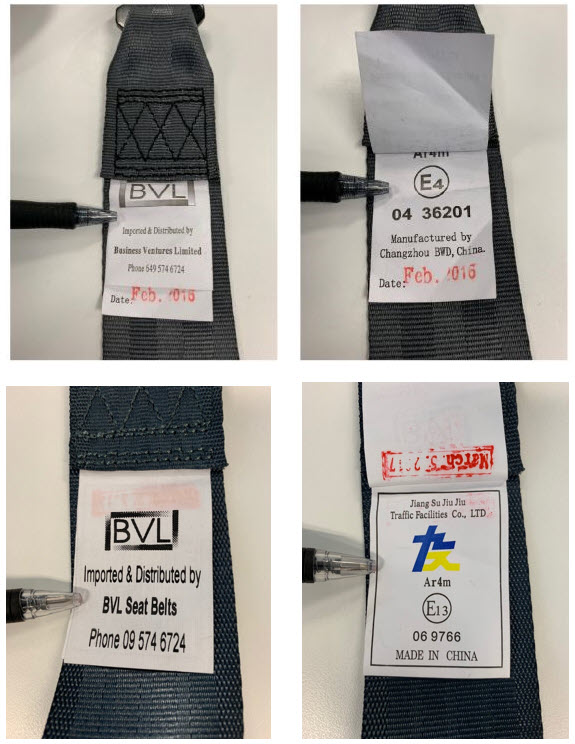
4. A three-point seatbelt imported and distributed by BVL (Business Ventures Limited) and manufactured by Changzhou BWD, China or Jiang Su Jiu Jiu Traffic Facilities Co. Ltd. is installed (See Figure 7-5-1 for samples to help identify the seatbelts).
5. A re-webbed seatbelt is fitted without evidence of exemption from requirements by NZTA.
Condition
6. Refer to general vehicle pages.
Performance
7. Refer to general vehicle pages.
Modification and repair
8. A modification or repair since 1 April 2002 affects a seatbelt or seatbelt anchorage and:
a) is not excluded from the requirements for HVS certification (Table 7-5-8), or
b) the modification is not for the purpose of law enforcement or the provision of emergency services, or
c) is missing proof of HVS certification, ie the vehicle has been modified or repaired, and:
i. no LANDATA record has been entered, or
ii. no valid LT400 form from an HVS certifier of category HVEC or HMCD has been presented.
9. The seatbelt assembly has been removed after it was rejected for one or more reasons for rejection due to Condition or Performance (above), whether or not the seatbelt is required to be fitted.
Note 1
On NZ Army Pinzgauer vehicles, the belts/harnesses fitted in the rear are attached to load anchorage points certified to NZS 5444. They are not considered to be seatbelts for the purpose of CoF inspections.
Note 2
Except as provided by Table 7-5-8, item 5, any seatbelt fitted to a seating position of a vehicle—either having been entry certified (as originally manufactured or modified) or subsequently specialist certified—must remain and be restored when damaged. It cannot be removed on the grounds that Table 7-5-7 doesn’t require a seatbelt.
Table 7-5-7. Seatbelt requirements for heavy vehicles (first registered in New Zealand from 1 April 2002) and all heavy motorhomes (first registered anytime)
|
Vehicle class |
Seating position |
Manufactured3 |
|
|---|---|---|---|
|
before 1 October 2003 |
from 1 October 2003 |
||
|
NB, NC |
Front outer and driver’s |
– |
R22 |
|
Front middle |
– |
L |
|
|
Rear outer1 |
– |
– |
|
|
Rear middle1 |
– |
– |
|
| Motorhome | Front outer and driver's |
– |
R2 |
| Front middle |
– |
L | |
| Rear outer1, 4 |
– |
R1 or R2 or L |
|
| Rear middle4 |
– |
L or S or R1 or R2 |
|
| Rear sideways-facing1, 4 | - | L | |
1 A sideways-facing seating position in a vehicle first registered in New Zealand before 1 October 2002 may be fitted with a seatbelt of any type, and in a vehicle first registered from 1 October 2002 may be fitted with a seat belt that is a lapbelt only.
2 Front type R1 seatbelts may remain fitted if they were fitted as OE and have a declaration issued by a certifier, or a plate affixed to the vehicle in a position approved by NZTA.
3 For a motorhome, manufactured means motor vehicles converted to motorhomes as well as manufactured as motorhomes.
4 Rear seating positions: at least as many lap (type L) or lap-and-diagonal (type R1 or R2) seatbelts as there are sleeping berths minus the number of front seating positions.
Table 7-5-8. Certification requirements for seatbelts and seatbelt anchorages
|
HVS certification is required |
HVS certification is not required |
|---|---|
|
1. Retrofitting of seatbelt anchorages, including seats with integrated seatbelts (for Pinzgauers see (Note 1)). 2. Fitting of an alternative type of seatbelt. |
1. Fitting of or modification to seatbelts, when: a) the modification is approved by the seatbelt or vehicle manufacturer, or b) the modification is temporary for the accommodation of a child restraint, and does not: i. affect the performance of the child restraint, or ii. cause injury to a vehicle occupant, or iii. cause damage to the seatbelt. 2. Top-tether anchorage for a child seat or harness, when the installation has been carried out in accordance with the instructions of the seat or harness manufacturer. 3. Fitting of unmodified seatbelts. 4. Retrofitting type-tested rear seatbelt anchorages. 5. Removal of seatbelts (full or partial) where the seating position has been removed (Note 2). 6. Any repair or modification not listed in the left-hand column unless the vehicle inspector considers that certification is required because the modification or repair has affected the vehicle’s safety performance (a second opinion from an expert may be needed, eg the manufacturer’s representative, or a reputable workshop). |
Figure 7-5-1. Identifying seatbelts by BVL (Business Ventures Limited) and manufactured by Changzhou BWD, China or Jiang Su Jiu Jiu Traffic Facilities Co. Ltd.
Applicable legislation
Mandatory equipment
1. Refer to general vehicle pages.
2. A class NB or NC vehicle must be fitted with seatbelts as specified in Table 7-5-7.
3. A motorhome manufactured on or after 1 October 2003 or a motor vehicle converted into a motorhome on or after 1 October 2003 must be fitted with seatbelts as specified in Table 7-5-7.
Permitted equipment
4. Refer to general vehicle pages.
Condition
5. Refer to general vehicle pages.
Performance
6. Refer to general vehicle pages.
Modification
7. Refer to general vehicle pages.
8. The fitting of an alternative type of seatbelt, or a modification on or after 1 April 2002 that affects a seatbelt anchorage in a heavy vehicle, must be inspected and certified by an HVS certifier of category HVEC or HMCD unless the vehicle is:
a) excluded from the requirement for HVS certification (Table 7-5-8), and
b) has been inspected in accordance with the requirements in this manual, including those for equipment, condition and performance.
Page amended 1 April 2023 (see amendment details).
7-6 Frontal impact airbags
Reasons for rejection
Mandatory equipment
1. Refer to general vehicle pages.
Condition and performance
2. Refer to general vehicle pages.
Modification
3. A modification affects an airbag system (eg an airbag has been removed or made inoperable, including retrofitting a switch), and
a) the modification is not for the purposes of law enforcement or the provision of emergency services, or
b) is missing proof of HVS certification, ie the vehicle has been modified or repaired, and:
i. no LANDATA record has been entered, or
ii. no valid LT400 form from a HVS certifier of category HVEC or HMCD has been presented.
4. A motor vehicle that has an airbag system removed or made inoperable and been certified as above does not:
a) have all OE signs, lights, or other devices that indicated that the vehicle was fitted with an airbag removed, or
b) if the signs, lights or other devices cannot be readily removed, have a label that indicates an airbag has been removed permanently attached in a prominent location where it is clearly visible to any occupant of the seating position that was previously protected by the airbag.
Note 1
Some modifications are permitted, but they must always be LVV certified. The only modifications permitted are:
1. fitting a switch to render an airbag temporarily inoperable, and
2. the removal or permanent deactivation of an airbag in a vehicle that:
- is at least 14 years old, or
- has been adapted for a person with a disability, or
- has been extensively modified for motorsport use.
Table 7-6-1. Modifications that do not require LVV certification
Fitting of or modification to: | LVV certification is never required: |
|---|---|
Any modification for the purposes of law enforcement or the provision of emergency services |
|
Summary of legislation
Applicable legislation
Mandatory equipment
1. A frontal impact airbag and its operating system must remain operational if the vehicle was originally manufactured with a frontal impact airbag.
2. An airbag warning light system must remain operational if it was fitted by the vehicle manufacturer.
3. A motor vehicle must not have a sign, light, or other device that indicates the vehicle is fitted with an airbag if it is not fitted with an airbag.
4. A motor vehicle must not have a light or other device indicating an airbag operating system is operable if it is inoperable.
Permitted equipment
5. A switch may be installed as OE to render an airbag temporarily inoperable.
Condition and performance
6. An airbag and its operating system must be safe and in good condition.
7. An airbag warning light fitted by the manufacturer must remain operational.
Modification
8. A motor vehicle that has had an airbag removed or made inoperable must either:
a) have all OE signs lights, or other devices that indicated the vehicle was fitted with an airbag removed, or
b) if the signs, lights, or other devices cannot be readily removed, have a label that indicates an airbag has been removed permanently attached in a prominent location where it is clearly visible to any occupant of the seating position that was previously protected by the airbag.
9. A modification that affects an airbag system must be inspected and certified by an LVV specialist certifier, unless the vehicle is:
a) excluded from the requirement for LVV specialist certification (Table 7-6-1), and
b) has been inspected in accordance with the requirements in this manual, including those for equipment, condition and performance.
Page amended 1 December 2016 (see amendment details).
7-7 Interior impact
Reasons for rejection
Mandatory equipment
1. Where an interior fitting, control or surface has been added, removed, substituted or has deteriorated, the likelihood of injury to occupants has not been minimised.
Modification
2. A modification (Note 1) affects an interior fitting, control or surface, and:
a) is not excluded from the requirements for LVV specialist certification (Table 7-7-1), and
b) is missing proof of LVV specialist or accepted overseas certification, ie:
i. the vehicle is not fitted with a valid LVV certification plate, or
ii. the operator is not able to produce a valid modification declaration or authority card, or
iii. the vehicle has not been certified to an accepted overseas system as described in Technical bulletin 13.
Note 1 Definitions
Modify means to change a vehicle from its original state by altering, substituting, adding or removing a structure, system, component or equipment, but does not include repair.
Repair means to restore a damaged or worn vehicle, its structure, systems, components or equipment to within safe tolerance of its condition when manufactured, including replacement with undamaged or new structures, systems, components or equipment.
Table 7-7-1. Modifications that do not require LVV certification
|
Fitting of or modification to: |
LVV certification is not required provided that: |
|---|---|
| Isolation shields (to separate vehicle occupants for the purpose of medical isolation) (Note 3) |
The shield:
|
|
Additional and substituted items such as instruments, switches, cellphone installations and navigation equipment or an OE item from another vehicle |
|
| Additional accelerator and brake pedal (for driving school vehicles) |
See also Table 8-1-1 |
|
Aftermarket brake pedal pads or covers |
See also Table 8-1-1 |
| Aftermarket or custom brake pedal extensions (for unusually short people) |
See also Table 8-1-1 |
| Cargo hoist/cargo lift platform (fitted inside the vehicle) |
See also Table 3-1-1 |
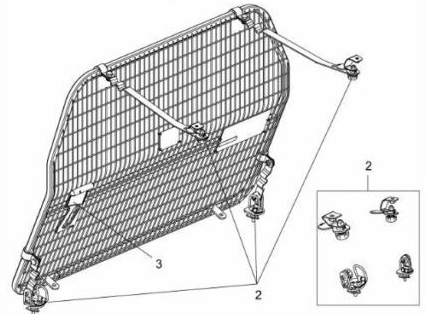
| Cargo barriers |
The cargo barriers are positioned vertically behind the back of the rearmost seat, and
Notes
|
|
Disability adaptive controls |
For disability adaptive hand control systems:
For an additional accelerator pedal fitted to the left of the brake pedal:
For a steering wheel spinner to assist in the operation of the steering wheel:
|
|
Stereo equipment and speakers |
If fitted to the rear parcel shelf:
If fitted to a part of the vehicle other than the rear parcel shelf:
See also Table 3-1-1 and Table 7-5-1 |
|
Steering wheels |
1 A vehicle that cannot comply with this clause cannot be LVV certified unless it has been issued with an LVV authority card or is at least 14 years old. 2 A vehicle fitted with a quick release steering wheel must always be referred for LVV certification and is only permitted within strict criteria See also Table 9-1-1 |
|
Roll-bar or roll-cage structures (roll protection or cosmetic) |
– behind, following a plane extending upward, parallel to the back of the backrest on the rear-most seat, and – in such a way that the head restraint would provide protection from head contact with any bar section during a crash. |
|
Gear shift lever relocation |
See also Table 3-1-1 |
|
Fitting of or modification to: |
LVV certification is never required: |
|---|---|
|
Modified accelerator pedal |
|
|
Roof and door lining replacement |
|
|
Cargo barriers |
|
|
Any modification for the purpose of law enforcement or the provision of emergency services |
Note 2
The following vehicles with a GVM of 2500 kg or less are required to comply with such a standard:
- class MA motor vehicles manufactured from 1 March 1999, and
- class MA motor vehicles that were less than 20 years old when they were first registered in New Zealand on or after 1 April 2002, and
- class MB or MC motor vehicles manufactured from 1 October 2003.
Note 3
NZTA makes no representations about the effectiveness of these installations, whether they are required, or whether they are sufficient for the purposes of meeting health and safety or other requirements. It takes no responsibility for the installation and use of isolation shields.
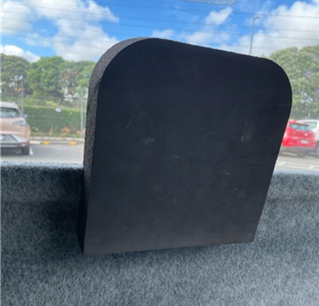
Figure 7-7-1. Cargo barriers
| Suitable impact absorbing padding on a solid cargo barrier |
 |
| Typical cargo barrier. Usually compliant with the thresholds. Check threshold technical requirements |
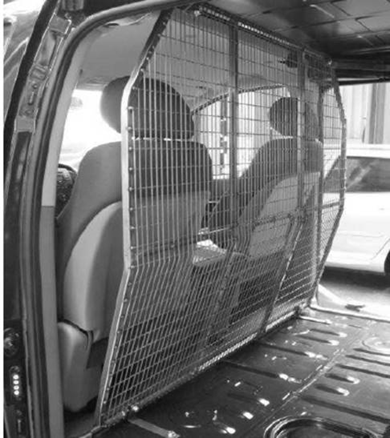 |
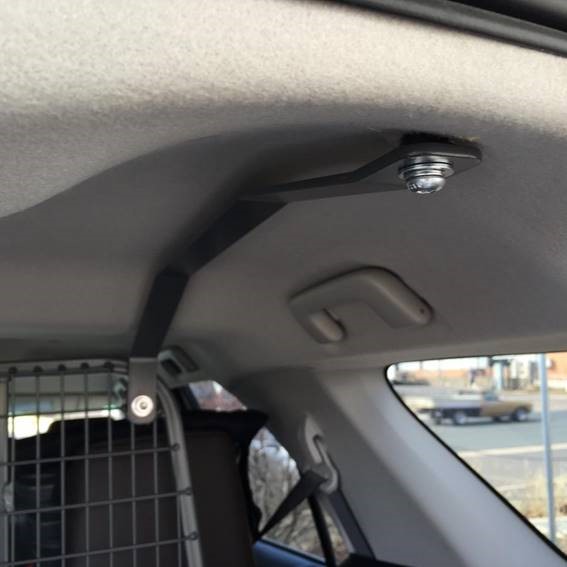
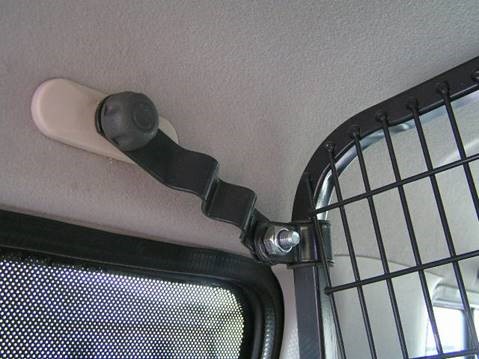
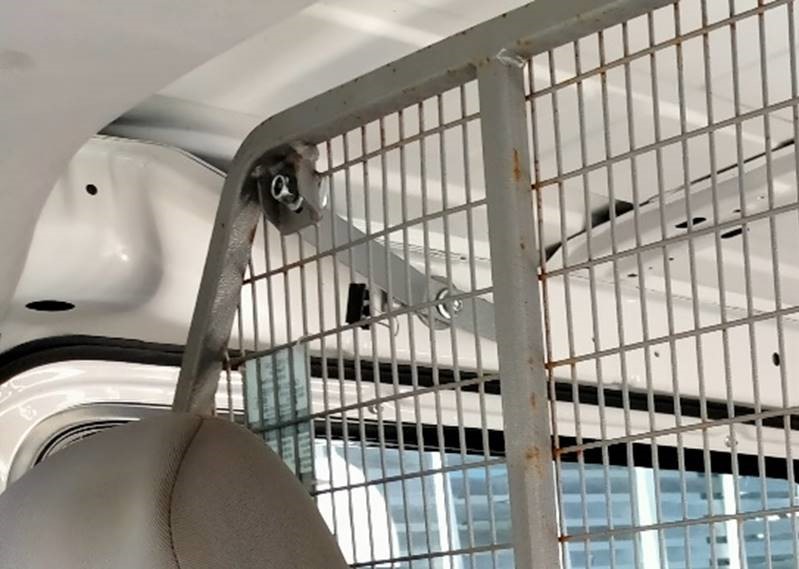
Figure 7-7-2. Collapsible mechanisms
 |
 |
 |
 |
Summary of legislation
Applicable legislation
Condition and performance
1. Interior fittings, controls and surfaces in the passenger compartments must be such that the likelihood of injury to occupants is minimised.
Modification
2. A modification that affects the interior fittings, controls or surfaces must be inspected and certified by an LVV specialist certifier, unless the vehicle:
a) is excluded from the requirement for LVV specialist certification (Table 7-7-1), and
b) has been inspected in accordance with the requirements in this manual, including those for equipment, condition and performance.
Page amended 2 December 2021 (see amendment details).
7-12 Speedometer
Reasons for rejection
Mandatory equipment
1. A vehicle first registered in New Zealand on or after 1 December 1951 that is capable of a speed exceeding 50km/h is not fitted with a speedometer, and the vehicle operator cannot produce acceptable written evidence (Note 2) that:
a) the speedometer has been removed for repair, or
b) there are no undue delays by the vehicle owner in having the speedometer replaced.
Condition and performance
2. The speedometer:
a) does not operate as intended when the vehicle is moving forward (Note 3), or
b) is obscured from the driver’s position, or
c) does not indicate the vehicle’s speed in km/h or mph.
3. Reason for rejection 2(a), 2(b) or 2(c) applies and the vehicle operator cannot produce acceptable written evidence (Note 2) that repair of the speedometer or associated equipment is impracticable or that a suitable replacement is not available.
Note 1
Speedometer means an instrument in a motor vehicle that continuously indicates to the driver the forward speed of the vehicle in either kilometres per hour (km/h) or miles per hour (mph). For clarification: This definition does not include the speed provided by a GPS system.
Note 2
Acceptable written evidence is documentation provided by the speedometer repairer or supplier. A copy of the documentation must be kept on file with the checksheet.
Note 3
If an odometer is not fitted, not working or unable to be read an appropriate note must be entered into the ‘Comments’ section of the check sheet and '000001' entered into the odometer field of the check sheet and, if required, '000001' entered into VIC or LANDATA. This may display as “1” on some screens.
Summary of legislation
Applicable legislation
Mandatory equipment
1. A vehicle first registered in New Zealand on or after 1 December 1951 that is capable of a speed exceeding 50km/h must be fitted with a speedometer (Note 1).
2. A vehicle is not required to have a speedometer if the speedometer or associated equipment:
a) has been removed for repair and there are no undue delays by the vehicle owner in having it replaced, or
b) is out of repair, repair is impracticable and a suitable replacement is not available.
Condition and performance
3. The speedometer must be in good working order and operate while the vehicle is moving forward.
Modification
4. A speedometer that is affected by a modification:
a) must meet the requirements for equipment, condition and performance, and
b) does not require LVV specialist certification.
Page amended 1 October 2022 (see amendment details)
Page updated 1 November 2024 (see details)
7-13 Audible warning devices
Reasons for rejection
Mandatory equipment
1. A motor vehicle is:
a) not fitted with a horn, or
b) fitted with a bell or whistle (Note 2), or
c) not an emergency vehicle (Note 1) and is fitted with a siren (Note 2).
2. A horn cannot be easily operated from the driver’s seating position.
Performance
3. The horn does not operate when activated.
4. The horn operates when not activated.
5. The sound from the horn is not steady and continuous, eg the horn plays a tune.
6. The horn is not audible at a distance of 100 m.
7. A siren fitted to an emergency vehicle operates when not activated.
Note 1
Emergency vehicle means a vehicle used for the attendance of emergencies and operated:
a) by an enforcement officer, or
b) by an ambulance service, or
c) as a fire service vehicle, or
d) as a civil defence emergency vehicle, or
e) as a New Zealand Defence Force emergency vehicle.
Note 2
A vehicle may be fitted with a bell, whistle or siren that is part of an anti-theft car alarm, personal security alarm or reversing warning device.
Summary of legislation
Applicable legislation
Mandatory equipment
1. A vehicle must be fitted with a device (horn) that is audible to other road users.
Permitted equipment
2. A vehicle may be fitted with a bell, whistle or siren only as follows:
a) a siren fitted to an emergency vehicle (Note 1), or
b) a siren, bell or whistle that is part of an anti-theft car alarm, personal security alarm or a reversing warning device.
Performance
3. The device must be in good working order.
4. The device must be capable of giving a warning that is audible under normal traffic conditions from a distance of at least 100 m.
Modification
5. An audible warning device that is affected by a modification:
a) must meet the requirements for equipment and performance, and
b) does not require LVV specialist certification.