
11 Exhaust
11-1 Exhaust system and silencer
Reasons for rejection
Mandatory equipment
1. A vehicle does not comply with the requirements relating to mandatory equipment set out in:
- VIRM: In-service certification, section 11-1, general vehicles
- VIRM: In-service certification, section 11-1, heavy vehicles
- VIRM: In-service certification, section 11-1, light PSVs
- VIRM: In-service certification, section 11-1, heavy PSVs
Compliance with approved standards
2. A class LC, LD, LE, MA, MB, MC, MD1, MD2, MD3, MD4, ME, NA, NB or NC vehicle, other than one listed in Table 11-1-1, manufactured on or after 1 January 1985 and certified for entry on or after 1 June 2008:
a) did not comply, or cannot be demonstrated to have complied, with at least one of the approved standards listed in Table 11-1-2 at the time the vehicle was manufactured, or
b) exceeded the noise limits in Table 11-1-2 when it was tested in accordance with the standards in Table 11-1-2 at the time the vehicle was manufactured, or
c) does not have evidence that the vehicle has passed an LVVTA objective noise test, for instance:
i. the owner cannot produce a valid ‘Objective exhaust noise emission test certificate’ (Figure 11-1-1), or
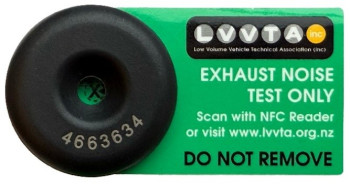
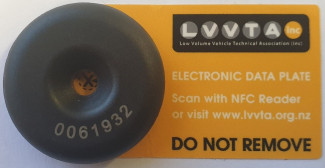
ii. the exhaust system tailpipe is not fitted with a valid LVVTA noise test label (Figure 11-1-2) or an appropriate LVV data plate (Figure 11-1-3)
Condition and performance
3. A vehicle does not comply with the requirements relating to condition and performance set out in:
Table 11-1-1. Vehicles deemed to comply with approved noise standards and drive-by noise limits
Evidence of compliance with an approved noise standard and noise limit is not required for the following vehicles: |
|---|
|
Table 11-1-2. List of approved noise standards and drive-by noise limits
A vehicle manufactured on or after 1985 for which evidence of compliance with an approved standard and noise level is required must comply with the following: | ||
|---|---|---|
Approved noise standard | Vehicle class | Maximum noise level (dBA) |
ISO 362 BS 3425 SAE J1470 ADR 28/01 TRIAS 20 | LC, LD, LE (engine capacity of 125 cc or less) LC, LD, LE (engine capacity more than 125 cc) MA, MB, MC, MD1, MD2, NA MD3, MD4, ME, NB, NC (power output 150 kW or less) MD3, MD4, ME, NB, NC (power output more than 150 kW) | 82 86 81 86 88 |
Figure 11-1-1. Objective exhaust noise emission test certificate
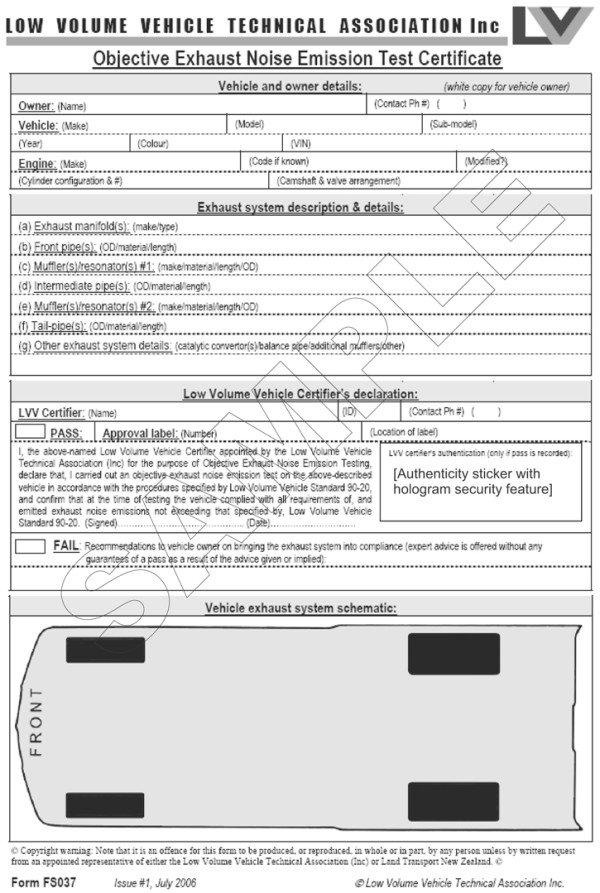
Figure 11-1-2. Objective noise test label
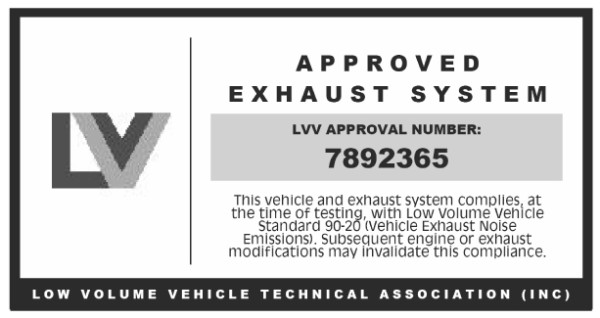
Figure 11-1-3. Green objective noise test electronic data plate and orange electronic data plate
|
|
From September 2025 a vehicle that passes an objective noise test (ONT) will be fitted with an electronic data plate (EDP), which will include either a green or orange label.
The green label indicates the EDP only contains ONT information, however the vehicle may also have an older style LVV engraved certification plate.
The orange label will be used when the vehicle has been LVV certified for modifications and may only cover modifications, but where an ONT is required and passed the EDP will cover both the ONT data and the LVV certified modifications.
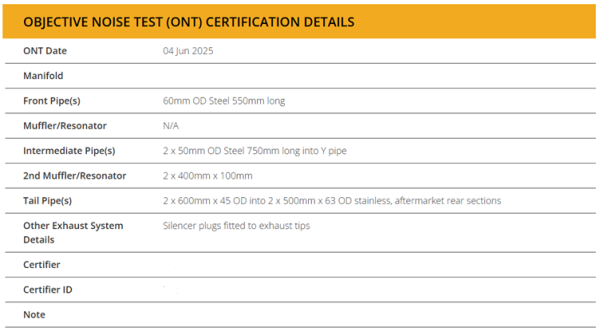
Figure 11-1-4. Sample of objective noise test data
Summary of legislation
Applicable legislation
Mandatory equipment
1. A vehicle must comply with the requirements relating to mandatory equipment set out in:
- VIRM: In-service certification, section 11-1, general vehicles
- VIRM: In-service certification, section 11-1, heavy vehicles
- VIRM: In-service certification, section 11-1, light PSVs
- VIRM: In-service certification, section 11-1, heavy PSVs
Compliance with approved standards
2. A class LC, LD, LE, MA, MB, MC, MD1, MD2, MD3, MD4, ME, NA, NB or NC vehicle manufactured on or after 1 January 1985 and certified for entry on or after 1 June 2008 must comply with:
a) an approved standard and not exceed the relevant noise limit, as specified in Table 11-1-2, or
b) the LVVTA objective noise test.
Condition and performance
3. The exhaust system and silencer must comply with the requirements relating to condition and performance set out in the relevant section of the VIRM: In-service certification, section 11-1.
Modification
4. A vehicle must comply with the requirements relating to modifications set out in:
Page updated 1 October 2025 (see details)
11-2 Exhaust emissions
Reasons for rejection
Compliance with approved standards
1. A vehicle that is less than 20 years old and required to comply with an approved (or a more recent version, or a higher) exhaust emission standard did not comply or cannot be demonstrated to have complied with at least one of the standards listed in the following tables or in Technical bulletin 28 at the time the vehicle was manufactured or modified.
The following tables only list approved vehicle exhaust emissions standards. More recent versions of the standards and higher standards (as well as approved standards) are listed in Technical bulletin 28
- Table 11-2-1 Exhaust emissions requirements for class MA, MB, MC, MD1, MD2, NA vehicles (except used-import disability vehicles) – see Note 3
- Table 11-2-2 Exhaust emissions requirements for class MA, MB, MC, MD1, MD2, NA used-import disability vehicles – see Note 3
- Table 11-2-3 Exhaust emissions requirements for class MD3, MD4, ME, NB, NC vehicles
- Table 11-2-4 Exhaust emissions requirements for class LA, LB, LC, LD, LE vehicles
Performance and modification
2. A vehicle that is required to pass the prescribed metered test (see 4. under Compliance with approved standards) does not pass the prescribed metered emissions test (see section 11-3, Metered emissions test specifications).
3. The exhaust system does not comply with requirements relating to performance set out in the VIRM: In-service certification, section 11-2
4. A vehicle that is required to comply with an exhaust emission standard doesn't illuminate a malfunction lamp self test related to emissions and/or engine systems when the ignition is first cycled (on).
5. A vehicle that is required to comply with an exhaust emission standard displays a message or warning which may indicate a fault or noncompliance of the engine or the vehicle's emissions system (other than a warning system self test cycle).
Note 1
Technical bulletin 28 describes methods of identifying compliance with emissions standards, and explains how to record the information in LANDATA.
Note 2
1. New model vehicle means a new motor vehicle that has a date of manufacture occurring in the same calendar year as that in which the particular model of the vehicle was first manufactured.
2. Existing model vehicle means a new vehicle that is not a new model vehicle.
3. New means a vehicle that has not been previously registered or operated and is not a low volume vehicle. Operation expressly for the purpose of the specific vehicle's, manufacture, delivery to New Zealand and entry certification is exempt. Using the vehicle in activities like demonstration, training, testing, courtesy or transport services is operation.
4. Used means a vehicle that has been previously registered (anywhere) or operated and is not new. Refer to 9 Definitions and abbreviations
Note 3
Disability vehicle means a light vehicle that is used for the transportation of a person with a disability and is modified to do either or both of the following:
- enable a person in a wheelchair to safely enter and exit the vehicle and enable the person and the wheelchair to be safely restrained while the vehicle is moving:
- provide a person in a wheelchair or of limited mobility with assistance to enter and exit the vehicle through the use of a swivel or swing-out seat.
A different definition of disability vehicle is used to exempt vehicles from the Clean Vehicle Standard.
Table 11-2-1 Exhaust emissions requirements for Class MA, MB, MC, MD1, MD2, NA vehicles (except used-import disability vehicles)
- see Note 3
| Date of border inspection (used vehicles) or manufacture (new vehicles) | Fuel type | Used or new | Exhaust emissions requirements |
|---|---|---|---|
| Before 30 April 2024 | Petrol, CNG/LPG | Used |
Euro 4; or US 2004; or Japan 05; or ADR 79/02 |
| New |
Euro 5; or US 2007; or Japan 05; or ADR 79/04 | ||
| Diesel | Used |
Euro 4; or US 2004; or Japan 05; or ADR 30/01 and ADR 79/01 | |
| New |
Euro 5; or US 2007; or Japan 05; or ADR 79/04 | ||
| From 30 April 2024 to 30 June 2027 | Petrol, CNG/LPG | Used |
Euro 5; or US Tier 2; or Japan 2005 Low Harm; or Japan 2018; or ADR 79/04 |
| New |
Euro 5; or US Tier 2; or Japan 2005 Low Harm; or Japan 2018; or ADR 79/04 | ||
| Diesel | Used |
Euro 5; or US Tier 2; or Japan 09; or ADR 79/04 | |
| New |
Euro 5; or US Tier 2; or Japan 09; or ADR 79/04 | ||
| From 1 July 2027 to 30 June 2028 | Petrol, CNG/LPG | Used |
Euro 5; or US Tier 2; or Japan 2005 Low Harm; or Japan 2018; or ADR 79/04 |
| New |
For existing model vehicles (Note 2) Euro 5; or US Tier 2; or Japan 2005 Low Harm; or Japan 2018; or ADR 79/04 For new model vehicles (Note 2) Euro 6d; or US Tier 3; or Japan 2018 Low Harm; or UNR83/08 | ||
| Diesel | Used |
Euro 5; or US Tier 2; or Japan 09; or ADR 79/04 | |
| New |
For existing model vehicles (Note 2) Euro 5; or US Tier 2; or Japan 09; or ADR 79/04 For new model vehicles (Note 2) Euro 6d; or US Tier 3; or Japan 2018; or UNR83/08 | ||
| From 1 July 2028 | Petrol, CNG/LPG | Used |
Euro 6d; or US Tier 3; or Japan 2018 Low Harm; or UNR83/08 |
| New |
Euro 6d; or US Tier 3; or Japan 2018 Low Harm; or UNR83/08 | ||
| Diesel | Used |
Euro 6d; or US Tier 3; or Japan 2018; or UNR83/08 | |
| New |
Euro 6d; or US Tier 3; or Japan 2018; or UNR83/08 |
Table 11-2-2 Exhaust emissions requirements for used-import disability vehicles – Class MA, MB, MC, MD1, MD2, NA
- see Note 3
| Date of border inspection (used vehicles) or manufacture (new vehicles) | Fuel type | Exhaust emissions requirements |
|---|---|---|
| Before 30 April 2024 | Petrol, CNG/LPG |
Euro 4; or US 2004; or Japan 05; or ADR 79/02 |
| Diesel |
Euro 4; or US 2004; or Japan 05; or ADR 30/01 and ADR 79/01 | |
| 30 April 2024 to 31 December 2030 | Petrol, CNG/LPG |
Euro 5; or US Tier 2; or Japan 2005; or ADR 79/04 |
| Diesel |
Euro 5; or US Tier 2; or Japan 2005; or ADR 79/04 | |
| From 1 January 2031 | Petrol, CNG/LPG |
Euro 6d; or US Tier 3; or Japan 2018; or UNR83/08 |
| Diesel |
Euro 6d; or US Tier 3; or Japan 2018; or UNR83/08 |
Table 11-2-3 Exhaust emissions requirements for Class MD3, MD4, ME, NB, NC vehicles
| Date of border inspection (used vehicles) or manufacture (new vehicles) | Exhaust emissions standards | |
|---|---|---|
| Used | New | |
| Before 30 April 2024 |
Euro IV; or US 2004; or Japan 05; or ADR 30/01 and ADR 80/02 |
Euro V; or US 2007; or Japan 05; or Japan 09; or ADR 80/03 |
| 30 April 2024 to 31 October 2024 |
Euro V; or US Tier 2; or Japan 09; or ADR 80/03 |
Euro V; or US Tier 2; or Japan 09; or ADR 80/03 |
| 1 November 2024 to 31 October 2025 |
Euro V; or US Tier 2; or Japan 09; or ADR 80/03 |
For existing model vehicles (Note 2) Euro V; or US Tier 2; or Japan 09; or ADR80/03 For new model vehicles (Note 2) Euro VI step C; or US Tier 3; or US 2013; or Japan 2016; or ADR 80/04; or UNR49/06(Supp.4); or UNR83/07 |
| From 1 November 2025 |
Euro VI step C; or US Tier 3; or US 2013; or Japan 2016; or ADR 80/04; or UNR49/06(Supp.4); or UNR83/07 |
Euro VI step C; or US Tier 3; or US 2013; or Japan 2016; or ADR 80/04; or UNR49/06(Supp.4); or UNR83/07 |
Table 11-2-4 Exhaust emissions requirements for Class LA, LB, LC, LD, LE vehicles
| Date of border inspection (used vehicles) or manufacture (new vehicles) | Exhaust emissions standards | |
|---|---|---|
| Used | New | |
| From 30 April 2025 to 31 December 2026 |
Euro 4m, or US 2010m, or Japan 2012m |
Euro 4m; or US 2010m; or Japan 2012m |
| From 1 January 2027 |
Euro 5m; or US 2010m; or Japan 2016m |
Euro 5m; or US 2010m; or Japan 2016m |
Summary of legislation
Applicable legislation
Compliance with approved standards
1. The following are required to meet an approved vehicle exhaust emissions standard, or a more recent version of the standard or a higher standard:
- Vehicles that are:
- petrol, CNG, LPG or diesel vehicles, and
- class LA, LB, LC, LD, LE, MA, MB, MC, MD1, MD2, MD3, MD4, ME, NA, NB or NC, and
- less than 20 years old. Less than 20 years old means first registered outside of New Zealand or manufactured 20 years or less before its date of certification for entry into service.
2. The following are not required to meet an approved vehicle exhaust emissions standard, or a more recent version of the standard or a higher standard:
- Tractors – meaning a motor vehicle (other than a traction engine) constructed principally for towing an agricultural trailer or powering agricultural implements.
- Class MA or Class MC motorsport vehicles – as defined in the Land Transport Rule: Frontal Impact 2001.
- Immigrants' vehicles – meaning a motor vehicle that has been identified in writing, under Land Transport Rule: Frontal Impact 2001, or in accordance with Schedule 4 by the Director or by an organisation appointed by the Director under 5.3(2).
- Class MA special interest vehicles
- Mobile cranes – this doesn't include a truck mounted with crane apparatus.
- Scratchbuilt vehicles – as specified in paragraph (a) of the definition of ‘low volume vehicle’ that comply with the emissions requirements of the Low Volume Vehicle Code.
- Military vehicles – as referred to in regulation 5(e) of the Land Transport (Clean Vehicle Standard) Regulations 2022.
- Enduro, farm, special interest or trial motorcycles – as defined in Land Transport Rule: Light-vehicle Brakes 2002.
3. The Land Transport Rule: Vehicle Exhaust Emissions doesn't apply to ancillary engines that don't power the vehicle's wheels (for example, refrigeration units, motorhome electricity generators).
4. Approved vehicle emissions standard and higher standard are defined terms:
- Approved vehicle emissions standard means a vehicle emissions standard specified in Table 11.-2-1, or Table 11-2-2, or Table 11-2-3 or Table 11-2-4 (Part 3 Schedule 1 of the Land Transport Rule Vehicle Exhaust Emissions 2007).
- Higher standard means an approved vehicle emissions standard that would have applied to the vehicle if the vehicle was inspected at the border or manufactured (as the case may be) during a later period.
5. Land Transport Rule: Vehicle Exhaust Emissions 2007 defines Euro 4 as follows:
Euro 4
(a) means:
1. UN/ECE Regulation No. 83, uniform provisions concerning the approval of vehicles with regard to the emission of pollutants according to engine fuel requirements (E/ECE/324E/ECE/TRANS/505/Rev.1/Add.82/Rev.2) incorporating the 05 series of amendments, as per the limit values in row B of the table to clause 5.3.1.4; or
2. Council Directive 70/220/EEC as amended by Council Directive 98/69/EC as per the limit values in row B of the table to clause 5.3.1.4 of Annex I of 98/69/EC…
This definition does not necessarily require the vehicle to be formally certified as Euro 4. The two elements required to meet this definition are:
1. The vehicle must be certified to UN/ECE Regulation 83.05 or EC Directive 70/220/EEC as amended by 98/69/EC (or a later amendment), and
2. The declared emissions values on that certification must be within the specified limits set out in Row B of the quoted table (the Euro 4 emissions limits).
In practice, it is possible for a vehicle to be formally certified in Europe as a Euro 3 vehicle, but for it to comply with the Row B emissions limits required for Euro 4. Such vehicles are certified to UN/ECE Regulation 83.05 or 98/69/EC, or later amendment, (which contain both Euro 3 and Euro 4 requirements) In cases like this, despite being formally certified as Euro 3, the vehicle meets the Emissions Rule definition as a Euro 4 vehicle and can be accepted as such.
Performance
6. The following must pass a metered test (see section 11-3, Metered test specifications).
- Vehicles that are:
- petrol, CNG, LPG or diesel, and
- class MA, MB, MC, MD1, MD2, MD3, MD4, ME, NA, NB or NC, and
- less than 20 years old (first registered outside of New Zealand or manufactured 20 years or less before its date of certification for entry into service), and
- either
- used vehicles, or
- new vehicles that have been modified such that the modification might prevent the vehicle being able to pass the vehicle's test.
7. The following vehicles are exempt from the requirement to pass a metered emissions test:
- tractors, or
- class MA or class MC motor sport vehicles.
8. The exhaust system must comply with requirements relating to performance set out in the VIRM: In-service certification, section 11-2.
Page amended 10 April 2025 (see amendment details)
11-3 Metered emissions test specifications
Applicable legislation
Application
Group M or N vehicles less than 20 years old (Note 4) and certified for entry on or after 1 May 2008 must pass a prescribed metered exhaust emissions test, according to the following procedures and requirements.
Note 1
This requirement does not apply to tractors, class MA or MC motorsport vehicles, or a vehicle certified to the low-volume vehicle standard exhaust gas emissions 90–10(00).
Note 2
This requirement does not apply to vehicles being re-registered or new vehicles.
Note 3
The entry inspector must personally carry out the tail-pipe test. Other staff may prepare the vehicle for testing but the test must be carried out by the entry inspector.
Note 4
Less than 20 years old means “a motor vehicle first registered outside of New Zealand, or manufactured, 20 years or less before its date of certification for entry into service”.
Procedure for measuring exhaust emissions of petrol, LPG or CNG vehicles
1. The test equipment must be warmed up and calibrated before use, in accordance with the equipment manufacturer’s instructions.
2. Ensure the vehicle has reached normal operating temperature, as recommended by the vehicle manufacturer.
3. Insert the sampling probe (ie the exhaust gas sampling part of the measuring equipment) far enough into the exhaust pipe to prevent the admission of open air. This is to ensure that only exhaust gas is sampled.
4. For the duration of the test:
a) the vehicle’s engine must be idling, and
b) the acceleratior pedal must be released, and
c) the handbrake must be applied, and
d) the vehicle’s transmission must be
i. in neutral, or
ii. if the vehicle is an automatic, in park.
Pass requirements
A petrol, LPG or CNG vehicle must not exceed the applicable maximum carbon monoxide and hydrocarbon emissions limits set out in below.
|
Vehicle |
Carbon monoxide |
Hydrocarbons |
|---|---|---|
|
A motor vehicle powered by a four-stroke or rotary engine |
1% |
300 |
|
A motor vehicle powered by a two-stroke engine |
4.5% |
7800 |
Re-testing
If a vehicle fails the test, it may be necessary to ensure the vehicle has reached normal operating temperature, as recommended by the manufacturer.
Procedure for measuring exhaust emissions of diesel vehicles (using an opacimeter)
Pre-testing
1. The vehicle must be brought to the normal operating temperature as recommended by the manufacturer.
2. The equipment must be readied before use, in accordance with the equipment manufacturer’s instructions.
During testing
For the duration of the test:
a) the vehicle must be stationary, and
b) the handbrake must be applied, and
c) the vehicle’s transmission must be:
i. in neutral, or
ii. if the vehicle is an automatic, in park.
Operation of the vehicle while testing
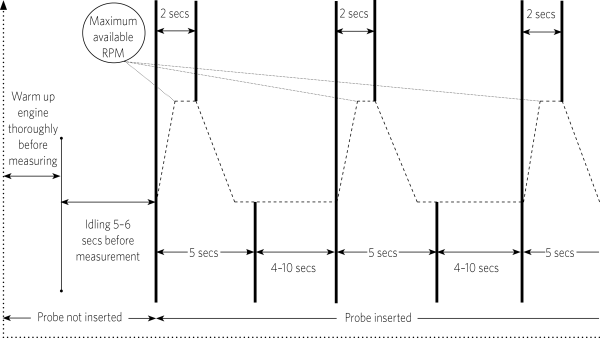
During the test procedure, the vehicle operation cycle must follow these phases (refer to Figure 11-3-1):
1. Purge
a) Residual smoke must be purged from the vehicle’s exhaust system before the vehicle’s diesel smoke is sampled.
2. Inserting probe
a) The probe (the exhaust gas sampling part of the measuring equipment) must be inserted sufficiently into the exhaust pipe to prevent outside air from entering the probe and ensure that only exhaust gas is sampled.
3. Idling before testing
a) The engine must be run at idle for five or six seconds before the first test cycle.
4. Test cycle
a) The accelerator pedal must be fully and rapidly depressed, held in this state for two seconds, then released for three seconds (refer to Figure 11-3-2).
b) Despite the above, if the opacimeter has a function allowing the measurement of the engine revloutions per minute (RPM), the accelerator pedal should only be depressed until the maximum available RPM is indicated by the opacimeter (rather than for the fixed period of two seconds).
c) The exhaust emissions must be sampled throughout this (five-second) period.
5. Idling between test cycles
a) The engine must be run at idle for 4–10 seconds between each test cycle that is performed.
Measured values
1. One, two or three test cycles must be performed as necessary.
a) If the result of measurement 1 is:
i. less than or equal to an optical absorption coefficient (OAC) of 0.64m-1, the vehicle passes the test,
ii. more than an OAC of 0.64m-1, the test cycle must be repeated.
b) If the result of measurement 2 is:
i. less than or equal to an OAC of 0.64m-1, the vehicle passes the test,
ii. more than 0.64m-1, the test cycle must be repeated.
c) If the average of the three measurements is:
i. less than or equal to an OAC of 0.80m-1, the vehicle passes the test,
ii more than an OAC of 0.80m-1, the vehicle fails the test.
2. To avoid doubt, if the vehicle does not meet the prescribed standard after three test cycles, the vehicle fails the test.
Figure 11-3-1. Diesel exhaust emission test vehicle operation cycle using an opacimeter
Procedure for measuring exhaust emissions of diesel vehicles (using filter paper test equipment)
Pre-testing
1. The test equipment must be warmed up and calibrated before use, in accordance with the equipment manufacturer’s instructions.
2. Insert the sampling probe (ie the exhaust gas sampling part of the measuring equipment) far enough into the exhaust pipe to prevent the admission of open air. This is to ensure that only exhaust gas is sampled.
Operation of the vehicle during testing
For the duration of the test:
a) the vehicle must be stationary, and
b) the handbrake must be applied, and
c) the vehicle’s transmission must be:
i. in neutral, or
ii. if the vehicle is an automatic, in park.
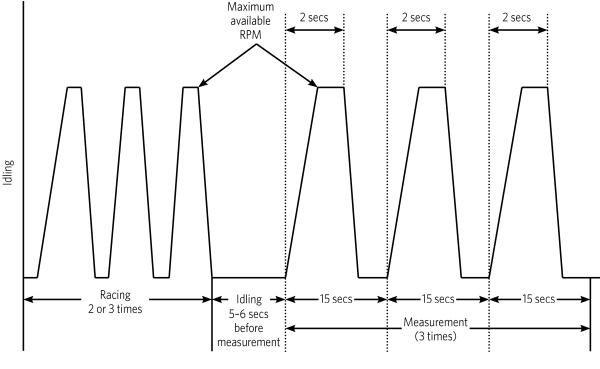
During the test procedure, the vehicle operation cycle must follow these phases (refer to Figure 11-3-2 over the page):
1. Racing purge
a) When the engine is idling, rapidly depress the accelerator to the maximum available RPM.
b) Immediately after the engine reaches its maximum available RPM, release the accelerator to return the engine to idling.
c) Repeat this two more times.
2. Idling phase
a) Run the engine at idle for five or six seconds.
3. Measuring phase
a) Fully depress the accelerator and hold for two seconds.
b) Release the accelerator for 13 seconds and sample the diesel smoke during this period.
c) Repeat this two more times.
Diesel sampling requirements
1. A sample of 0.33 litres must be absorbed through a filter paper by means of a pump-type exhaust smoke sampling device.
2. Class 5A filter paper (or equivalent) must be used.
3. The extent the filter paper is polluted by the smoke contained in the vehicle’s exhaust emissions must be measured by a prescribed exhaust smoke analyser measurement device.
4. The final result must be calculated as an average of the three measured values obtained during the test procedure.
Pass requirements
A diesel vehicle must not exceed 25% opacity.
Figure 11-3-2 Diesel exhaust emission test vehicle operation cycle
Page amended 1 January 2013 (see amendment details).