

Technical bulletins
28 Exhaust emissions standard compliance
Vehicle inspection requirements manual references and application
This bulletin gives guidance to vehicle inspectors in applying the following requirements in the VIRM: Entry certification:
Under Land Transport Rule: Vehicle Exhaust Emissions 2007, when a vehicle undergoes entry-level certification in New Zealand, proof that the vehicle was manufactured to meet an approved emissions standard or a more recent version or a higher standard is required.
This technical bulletin applies to all vehicles being certified for entry into New Zealand that are required to meet an approved exhaust emissions standard. It provides approved standards, more recent versions, and higher standards. Section 11-2 only provides approved standards (meaning those specified in schedule 1 of the Rule).
Acceptable proof of exhaust emissions rule compliance for vehicles from any country
For a vehicle imported from any country, an acceptable statement of compliance including an approved, or a more recent version or a higher emissions standard is acceptable evidence of compliance (see section 3-1-1 for other SoC requirements). The emissions standard provided in the statement of compliance must be recorded on the vehicle checksheet.
- A Statement of Compliance containing one of the the following statements is also acceptable as proof for Euro 4 only:
- “This vehicle has been certified to UN/ECE Regulation 83.05 and complies with the limit values specified in Row B of the table to clause 5.3.1.4”, or
- “This vehicle has been certified to 70/220/EC as amended by 98/69/EC [or later amendment if applicable] and complies with the limit values specified in Row B of the table to clause 5.3.1.4 of Annex 1”
- An emission certificate produced by TÜV SÜD or DEKRA which confirms the vehicle is compliant with an approved, more recent version or higher Euro emissions standard is also acceptable. Each individual vehicle is required to have an approved Exhaust Emissions Compliant Certificate. TÜV SÜD certificates can be issued by SOC NZ (until February 2017 Autohub issued the certificates) and DEKRA certificates can be issued by VTNZ. For a TÜV SÜD sample certificate see Reference Material 73c; for a DEKRA sample Certificate, see Reference Material 73b
SOC NZ Limited may be able to supply TÜV SÜD full statements of compliance and emission certificates via socnz.co.nz, or emailing: karen@socnz.co.nz or joe@socnz.co.nz
VTNZ certificates (DEKRA) can be ordered by contacting Paul Deans or David Thomson at technical@vtnz.co.nz
The certifier must keep the original certificate in their vehicle certification file.
An emailed copy of a TÜV SÜD or DEKRA certificate can be accepted providing they are emailed directly to a KSDP email address.
Rainon Contracting may be able to supply full statements of compliance for the following used GM products: Buick, Cadillac, Chevrolet, Holden, Oldsmobile, Pontiac, Vauxhall, Opel (before 2022) by emailing contracting@rainon.co.nz
Statements of compliance from Motor Industry Association manufacturers’ representatives
Statements of compliance from the Motor Industry Association of New Zealand (MIA) manufacturers’ representatives can use an abbreviated format to refer to emissions standards. In particular, this involves using the terms Euro 4, Euro 5 and Euro 6d and so on, instead of quoting the relevant UN/ECE regulation or EC directive in full, subject to the following conditions:
a) This terminology is only acceptable on statements of compliance issued by the MIA representatives of the vehicle manufacturer.
b) By using the abbreviated term, the person signing the statement of compliance is certifying that the vehicle has been formally homologated to the UN/ECE regulation or EC Directive for exhaust emissions that is appropriate to the vehicle.
c) The issuer of the statement of compliance must be able to provide, on request, the relevant certification documentation as set out in declaration 2 of the standard statement of compliance.
NZ new heavy vehicles imported by Motor Industry Association manufacturers’ representatives
Some manufacturers are directly notifying NZTA of the emission standards for the models of heavy vehicles that they're importing into New Zealand.
Therefore, if a new heavy vehicle is presented for certification and the emissions code (test regime) fields in LANDATA are already populated, additional documentation proving compliance with an approved emissions standard is not needed.
- The manufacturer and distributor must be listed on the New heavy motor vehicles – statements of compliance contact details list.
- The vehicles can be identified in LANDATA by the manufacturer/distributor's name displaying on the bottom right of the VIN screen. It won't be visible once the Certifier ID field is entered.
Acceptable proof of exhaust emissions rule compliance for vehicles from Japan
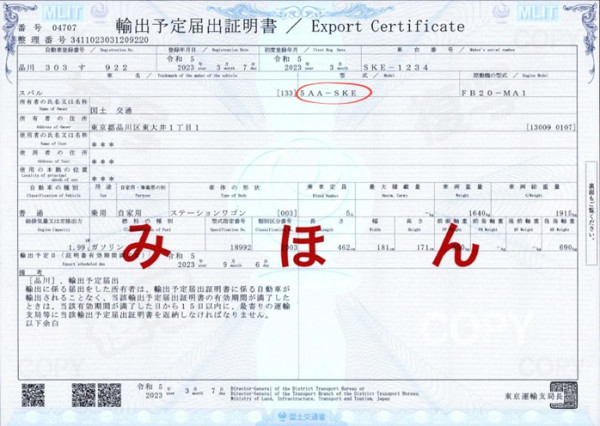
An original Japanese de-registration, export or completion inspection certificate with a 3 digit emissions code as listed in the appropriate table below, relevant to its import status, class, fuel type and date. The emissions code is the prefix (ie before the hypen) at the beginning of the Industry Model code, see the circled area on Figure 28-1-1
If the industry model code recorded on the de-registration, export or completion inspection certificate does not include an emissions prefix or the code is not listed in the appropriate table below, other evidence of compliance with an approved exhaust emissions standard, such as a statement of compliance or appropriate compliance plates, must be provided.
- Table 28-1-1 Used vehicles – Class MA, MB, MC, MD1, MD2, and NA (except used-import disability vehicles)
- Table 28-1-2 New vehicles – Class MA, MB, MC, MD1, MD2, and NA
- Table 28-1-3 Used vehicles – Class MD3, MD4, ME, NB, and NC
- Table 28-1-4 New vehicles – Class MD3, MD4, ME, NB, and NC
- Table 28-1-5 Used-import disability vehicles – Class MA, MB, MC, MD1, MD2, and NA
- Table 28-1-6 New and used vehicles – Class LA, LB, LC, LD, and LE
Recording the information
This emissions code information must be recorded on the vehicle checksheet and the industry model code and test regime must be recorded in LANDATA.
Enter the full industry model code from the de-registration, export or completion inspection certificate, including the emissions code characters, into the ‘industry model code’ field.
For vehicles requiring a Fuel Consumption Statement the emissions test regime is entered by the Fuelsaver system.
For vehicles not requiring a Fuel Consumption Statement (such as heavy vehicles and motorcycles, from 30 April 2025) enter the emissions test regime code into LANDATA in the VCAAS screen. The test regime code to be recorded in LANDATA is determined by adding a ‘J’ to the beginning of the emissions code prefix (eg the emissions code prefix DBA is recorded as test regime code JDBA).
If the test regime code is not recognised by LANDATA (error 60803 Emission Standard (Test Regime) is not valid) email vehicleemissions@nzta.govt.nz including a copy of the export, completion or de-registration certificate.
Acceptable proof of exhaust emissions rule compliance for used vehicles imported from Singapore
Standards compliance for vehicles imported from Singapore can be demonstrated using the following documents:
a) a Singapore de-registration certificate, and
b) an outcome notification letter from an entry certifier head office advising that the Singapore LTA technical letter is acceptable documentation, and
either
c) if the vehicle is a used Japanese domestic vehicle , a Singapore Land Transport Authority (LTA) technical letter listing an acceptable Japanese emissions code as shown in the Japanese tables, or
d) a Singapore Land Transport Authority (LTA) technical letter listing an approved, more recent or higher emissions standard.
Vehicles that can be accepted based on date of registration
Some vehicles may be accepted as complying with emissions standards, and might meet a higher standard, based on their registration date.
| Fuel type | Date first registered in Singapore | Can be accepted as complying with |
|---|---|---|
| Diesel | On or after 1 October 2006 | Euro 4 – may meet a higher standard |
| On or after 1 April 2014 | Euro 5 – may meet a higher standard | |
| On or after 1 January 2018 | Euro 6 – may meet a higher standard | |
| Petrol | On or after 1 April 2014 | Euro 4 – may meet a higher standard |
| On or after 1 September 2017 | Euro 6 – may meet a higher standard |
Vehicles registered before these dates require further evidence of emissions compliance.
Note: As of 1 January 2017, the Singapore emissions exemptions document, a Waka Kotahi list of exemption-eligible vehicles, ceased to be valid. The above advice replaces the previous exemptions procedure.
Acceptable proof of exhaust emissions rule compliance for vehicles imported from Australia
Classes LA, LB, LC, LD, LE
Australian Design Rules (ADR) compliance does not include a vehicle emissions standard for class LA, LB, LC, LD and LE vehicles. If an L class vehicle is required to meet a vehicle emissions standard, a Statement of Compliance or alternative evidence of compliance will be required.
Classes MA, MB, MC, MD1, MD2, MD3, MD4, ME, NA, NB, NC, TC and TD recorded on the Register of Approved Vehicles
See Technical bulletin 48 Verification of compliance with Australian Design Rules (ADRs)
Classes MA, MB, MC, MD1, MD2 and NA with an ADR plate/label
Which version of ADR 79 that a vehicle complies with can be determined using the date on the ADR compliance plate as follows:
|
Date on ADR plate |
Petrol |
Diesel |
|---|---|---|
|
01/2007 – 06/2010 |
Not proven to be compliant |
ADR 79/01 (Euro 4) |
|
07/2010 –10/2016 |
ADR 79/02 (Euro 4) |
ADR 79/01 (Euro 4) |
| 11/2016 – 01/07/2028 | ADR 79/04 (Euro 5) | ADR 79/04 (Euro 5) |
- If there is no emissions standard on the plate, the compliance plate approval number must be recorded on the vehicle check sheet.
- Some vehicles may comply in advance of these dates. In these cases, it may be possible to confirm compliance via the vehicle manufacturer's official representative for vehicle compliance. The certifier must keep such correspondence in the vehicle certification file.
- Diesel vehicles complying with ADR 79/01 or ADR 79/02 must also comply with ADR 30/01. If a diesel vehicle has an ADR compliance plate and can be established as complying with the appropriate ADR 79/01 or ADR 79/02, it also complies with ADR 30/01.
Classes MD3, MD4, ME, NB and NC with an ADR plate/label
Which version of ADR 80 that a vehicle complies with can be determined using the date on the ADR compliance plate as follows:
|
Date on ADR plate |
Petrol |
Diesel |
|---|---|---|
|
03/2008 – 12/2010 |
ADR 80/02 |
ADR 80/02 |
|
01/2011 – 11/2025 |
ADR 80/03 |
ADR 80/03 |
- If there is no emissions standard on the plate, the compliance plate approval number must be recorded on the vehicle check sheet.
- Some new model vehicles may comply in advance of these dates. In these cases, it may be possible to confirm compliance via the vehicle manufacturer's official representative for vehicle compliance. The certifier must keep such correspondence in the vehicle certification file.
- Diesel vehicles complying with ADR80/02 must also comply with ADR 30/01. If a diesel vehicle has an ADR compliance plate and can be established as complying with ADR 80/02, it also complies with ADR 30/01.
Which standards are the most recent?
More recent versions of an approved ADR79/xx or ADR80/xx standard will have a higher suffix. For example, ADR79/05 is a more recent version of ADR79/04.
Acceptable proof of exhaust emissions rule compliance for vehicles from the United Kingdom
Any light vehicle (except a motorcycle or moped) ex-UK that is presented for entry certification, that has a valid Certificate of permanent export, V5C, V308 or VX302 registration certificate (see Reference material 59, 67 and 68) showing that it was first registered as new in the UK:
- on or after 1 October 2007 may be accepted as complying with the Euro 4 emissions standard and might meet a higher standard
- on or after 1 January 2011 will be certified to the Euro 5 emission requirements and might meet a higher standard
- on or after 1 January 2015 will be certified to the Euro 6d TEMP or lower emission requirements and might meet a higher standard. Registration date cannot be used as evidence of compliance with Euro 6d or higher.
If an acceptable emission code (such as Euro 5) for the vehicle is listed on a valid Certificate of permanent export, V5C, V308 or VX302 registration document of a vehicle first registered as new in the UK, it may be accepted as proof of emissions compliance. If listed on the document use Table 28-1-7 to determine the Step or Level (for example, “EURO 6 AP” is Euro 6d).
If an acceptable emission code (such as Euro 5) for the vehicle is listed on https://carfueldata.vehicle-certification-agency.gov.uk/ for a vehicle first registered as new in the UK, it may be accepted as proof of emissions compliance.
Acceptable proof of exhaust emissions rule compliance for vehicles from Europe
a) A statement of compliance listing an approved emissions standard, or an appropriate EC directive or UN/ECE regulation as shown in Table 28-1-7, or
b) A UN/ECE compliance plate listing an approved emissions standard or one of the UN/ECE regulations shown in Table 28-1-8, or
c) An EC Certificate of Conformity (CoC) issued by the vehicle manufacturer for individual vehicles that have undergone European Commission Whole Vehicle Type Approval (EC WVTA). The CoC is linked to the EC Whole Vehicle Approval Plate – if a vehicle has a CoC, it will also have a Whole Vehicle Approval Plate. A sample CoC is shown in Reference material 49. The emissions standard information is recorded in item 46.1 or 48 of the CoC, or
d) An EC whole vehicle approval plate showing an appropriate regulation/directive. Refer to Reference material 29
e) An EC Certificate of Conformity showing an EC Whole Vehicle Approval number of 2001/116 or later, and with all emissions values (quoted in section 48) falling below the limit values set out in Table 28-1-9, may be accepted as complying with the Euro 4 emissions standard, or
f) An Irish Certificate of registration (see Reference material 83) showing it was first registered as new on or after 1 February 2008 may be accepted as complying with the Euro 4 emissions standard and might meet a higher standard.
Decoding EC Directive and UN/ECE Regulation emissions system approval numbers
Refer to Table 28-1-10
Acceptable proof of exhaust emissions compliance for used vehicles imported from the United States
|
If a vehicle has: |
Then either of the following is acceptable proof of exhaust emissions compliance: |
|---|---|
|
|
Check sheet recording
If the vehicle has an emissions standard identified on the EPA plate/label then the standard must be recorded on the vehicle checksheet; otherwise record 'EPA VECI' and the model year on the plate/label.
Table 1
Notes
- US 2007 cannot be confirmed by the model year on the EPA label.
- EPA vehicle classes do not match FMVSS or NZ vehicle classes.
|
Class |
Conditions |
Conditions |
Conditions |
Model year on EPA VECI label |
Standard |
|---|---|---|---|---|---|
|
LA and LC |
280cc or more |
2010 or later |
US 2010m |
||
|
279cc or less |
2006 or later |
US 2010m |
|||
|
LB, LD and LE |
280cc or more |
Curb mass 682kg or less |
2010 or later |
US 2010m |
|
|
279cc or less |
2006 or later |
US 2010m |
|||
|
MA, MB, MC MD1, MD2 and NA |
2017 or later |
US TIER3 |
|||
|
2004 or later |
US TIER2 |
||||
|
2004 or later |
US 2004 |
||||
|
MD3 |
12 or less seats |
GVM 3856kg or less |
2017 or later |
US TIER3 |
|
|
2004 or later |
US TIER2 |
||||
|
2004 or later |
US 2004 |
||||
|
12 or less seats |
GVM 3857kg or more |
2017 or later |
US TIER3 |
||
|
2004 or later |
US TIER2 |
||||
|
2004 or later |
US 2004 |
||||
|
13 or more seats |
GVM 3856kg or less |
2017 or later |
US TIER3 |
||
|
2004 or later |
US TIER2 |
||||
|
2004 or later |
US 2004 |
||||
|
13 or more seats |
GVM 3857kg or more |
2018 or later |
US TIER3 |
||
|
Diesel only |
2007 or later |
US TIER2 |
|||
|
2013 or later |
US 2013 |
||||
|
Diesel only |
2004 or later |
US 2004 |
|||
|
MD4 |
12 or less seats |
GVM 4536kg or less |
2017 or later |
US TIER3 |
|
|
2004 or later |
US TIER2 |
||||
|
2013 or later |
US 2013 |
||||
|
12 or less seats |
GVM 4537kg or more |
2018 or later |
US TIER3 |
||
|
Diesel only |
2007 or later |
US TIER2 |
|||
|
2013 or later |
US 2013 |
||||
|
13 or more seats |
GVM 4537kg or more |
2018 or later |
US TIER3 |
||
|
Diesel only |
2007 or later |
US TIER2 |
|||
|
2013 or later |
US 2013 |
||||
|
ME |
2018 or later |
US TIER3 |
|||
|
Diesel only |
2007 or later |
US TIER2 |
|||
|
2013 or later |
US 2013 |
||||
|
Diesel only |
2004 or later |
US 2004 |
|||
|
NB |
GVM 3856kg or less |
2017 or later |
US TIER3 |
||
|
2004 or later |
US TIER2 |
||||
|
2004 or later |
US 2004 |
||||
|
GVM 3857kg or more |
2018 or later |
US TIER3 |
|||
|
Diesel only |
2007 or later |
US TIER2 |
|||
|
2013 or later |
US2013 |
||||
|
Diesel only |
2004 or later |
US 2004 |
|||
|
NC |
2018 or later |
US TIER3 |
|||
|
Diesel only |
2007 or later |
US TIER2 |
|||
|
2013 or later |
US 2013 |
||||
|
Diesel only |
2004 or later |
US 2004 |
Emissions test regime codes to be keyed to LANDATA
See Pre-registration and VIN: 2-2 Vehicle attributes definitions, 26 Test regime
Table 28-1-1 Used vehicles – Class MA, MB, MC, MD1, MD2, NA (except used-import disability vehicles)
| Border inspection date | Fuel type | Japanese regulation | 3 digit emissions code beginning with |
|---|---|---|---|
| Before 30 April 2024 | Petrol, CNG/LPG | Japan 2005 | Any three digit emissions code |
| Diesel | Japan 2005 | Any three digit emissions code | |
| From 30 April 2024 to 1 July 2028 | Petrol, CNG/LPG | Japan 2005 Low Harm | D and first registered anywhere on or after 1 January 2012 |
| Higher Standard or more recent version to Japan 2005 Low Harm (ie Japan 09 and Japan 2007) | E, G, H, L, M, R or Q | ||
| Japan 2018 | 3, 4, 5, 6, or 7 | ||
| Diesel | Japan 09 | L, F, M, R, or Q | |
| Higher standard or more recent version to Japan 09 (ie Japan 2010 and 2018) | S, T, 3, 4, 5, 6, or 7 | ||
| From 1 July 2028 | Petrol, CNG/LPG | Japan 2018 Low Harm | 3 (CNG/LPG only) 4(CNG/LPG only) 5AA, 5BA, 5LA, 6AA, 6BA or, 6LA |
| Diesel | Japan 2018 | 3, 4, 5,6, or 7 |
Table 28-1-2 New vehicles – Class MA, MB, MC, MD1, MD2, NA
| Date of manufacture | Fuel type | Existing or new model vehicles | Japanese regulation | 3 digit emissions code beginning with |
|---|---|---|---|---|
| Before 30 April 2024 | Petrol, CNG/LPG | Existing or new | Japan 05 | Any three digit emissions code |
| Diesel | ||||
| From 30 April 2024 to 30 June 2027 | Petrol, CNG/LPG | Existing or new | Japan 2005 Low Harm | D and first registered anywhere on or after 1 January 2012. |
| Higher Standard or more recent version to Japan 2005 Low Harm (ie Japan 09 and Japan 2007) | E, G, H, L, F, M, R or Q | |||
| Japan 2018 | 3, 4, 5, 6, or 7 | |||
| Diesel | Japan 09 | L, F, M, R, or Q | ||
| Higher standard or more recent version to Japan 09 (ie Japan 2010 and Japan 2018) | S, T, 3, 4, 5, 6, or 7 | |||
| From 1 July 2027 to 30 June 2028 | Petrol, CNG/LPG | Existing | Japan 2005 Low Harm | D and first registered anywhere on or after 1 January 2012. |
| Higher standard or later version to Japan 2005 Low Harm (ie Japan 2009 and Japan 2007) | E, G, H, L, M, R, or Q | |||
| Japan 2018 | 3, 4, 5, 6, or 7 | |||
| New | Japan 2018 Low Harm | 6AA, 6BA, 6LA, 5AA, 5BA or 5LA, or is an LPG vehicle or CNG vehicle that complies with Japan 2018) | ||
| Diesel | Existing | Japan 09 | L, F, M, R, or Q | |
| Higher standard or more recent version to Japan 09 (ie Japan 2010 and 2018) | S, T, 3, 4, 5, 6, or 7 | |||
| New | Japan 2018 | 3, 4, 5, 6, or 7 | ||
| From 1 July 2028 | Petrol, CNG/LPG | Existing or new | Japan 2018 Low Harm | 6AA, 6BA, 6LA, 5AA, 5BA or 5LA, or is an LPG vehicle or CNG vehicle that complies with Japan 2018 |
| Diesel | Japan 2018 | 3, 4, 5, 6, or 7 |
Table 28-1-3 Used vehicles – Class MD3, MD4, ME, NB, and NC
| Border inspection date | Japanese regulation | 3 digit emissions code beginning with |
|---|---|---|
| Before 30 April 2024 | Japan 05 | Any 3 digit emissions code |
| From 30 April 2024 to 31 October 2025 | Japan 09 | L, F, M, R, or Q |
| Higher standard or later version to Japan 09 (ie Japan 2010, 2016 and 2018) | S, T, 2, 3, 4, 5, 6, or 7 | |
| From 1 November 2025 | Japan 2016 | 2 |
| Higher standard or later version (ie Japan 2018) | 3, 4, 5, 6, or 7 |
Table 28-1-4 New vehicles – Class MD3, MD4, ME, NB, and NC
| Date of manufacture | Existing or new model vehicles | Japanese regulation | 3 digit emissions code beginning with |
|---|---|---|---|
| Before 30 April 2024 | Existing or new | Japan 05 | Any 3 digit emissions code |
| From 30 April 2024 to 31 October 2024 | Existing or new | Japan 09 | L, F, M, R, or Q |
| Higher standard or later version to Japan 09 (ie Japan 2010, 2016 and 2018) | S, T, 2, 3, 4, 5, 6 or 7 | ||
| From 1 November 2024 to 31 October 2025 | Existing | Japan 09 | L, F, M, R, or Q |
| Higher standard or later version to Japan 09 (ie Japan 2010, 2016 and 2018) | S, T, 2, 3, 4, 5, 6 or 7 | ||
| New | Japan 2016 | 2 | |
| Higher standard or later version to Japan 2016 (ie Japan 2018) | 3, 4, 5, 6 or 7 | ||
| From 1 November 2025 | Existing or new | Japan 2016 | 2 |
| Higher standard or later version to Japan 2016 (ie Japan 2018) | 3, 4, 5, 6 or 7 |
Table 28-1-5 Used-import disability vehicles – Class MA, MB, MC, MD1, MD2, and NA
| Border inspection date | Fuel type | Japanese regulation | 3 digit emissions code beginning with |
|---|---|---|---|
| Before 1 January 2031 | Petrol, CNG/LPG | Japan 2005 | Any 3 digit emissions code |
| Diesel | |||
| From 1 January 2031 | Petrol, CNG/LPG | Japan 2018 | 3, 4, 5, 6, or 7 |
| Diesel |
Table 28-1-6 New and used vehicles – Class LA, LB, LC, LD, and LE
|
Date of border inspection (used vehicles) or |
Japanese regulation |
3 digit emissions code beginning with |
|---|---|---|
|
From 30 April 2025 to 31 December 2026 |
Japan 2012m |
New JBK, JBH, EBL or EBJ |
|
Used JBK, JBH, EBL or EBJ and was first registered anywhere on or after 1 January 2012 |
||
|
Higher standard or later version to Japan 2012m (ie Japan 2016 and 2020) |
2BK, 2BL, 2BH, 2BJ or 8 |
|
|
From 1 January 2027 |
Japan 2016m |
2BK, 2BL, 2BH, 2BJ or 8 |
|
Higher standard or later version (ie Japan 2020) |
8 |
Table 28-1-7. Translating EU Directives and Regulations
Refer to Reference material 80 for old EC directives.
|
Vehicle class |
EU Base Emissions regulation |
Followed by the EU Implementing or amending emissions directive or regulation |
Followed by 1 or 2 characters identifying the level or step (Note 2) |
Emissions Rule Standard |
|---|---|---|---|---|
|
Light vehicles except motorcycles and mopeds (Note 1) |
70/220 |
98/69 2001/100 |
No character or an A - providing documentation is supplied that contains a set of certified emissions values that fall below the limits set out in Table 28-1-8 (as applicable to petrol or diesel models). |
Euro 4 |
|
B |
Euro 4 |
|||
|
715/2007 |
692/2008 |
A, B, C, D or E |
Euro 5a |
|
|
F, G, H, I, J, K, L, or M |
Euro 5b |
|||
|
N, O or P |
Euro 6a |
|||
|
Q, R, S, T, U, V, W, X, or Y |
Euro 6b |
|||
|
BA, BB or BC |
||||
|
AA, AB, AC, AD, AE, AF, ZA, ZB, ZC, ZD, ZE, or ZF |
Euro 6c |
|||
|
AG, AH, AI, BG, BH, BI, CG, CH, CI, DG, ZG, ZH or ZI |
Euro 6d TEMP |
|||
|
ZJ, ZK, or ZL (Note 4) |
Euro 6d TEMP |
|||
|
AJ, AK, AL, AM, AN, AO, AP, AQ or AR |
Euro 6d |
|||
|
EA, EB, or EC |
Euro 6e |
|||
|
Heavy Vehicles (Note 1) |
88/77 or 2005/55 |
1999/96 |
B1, B or C |
Euro IV |
|
B2, C (EEV) (Note 5) D, E, F, G, H, I, J or K |
Euro V |
|||
|
595/2009 |
582/2011 64/2012 519/2013 136/2014 133/2014 627/2014 2016/1718 2017/1347 2017/2400 2018/932 2019/1939 2020/1181 2022/2383 |
A |
Euro VI A |
|
|
B |
Euro VI B |
|||
|
C |
Euro VI C |
|||
|
D |
Euro VI D |
|||
|
E |
Euro VI E |
|||
|
Motorcycles and mopeds
|
134/2014
|
901/2014 2016/1824 2018/295 2019/129 2023/2724
|
A1 |
Euro 4m |
|
A2 |
Euro 5m |
|||
|
A3 |
Euro 5+ |
Note 1
Some light vehicles may come with heavy compliance codes due to the differences between New Zealand and European classifications.
Note 2
Euro 5 and Euro 6 light vehicle codes that do not have an associated letter may be assumed to be Euro 5 and recorded as such.
Note 3
Any reference to 2006/96 must include the letter B and if it is referenced alongside 96/69 is not acceptable as evidence of emissions compliance.
Note 4
Some European documents may describe ZJ, ZK and ZL as Euro 6d, however due to being tested to NEDC these do not meet the Euro 6d definition in the Rule.
Table 28-1-8. Translating UN/ECE regulations
|
UN/ECE Regulation |
Conditional on |
Emissions Rule Standard |
|---|---|---|
|
R8305 R8305A |
Providing documentation is supplied that contains a set of certified emissions values that fall below the limits set out in Table 28-1-9 (as applicable to petrol or diesel models) |
Euro 4 |
|
R8305B |
Euro 4 |
|
|
R8306 |
Euro 5 |
|
|
83R/07 |
UNR83/07 |
|
|
83R/08 |
UNR83/08 |
|
|
49R/06/04 |
UNR49/06(supp.4) |
|
| UN/ECE regulations with a series of amendments and/or implementing stages higher than listed above for the UN/ECE regulation can be accepted due to being a more recent and higher standard. | ||
Table 28-1-9. Euro 4 light vehicle emissions limits
|
Light vehicles with a GVM of 2500kg or less |
Light vehicles with a GVM greater than 2500kg |
|||
|
1. Petrol (g/km) |
2. Diesel (g/km) |
3. Petrol (g/km) |
4. Diesel (g/km) |
|
|
5. CO |
6. 1.0 |
7. 0.5 |
2.27 |
0.74 |
|
8. HC |
9. 0.1 |
10. n/a |
0.16 |
n/a |
|
11. NOx |
12. 0.08 |
13. 0.25 |
0.11 |
0.39 |
|
14. HC+NOx |
15. n/a |
16. 0.3 |
n/a |
0.46 |
|
17. PM |
18. n/a |
19. 0.025 |
n/a |
0.06 |
Note: For the avoidance of doubt, if emissions values are being used to determine compliance, these are to be the official certification values from the applicable test cycle or cycles (ie not derived from an in-service emissions test). Emissions values for all gases/particulates must be below the limit values set out in the table.
NZTA is unlikely to approve an exemption application requesting acceptance of a vehicle with 96/69/EC as the emissions test method.
Table 28-1-10. EU and UN/ECE emissions system type approval certificate numbering and marking
For queries about EU emissions system approval numbers contact VehicleEmissions@nzta.govt.nz
EU emissions system type approval certificate numbering |
|||||||
|
EU Emissions system type approval number |
Section Each section is separated by an asterisk |
Decodes to |
|||||
|---|---|---|---|---|---|---|---|
|
e2*715/2007*2018/1832DG*00003*00 |
e2 |
Lower case “e” indicating the European Union followed by the number of the country issuing the approval. In this case 2 for France |
|||||
|
715/2007 |
The number of the base emissions directive or regulation. In this case Euro 5 & 6 |
||||||
|
2018/1832DG |
The number of the latest amendment to the base directive or regulation, followed by (where applicable) technical prescriptions. In this case DG indicates Euro 6dTEMP. Reference this number against Table 28-1-7 to determine the emissions level. |
||||||
|
00003 |
5-digit sequential number (with leading zeros if applicable), identifying the individual type approval |
||||||
|
00 |
2-digit sequential number (with leading zeros if applicable) denoting the number of an extension to the original type approval. 00= original approval, 01 = 1st extension, etc. |
||||||
UN/ECE emissions system type approval certificate numbering |
|||||||
|
UN/ECE Emissions system type approval number |
Section Each section is separated by an asterisk |
||||||
|
E11*83R03/00/J*2439*01 |
E11 |
Upper case “E” indicating the United Nations Economic Commission for Europe followed by the number of the country issuing the approval. In this case the UK. |
|||||
|
83R03/00/J |
The number of the UN Regulation, followed by the letter “R”, successively followed by:
|
||||||
|
2439 |
Four-digit sequential number (with leading zeros as applicable) |
||||||
|
01 |
Two digit sequential number (with leading zeros as applicable) to denote the extension. The sequence shall start from 00. |
||||||
UN/ECE emissions system type approval marking (affixed to a vehicle or engine) |
|||||||
|
Emissions system type approval marking |
Section |
||||||
|
E11 83R - 072439 - W |
E11 |
Upper case “E” indicating the United Nations Economic Commission for Europe followed by the number of the country issuing the approval. In this case the UK. |
|||||
|
83R |
The number of the UN Regulation, followed by the letter “R” followed by a “dash”. In this case Regulation 83 |
||||||
|
07 |
The series of amendments number. In this case the 07 series of amendments |
||||||
|
2439 |
Sequential Approval number |
||||||
|
W |
Letter according to class, engine type, OBD and emissions standard. |
||||||
|
format 2 E11 83RI – 052439 |
E11 |
Upper case “E” indicating the United Nations Economic Commission for Europe followed by the number of the country issuing the approval. In this case the UK. |
|||||
|
83RI |
The number 83 preceding the ‘R’ shows that the vehicle complies with UN/ECE regulation 83 for emissions. Roman numerals (I or II) after the ‘R’ may not be present but can, in combination with the first two digits of the following number, describe the emissions level (see below). |
||||||
|
05 |
The first two digits of the next section indicate the amendment of UN/ECE R83 that the vehicle complies with (for example, ‘04’ means the vehicle complies with UN/ECE Regulation 83.04) Special case for light vehicles: If this number is ‘05’ and the numeral immediately following the ‘R’ is ‘I’, the vehicle complies with Euro 3 limits. If the numeral immediately following the ‘R’ is ‘II’, the vehicle complies with Euro 4 limits. Special case for heavy vehicles: If this number is ‘03’ or ‘04’ and the numeral immediately following the ‘R’ is ‘I’, the vehicle complies with Euro 3 limits. If the numeral immediately following the ‘R’ is ‘II’ or ‘III’, the vehicle complies with Euro 4 limits. |
||||||
|
2439 |
|||||||
|
E11 49 RG - 052439 |
E11 |
Upper case “E” indicating the United Nations Economic Commission for Europe followed by the number of the country issuing the approval. In this case the UK. |
|||||
|
49RG |
The number of the UN Regulation, followed by the letter “R”, followed by an additional character to distinguish the emission limits, OBD etc”. In this case Regulation 49 and G for emissions row B1, OBD stage 2, with NOx control. Followed by a “dash”. |
||||||
|
05 |
The first two digits of the next section indicate the series of amendment of UN/ECE R49 that the vehicle complies with (for example, ‘05’ means the vehicle complies with UN/ECE Regulation 49.05) |
||||||
|
2439 |
The last 4 digits make up the model-specific approval number. For natural gas fuelled and dual fuel engines you may see additional characters to distinguish the range of gasses for which the approval has been issued Characters for:
For example:
|
||||||
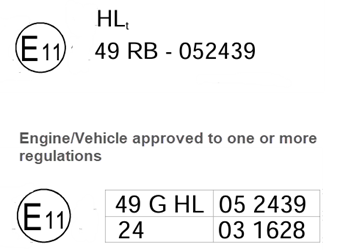
Figure 28-1-1 Japanese export certificate
Page amended 14 October 2026 (see amendment details)