Introduction
1 Purpose and scope
The NZ Transport Agency Waka Kotahi (NZTA) has prepared this manual to assist vehicle inspectors and inspecting organisations achieve correct and consistent standards of in-service vehicle inspection and certification (WoF and CoF).
The purpose of this manual is to enhance the safety of in-service vehicles in New Zealand by conveying to vehicle inspectors and inspecting organisations the conditions of their appointment and the requirements for the inspection and certification of vehicles for operation in service.
The scope of this manual is to set out the statutory requirements for all in-service vehicle inspections. No attempt has been made to give details on how to inspect a vehicle, a matter best addressed by training programmes.
Amendments to this manual will be issued from time to time as inspection requirements change and improvements are made. Details of amendments are available from the Amendments tab on the horizontal menu. Suggestions for improvement should be made using the feedback button found on every page.
2 Overview of the manual
How is the manual structured?
The manual is divided into ten vehicle-type sections plus technical bulletins and this introduction.
What information is in each part of the manual?
1. Introduction
The introduction is relevant to all vehicles requiring in-service inspection and certification (WoF and CoF). It explains the duties and responsibilities of the inspecting organisation and vehicle inspector, the inspection and certification process, complaints procedures, inspection premises and equipment, and the appointment of vehicle inspectors and inspecting organisations. It also includes definitions and abbreviations, and sample certification documents. Improvement suggestions can be made by clicking the 'Send us your feedback' button found on every page.
2. General vehicles (WoF)
This section contains the WoF inspection requirements for light vehicles of classes LE that do not have motorcycle controls, MA, MB, MC, MD1 and NA.
Many of these requirements are general requirements applicable to other types and classes of vehicles. They have been copied into other relevant sections as outlined below.
3. Heavy vehicles (CoF)
This section contains the CoF inspection requirements for heavy vehicles of classes NB and NC. They consist of general requirements applicable to all vehicles and additional or replacement requirements that apply specifically to heavy vehicles.
4. Light PSVs (CoF)
This section contains the CoF inspection requirements for light passenger service vehicles (PSVs) of classes LE that do not have motorcycle controls, MA, MB, MC, MD1 and MD2. They consist of general requirements applicable to all vehicles and additional or replacement requirements that apply specifically to light PSVs.
This section also contains the transport service licence (TSL) requirements for light vehicles of the above classes used in a rental service or vehicle recovery service.
5. Heavy PSVs (CoF)
This section contains the CoF inspection requirements for heavy passenger service vehicles (PSVs) of classes MD3, MD4 and ME, and any NB and NC class vehicles used as PSVs. They consist of general requirements applicable to all vehicles, requirements applicable to all heavy vehicles and additional or replacement requirements that apply specifically to heavy PSVs.
6. Motorcycles (WoF and CoF)
This section covers the WoF and CoF inspection requirements for vehicles of classes LC, LD and LE that have motorcycle controls. For CoF, this section also contains additional requirements for these vehicles used in a passenger service or rental service.
7 General trailers (WoF)
This section covers the WoF inspection requirements for light trailers of classes TA and TB. They consist of general requirements applicable to all trailers.
8. Heavy trailers (CoF)
This section covers the CoF inspection requirements for heavy trailers of classes TC and TD. They consist of general requirements applicable to all trailers and additional or replacement requirements that apply specifically to heavy trailers.
9. Forklifts (WoF)
This section contains the WoF inspection requirements for light and heavy forklifts which must meet WoF requirements as far as practicable for their design and type.
10. Tractors (WoF)
This section contains the WoF inspection requirements for light and heavy tractors and self-propelled machines used in agricultural, land management and roading operations.
11. Unclassified vehicles (WoF)
This section contains the WoF inspection requirements for light and heavy unclassified vehicles which must meet WoF requirements as far as practicable for their design and type. It includes heavy vehicles exempt from CoF, all-terrain vehicles (ATVs) and some trailers. It does not include vehicles already covered in the Forklifts and Tractors sections.
12. Technical bulletins (general)
These contain detailed requirements or helpful information which is not appropriate to put into the vehicle sections of the manual. Examples are processes/requirements for seatbelt replacements and jacking points for correctly checking suspension ball joints. These bulletins cover WoF vehicles and vehicles in general.
13. Technical bulletins (CoF)
These bulletins are similar to the Technical bulletins (general), but cover information specific to vehicles operated on a CoF.
'WoF only’ inspecting organisations
An inspecting organisation appointed to carry out WoF inspections only will only need to view the general vehicle pages, motorcycle pages, general trailer pages, forklift pages, tractor pages, unclassified vehicle pages and technical bulletin (general) pages.
'CoF only' inspecting organisations
An inspecting organisation appointed to carry out CoF inspections only will need to view the pages for motorcycles, heavy vehicles, light PSVs, heavy PSVs, heavy trailers, technical bulletins (general) and technical bulletins (CoF).
Note that some pages will refer to general vehicles or general trailers pages where appropriate.
‘WoF and CoF’ inspecting organisations
An inspecting organisation appointed to carry out WoF and CoF inspections will need to view all the WoF and CoF pages. These are the same pages as for 'WoF only', but with additional pages for heavy vehicles, light PSVs, heavy PSVs, heavy trailers and technical bulletins (CoF).
How to use the manual
WoF inspections
- For a WoF inspection on a car, for example, refer only to the general vehicle pages.
CoF inspections
Many CoF requirements are the same as the WoF requirements and have been copied into the relevant CoF sections. Where requirements differ:
- For a light PSV, refer to the light PSV pages and link to the general vehicle pages if so indicated on the light PSV page
- For a heavy truck, refer to the heavy vehicle pages and link to the general vehicle pages if so indicated on the heavy vehicle page
- For a heavy PSV, refer to the heavy PSV pages and link to the heavy vehicle pages and/or the general vehicle pages if so indicated on the heavy PSV page.
Layout of manual pages
For each vehicle component, the inspection requirement pages are generally divided into two tabs, one for reasons for rejection, the other for summary of legislation. These tabs list the requirements under ‘mandatory equipment’, ‘permitted equipment’, ‘condition’, ‘performance’ and ‘modifications’ (and ‘repairs’ for heavy vehicles on a CoF).
The Reasons for rejection column specifies the vehicle defects that must result in the vehicle being rejected for a WoF or CoF. The condition and performance reasons for rejection apply to mandatory, permitted, and modified equipment, unless otherwise stated. NZTA has imposed these requirements in accordance with Land Transport Rule: Vehicle Standards Compliance 2002, section 2.3(1). This column also contains notes for additional guidance, as referred to in the two columns.
The Summary of legislation column summarises the legislation that is relevant to in-service inspection and certification.
Many vehicle components have an additional one or two tabs:
- Tables and images contain tables and illustrations referred to in the Reasons for rejection and Summary of legislation tabs.
- Technical information contains additional relevant information that is not part of the manual, but which may be useful information, such as NZTA pamphlets.
Page amended 1 November 2014 (see amendment details).
3 Inspection and certification process
-
Overview – steps in the inspection and certification process
-
3-1 Duties and responsibilities
-
3-2 Identifying the vehicle class
-
3-3 Establishing whether the vehicle requires a WoF or CoF
-
3-4 Establishing whether the vehicle may be inspected for a WoF or CoF
-
3-5 Establishing whether the vehicle complies
-
3-6 Check sheets
-
3-7 Recording the inspection outcome (‘determination’)
-
3-8 Issuing the WoF or CoF label - ‘evidence of vehicle inspection’ - or temporary permit
-
3-9 Collecting fees
-
3-10 Operating a vehicle without a current WoF or CoF
-
3-11 Rechecks
Overview – steps in the inspection and certification process
In order to inspect and certify a vehicle for a WoF or CoF the vehicle inspector and inspecting organisation must take the following steps:
1. Know the vehicle inspector’s and inspecting organisation’s responsibilities.
The legal responsibilities are listed in section 3.1. The vehicle inspector and inspecting organisation must read these and understand them.
2. Identify the vehicle class.
A table of vehicle classes is given in section section 3.2.
3. Identify whether the vehicle requires a WoF or CoF inspection.
Section 3.3 shows a list of vehicles that require a WoF, a list of vehicles that require a CoF and a list of vehicles that do not require a WoF or CoF.
4. Establish whether the vehicle may be inspected for the purposes of issuing a WoF or a CoF.
The vehicle must meet a number of criteria before inspection. These are listed in section 3.4.
5. Establish whether the vehicle complies.
Section 3.5 explains how to use this manual in order to determine the vehicle’s compliance with the requirements.
6. Complete the inspection documentation (checksheet).
Section 3.6 explains the requirements for handling and completing checksheets.
7. Record the inspection outcome (‘determination’).
Section 3.7 explains how to record WoF and CoF inspection results into the NZTA computer system (Vehicle Inspection and Certification (VIC) and LATIS).
8. Issue the WoF label, CoF label, or temporary permit.
Section 3.8 explains the requirements when issuing the WoF label, CoF label, or temporary permit and attaching it to the vehicle.
9. Collect fees.
Section 3.9 lists the requirements for the inspecting organisation when charging and collecting fees.
3.10 Operating a vehicle without a current WoF or CoF.
Section 3.10 explains the vehicle operator’s responsibilities when operating a vehicle without a current WoF or CoF.
Page updated 1 November 2024 (see details)
3-1 Duties and responsibilities
3.1.1 General duties and responsibilities
Applicable legislation: Vehicle Standards Compliance Rule 2002 (the Rule).
1. Vehicle inspectors and inspecting organisations [Definitions in the Rule]
Vehicle inspector means an individual appointed by NZTA under 2.2(1) of the Rule to carry out inspection and certification activities in accordance with requirements and conditions imposed by NZTA.
Inspecting organisation means a person or organisation appointed by NZTA under 2.2(1) who is responsible for inspection and certification outcomes.
2. Inspection and certification activities [section 2.1(1) of the Rule]
Only vehicle inspectors and inspecting organisations appointed by NZTA may carry out inspection and certification activities as specified in the Land Transport Rule: Vehicle Standards Compliance 2002.
3. Primary duty [section 2.1(2) of the Rule]
Vehicle inspectors and inspecting organisations must carry out inspection and certification activities competently and diligently and in accordance with the Land Transport Rule: Vehicle Standards Compliance 2002, this manual, the Notice of appointment and the Code of conduct.
4. Inspection and certification activities that can be carried out [section 2.2(2) of the Rule]
Vehicle inspectors and inspecting organisations may carry out only those inspection and certification activities for which NZTA has appointed them.
5. Requirements, conditions, and period of appointment [section 2.3(1) of the Rule]
NZTA may specify the period of appointment for a vehicle inspector and inspecting organisation and may impose requirements and conditions as to the performance of the inspection and certification activities, including the performance of those activities at individual sites.
6. Driver licence
Vehicle inspectors must hold a current driver licence for the vehicles that they are inspecting.
7. Fit and proper person [section 2.3(3) of the Rule]
It is a condition of an appointment that a vehicle inspector or inspecting organisation continues to be fit and proper.
For further information about what it means to be a fit and proper person, refer to the NZTA's Fit and proper person guidelines.
8. Presentation and acceptance of emailed Inspection and certification documents
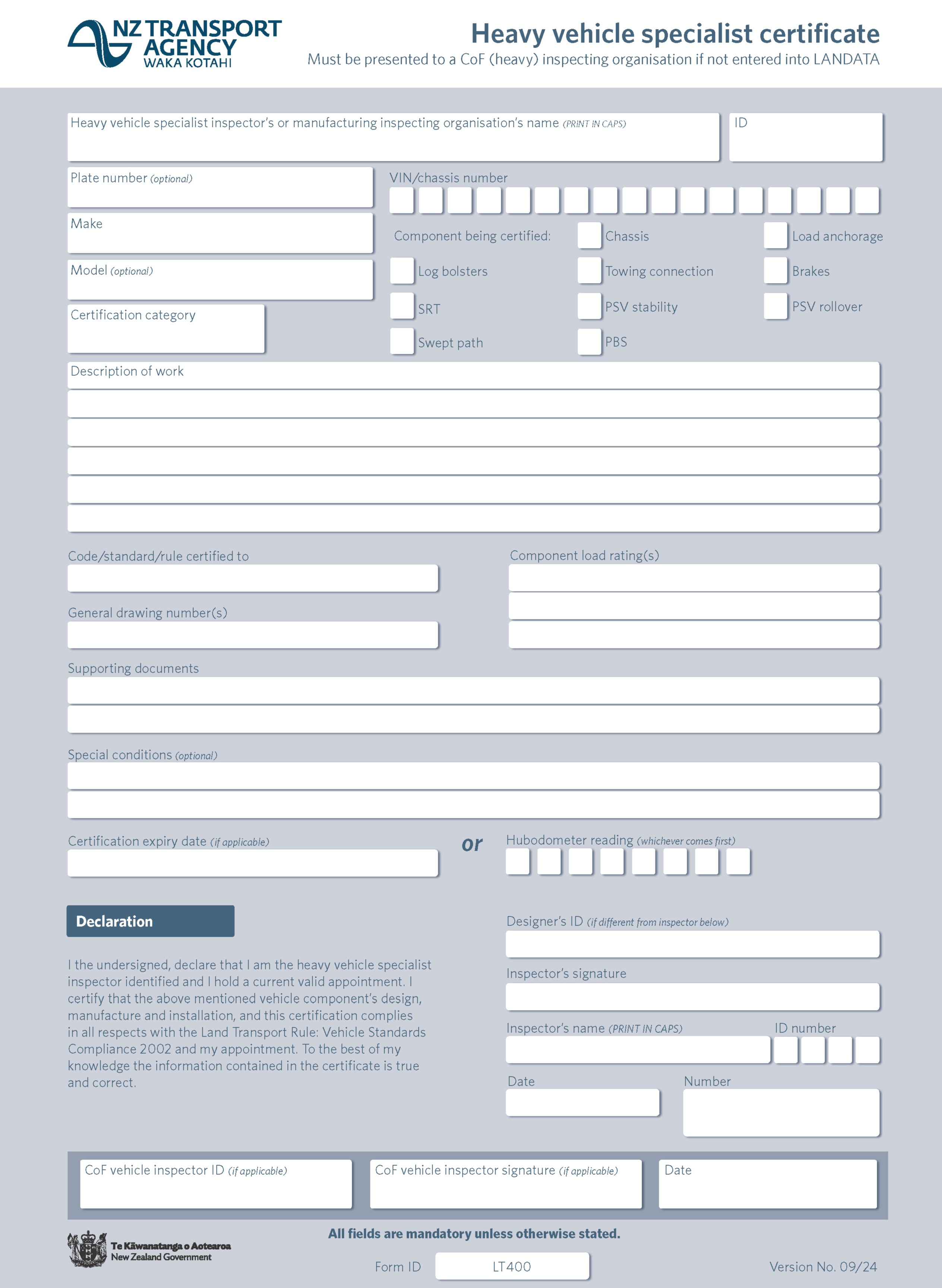
LT400s, chassis ratings and professional opinions from heavy vehicle specialist certifiers and chassis ratings from NZTA can be presented and accepted using email provided:
(i) emails are sent directly to the vehicle inspector or inspecting organisation from the heavy vehicle specialist certifier or NZTA, and
(ii) the electronic copy contains all of the information from the original copy and is clear and legible.
These may be:
|
9. Document retention, Advise incorrect certification, Advise vehicle defects [section 2.3(4) of the Rule]
It is a condition of an appointment that a vehicle inspector or inspecting organisation:
a) keeps all records and associated documents relating to vehicle inspections and certifications (including failed inspections) for a minimum period of 12 months (LT400s and other HVS/engineer certificates indefinitely), and
These may be:
|
b) advises NZTA as soon as practicable if there is a reason to believe that the inspection and certification of a vehicle has been carried out incorrectly, and
c) advises NZTA as soon as practicable of a defect in a manufacturer’s production run or quality control process of which the inspector or organisation has become aware that may affect the safety performance of a vehicle that has been inspected and certified.
10. Delegation [section 2.4(1) of the Rule]
A vehicle inspector or inspecting organisation may not delegate any function or power to carry out inspection and certification activities for which they were appointed, except under conditions specified by NZTA in writing.
11. Additional duties and responsibilities of inspecting organisations under the quality management system (QMS) and the Notice of appointment
In addition to requirements specified elsewhere in this manual, an inspecting organisation must comply with the requirements of their QMS and Notice of appointment, including the following:
a) advise NZTA as soon as possible when a vehicle inspector leaves or joins an inspecting organisation or moves to another site (Notification of vehicle inspector transfer)
b) manage actual, potential and perceived conflicts of interest (refer to Information for inspecting organisations)
c) report the loss or theft of controlled documents to the NZ Police and NZTA as soon as possible (Notification of lost or stolen controlled documents)
d) comply with any NZTA requirements relating to IT systems, including protecting access to the NZTA computer system from unauthorised persons
e) carry out regular internal performance assessments (at least once a year)
f) inspect and certify vehicles only at authorised sites unless otherwise permitted
g) responsible for maintaining technical and administrative competence of vehicle inspectors and other persons carrying out vehicle inspection and certification work
h) responsible for ensuring vehicle inspectors continue to abide by the Code of Conduct.
3.1.2 Inspection and certification
1. Inspection and certification of vehicles for operation in service [section 7.3(3) of the Rule]
The inspection and certification of a vehicle for operation in service must be carried out in accordance with requirements and conditions imposed by NZTA.
2. Determining compliance of a vehicle [section 7.4(1) of the Rule]
A vehicle is certified for in-service based on the condition of the vehicle at the time of the inspection.
A vehicle may be certified for operation in-service only if a vehicle inspector or inspecting organisation has identified the vehicle and has determined, on reasonable grounds, that the vehicle meets all of the following:
a) it is safe to be operated under normal conditions of use, and
b) it has been designed and constructed using components and materials that are fit for their purpose, and is within safe tolerance of its state when manufactured or modified, and
c) it complies with the applicable requirements (all of which are contained within this manual), and
d) it has undergone specialist inspection and certification as required by paragraphs 4, 5, and 6 below and the specific aspects of the vehicle have been certified.
3. Information to take into account when determining compliance of a vehicle [section 7.4(3) of the Rule]
A vehicle inspector or inspecting organisation, in making a determination, must take into account:
a) information obtained from inspecting the vehicle and associated documents, and
b) additional relevant information, if any, about the vehicle issued by a manufacturer, modifier, repairer, or other relevant person of which the inspector or organisation is aware.
4. Low volume vehicle specialist certification [section 7.5(1)(a) of the Rule]
Low volume vehicle (LVV) specialist inspection and certification is required prior to inspection and certification for in-service, if the vehicle is a light vehicle that, since it was last certified for operation in-service or last certified as a low volume vehicle, has been modified so as to affect its compliance with an applicable requirement (Note 1).
5. Heavy vehicle specialist certification [section 7.5(1)(b) of the Rule]
Heavy vehicle specialist (HVS) inspection and certification is required prior to inspection and certification for in service, if the vehicle is a heavy vehicle that, since it was last certified for operation in service or last certified for modification, has been modified so as to affect its compliance with an applicable requirement, including modifications to its chassis, brakes, log bolster attachments, towing connections or load anchorages.
6. Other specialist certification [section 7.5(1)(c) of the Rule]
Other specialist inspection and certification is required in accordance with an applicable requirement or as required by NZTA, all of which are contained within this manual.
7. Modified vehicles not requiring specialist certification [section 7.5(3) of the Rule]
Low volume vehicle (LVV) specialist inspection and certification or heavy vehicle specialist (HVS) inspection and certification is not required if a modified vehicle is:
a) excluded in this manual from the requirement for LVV or HVS certification and meets the inspection requirements in this manual, including those for equipment, condition, and performance, or
b) modified for the purposes of law enforcement or the provision of emergency services.
Note that this only covers the modifications for the specialised functions of the vehicle. Other modifications that affect compliance are subject to certification.
Note 1
Modifications not requiring LVV certification
All modifications must meet WoF or CoF requirements. However, not every modification requires LVV certification.
A modified light vehicle may or may not be required to undergo LVV certification, depending on the level of modification. Typical modifications that are made to vehicle components and systems are listed in tables, and identify:
a) those modifications that do not require LVV certification unless they exceed a certain level. Where modifications exceed those listed in the table, a WoF or CoF provider must not issue a WoF or CoF for the vehicle until LVV certification has been issued
b) those modifications that have been certified to an accepted overseas system as shown in Technical bulletin 13
c) those lower levels of modification that are never required to be LVV certified.
For most modifications, the introduction date for the requirement for LVV certification is 1 March 1999, which was the date that the Compliance Rule came into force. In addition, LVV certification was required for some items under the Transport (Vehicle Standards) Regulations 1990. In particular LVV certification is required for:
a) a modification after 1 January 1992 that affected compliance with a brake standard on a class MA vehicle, or after 1 January 1993 on a vehicle of class MB, MC or NA.
b) a modification after 1 January 1992 that affected a seatbelt anchorage standard on a passenger vehicle with up to nine seats, that is class MA, MB or MC.
c) a modification after 1 January 1992 that affected compliance with a standard for door locks and hinges, steering column impact or interior impact on a class MA vehicle.
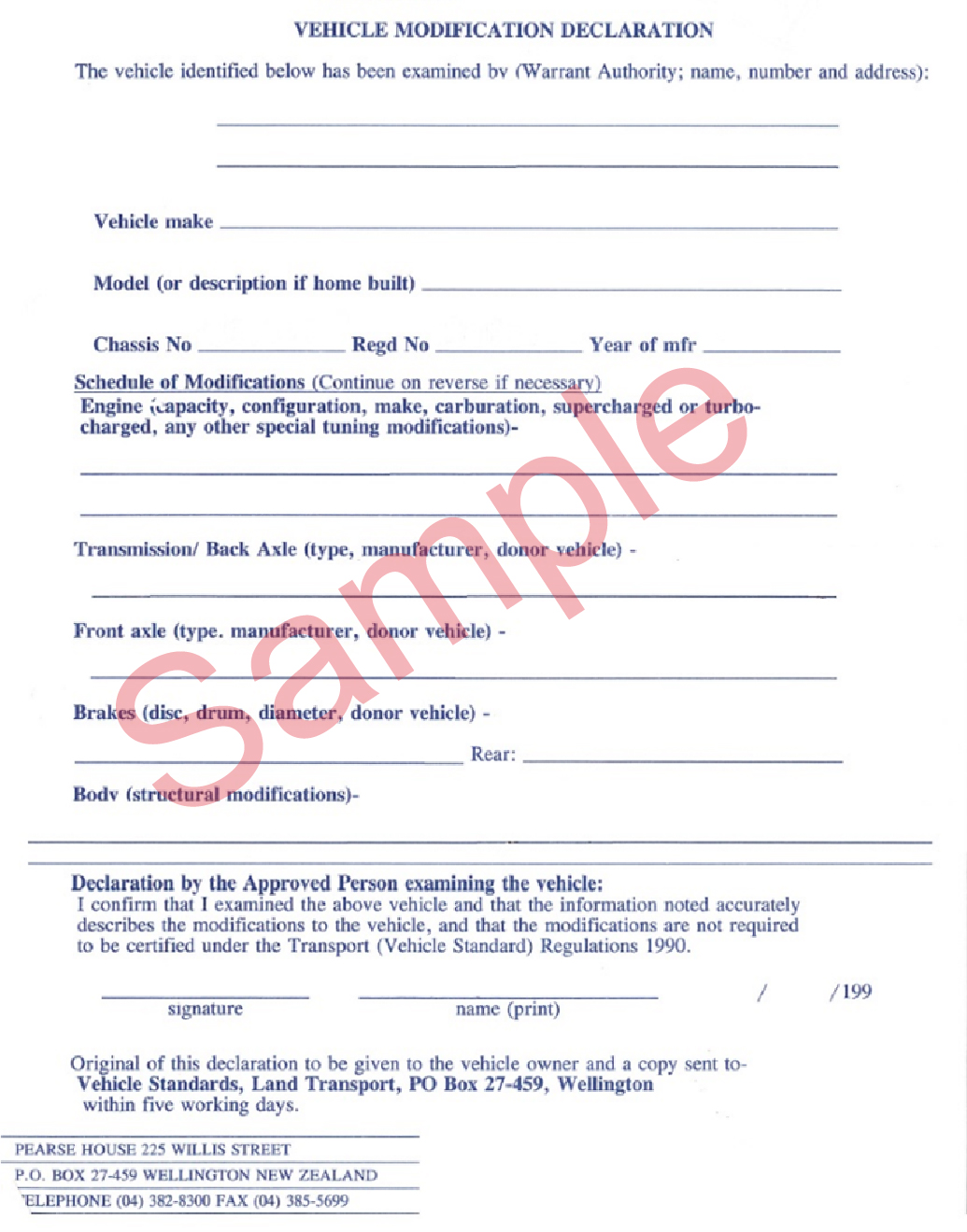
If a modification was carried out prior to LVV certification coming into force, a valid modification declaration must be produced. The vehicle inspector may also accept other authentic evidence to verify that the modifications were carried out prior to LVV certification coming into force. Examples are an invoice from the company that carried out the modification, insurance policy cover notes and motoring magazine features provided they record the vehicle’s registration number or VIN, the modification details and a date or other information verifying when the modifications were carried out. Documents such as statements from previous owners are not acceptable.
Where the information on the modification declaration (other than the plate number) differs from the vehicle, the vehicle must be failed and sent to an appropriate LVV certifier. For example, if the vehicle has been further modified or the declaration date is incorrect for the vehicle or the modifications. See sample modification declaration for information on modification declarations).
Note 2
Confirming LVV certification
Modifications can be confirmed as certified under the LVV Code by the following means:
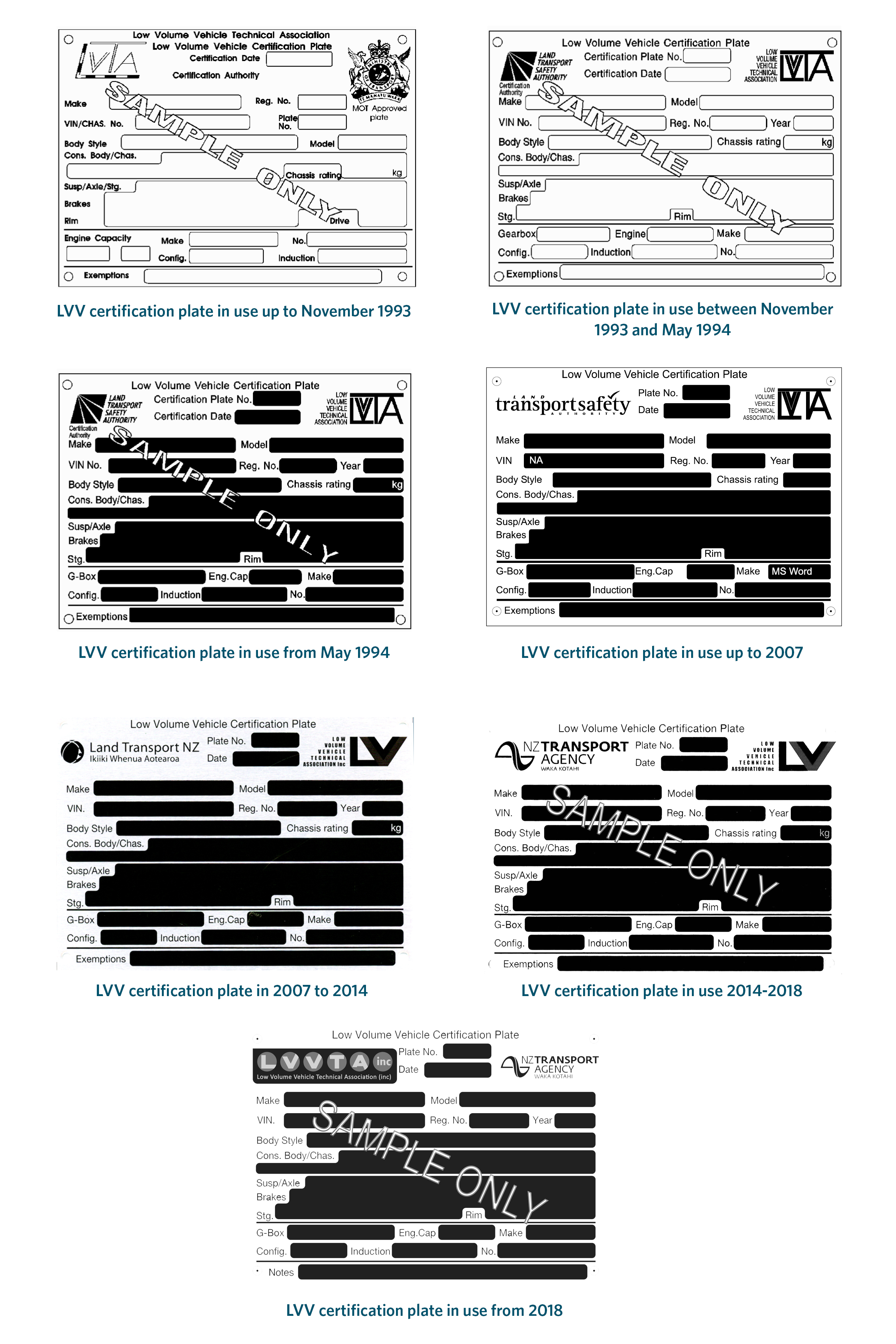
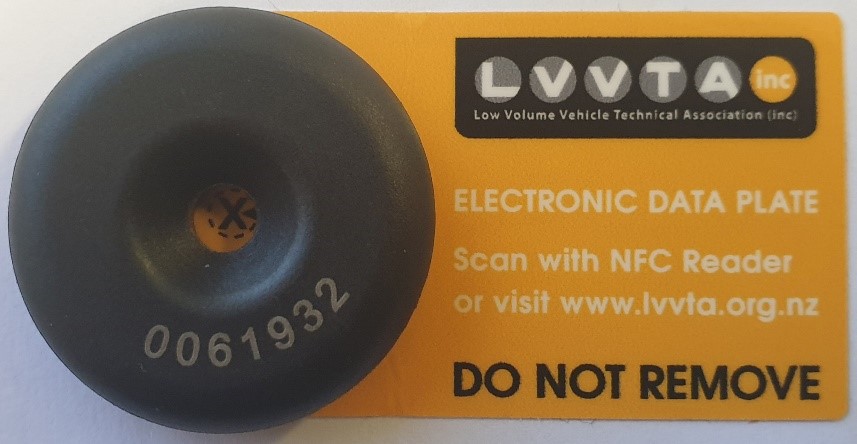
a) LVV certification plate (see Figure 8-1-1) or electronic data plate (see Figure 8-1-7) riveted and glued to the vehicle in any one of the following positions:
i. within the engine compartment in a clearly visible position, or
ii. where there is insufficient available space within the engine compartment to enable the LVV certification plate to be fitted and remain clearly visible, in any one of the following locations:
1. within the passenger compartment on the vehicle’s A-pillar or B-pillar, or
2. in the case of a sedan, on the rear bulkhead or other prominent position within the boot area, or
3. in the case of a van with an engine cover in the passenger compartment, on a non-removable panel steel part of the engine cover or seat frame, or
4. in the case of a vehicle with a raised floor, on the vertical area of a step behind a door, or
5.) in the case of a hatchback or station wagon, in the spare wheel well which is accessible without the use of tools.
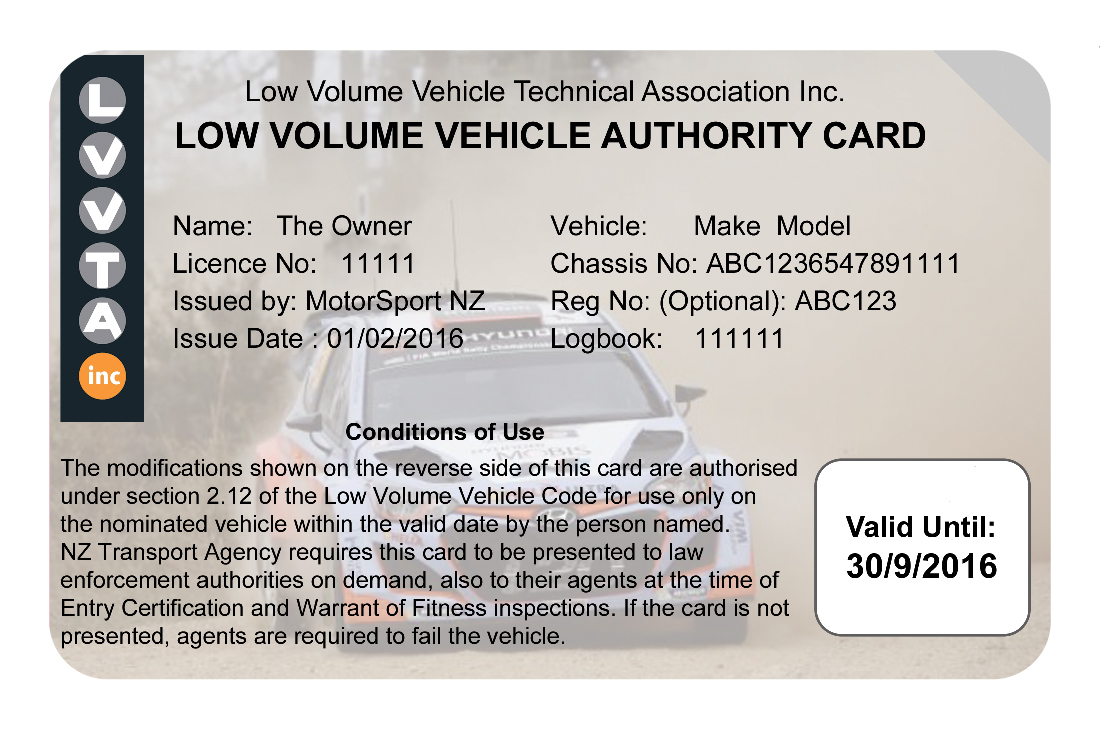
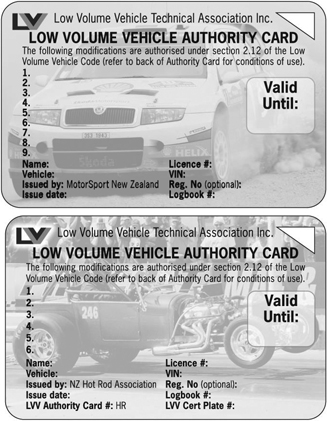
b) LVV authority card, linking listed vehicle modifications to the special requirements of one person.
Where a vehicle is presented with an LVV certification plate or electronic data plate affixed in an approved position, the vehicle inspector or inspecting organisation must confirm the modifications recorded on the plate match the modifications on the vehicle they are inspecting by the means described below.
How to confirm modifications for a vehicle with an LVV certification plate
1. Match the vehicle identifier and modifications engraved on the LVV certification plate with the vehicle identifier and modifications present on the vehicle they are inspecting.
AND
2. Look up the LVV certification plate on the LVVTA website (www.lvvta.org.nz) and confirm the plate is valid, and that the identifier and modifications presented on the look up result match the vehicle, certification plate, and modifications present on the vehicle.
How to confirm modifications for a vehicle with an LVV electronic data plate
- Scan the electronic data plate with an NFC reader and confirm that the identifier and modifications presented on the vehicle (including photos) match the vehicle, and modifications present on the vehicle.
OR
- Look up the LVV electronic data plate on the LVVTA website (www.lvvta.org.nz) and confirm that the identifier and modifications presented on the vehicle (including photos) match the vehicle, and modifications present on the vehicle.
Inspecting organisations and vehicle inspectors with LATIS access may also use the IVCERT screen in LANDATA to provide additional confirmation. See the LATIS manual for instructions on how to do this.
If the LVV certification plate or electronic data plate cannot be found on the LVVTA website look up or, in the case of electronic data plates, an NFC reader is unable to read it, the vehicle must be failed until information is obtained confirming the plate is valid, the modifications have been certified, and that the modifications match the vehicle.
All enquiries about the LVV process, LVV certifier locations and the issuing of LVV certification plates should be directed to NZTA (0800 587 287) or LVVTA (04 238 4343).
Note 3
Information on an LVV certification plate or electronic data plate differs from the vehicle
Where the information on the LVV plate (other than the vehicle’s registration plate or due to the temporary removal of seats) differs from the vehicle, for example where a vehicle has been further modified or returned to original, the vehicle must be failed and sent to an appropriate LVV certifier:
a) where the vehicle has been further modified or partially returned to the original condition, the LVV certifier will inspect and certify the vehicle to ensure the correct details are on the new LVV plate, or
b) where the vehicle has been fully returned to original, the LVV certifier will confirm that this has been done and remove the LVV plate from the vehicle (only an LVV certifier or delegated NZTA staff can remove an LVV plate).
3.1.3 Revocation of a WoF, CoF, temporary permit, CoL, or record of determination
1. Revocation of evidence of vehicle inspection and conditional permit [section 11.3(1) of the Rule]
NZTA may revoke, by giving written notice to a vehicle’s operator, a WoF, CoF, conditional permit or a record of determination issued under the Land Transport Rule: Vehicle Standards Compliance 2002 if NZTA believes, on reasonable grounds, that:
a) the vehicle does not comply with applicable requirements, or
b) the WoF, CoF, permit or record of determination was issued on the basis of an incorrect determination.
2. Revocation of certificate of loading [section 11.3(2) of the Rule]
The NZTA may revoke, by giving written notice to a vehicle’s operator, a certificate of loading issued for that vehicle under the Land Transport Rule: Vehicle Standards Compliance 2002 if NZTA believes, on reasonable grounds, that the certificate is not valid.
3. Re-inspection and re-certification of a vehicle [section 11.4 of the Rule]
If a WoF, CoF, conditional permit, record of determination or certificate of loading has been revoked, NZTA may require in writing that a vehicle inspector or inspecting organisation:
a) repeat the inspection and certification of the vehicle, and
b) issue, if appropriate, a WoF, CoF, permit, record of determination or other evidence, and
c) meet the costs of the activities undertaken under (a) and (b).
3.1.4 Vehicles ordered off the road (green and pink stickers) [Land Transport Act 1998: section 115 and section 96]
A green sticker, which directs that the vehicle is not to be driven on a road, may be issued to the driver or owner of a vehicle by an enforcement officer who believes on reasonable grounds that a vehicle does not comply with the provisions of the regulations or rules, or that a vehicle was operated with unnecessary exhibition of speed or acceleration or sustained loss of traction. At the discretion of the enforcement officer, the green sticker notice will remain in force until:
a) the vehicle has been inspected and a new WoF or CoF has been issued, or
b) the enforcement officer has been notified in writing that the vehicle is now compliant (this type of green sticker is often referred to as ‘discretionary green sticker’ or ‘G2 sticker’). A new WoF or CoF is not required, however, instead of notifying the enforcement officer in writing, the vehicle driver/owner may choose to obtain a new WoF or CoF, which will automatically remove the flag from the NZ Police system.
A pink sticker, which directs that the vehicle is not to be driven on a road, may be issued to the driver or owner of a vehicle by an enforcement officer who believes on reasonable grounds that a vehicle is not in a safe condition to be driven on a road. A pink sticker will remain in force until the vehicle has been inspected and a new WoF or CoF has been issued.
Where a light vehicle has been ordered off the road by an enforcement officer for non-compliant exhaust noise, the vehicle must pass an LVVTA objective noise test before the vehicle may be issued with a new WoF or CoF – even if the vehicle is presented with a quieter or original exhaust system or with a previous LVV noise certification. Due to this requirement, for each green- or pink-stickered light vehicle presented for WoF or CoF and before issuing a new WoF or CoF, the vehicle inspector must check (usually by sighting the ordering-off-the-road notice or Landata):
a) whether the vehicle was ordered off the road for non-compliant exhaust noise, and
b) if (a) applies, that a valid LVVTA objective exhaust noise emissions test certificate was issued for the vehicle after the date the ordering off the road notice was issued.
A vehicle that has been green or pink stickered can only be inspected by a vehicle inspector who is employed with an inspecting organisation that does not engage in the repair of vehicles in the course of their business (other than replacing bulbs or wiper blades). This generally includes VTNZ, VINZ, NZAA and some independent testing stations. A new WoF or CoF must be issued by the inspecting organisation before the vehicle is permitted to be used on the road. Once the new WoF or CoF has been issued, the vehicle inspector removes the green or pink sticker. The flag is automatically removed from the NZ Police system.
3.1.5 Performance review
1. The NZTA may monitor and review performance [section 3.1(1) of the Rule]
The NZTA may monitor and review the performance of a vehicle inspector or inspecting organisation in complying with the requirements and conditions imposed by NZTA, including the performance of inspection and certification activities at individual sites.
The requirements and conditions are contained in this manual, the Notice of appointment and the Transport Agency’s Quality Management System (QMS) requirements.
2. Providing information to NZTA [section 3.1(2) & (3) of the Rule]
In monitoring and reviewing performance, NZTA may require a vehicle inspector or inspecting organisation to undergo such monitoring and review and provide such information as NZTA reasonably considers relevant. A vehicle inspector or inspecting organisation must comply with a requirement from NZTA.
3. Costs of monitoring and review [section 3.1(4) of the Rule]
A vehicle inspector or inspecting organisation must bear the costs of the monitoring and reviewing of their performance in accordance with any prescribed fee.
Any non-payment of the required fees may result in suspension of the appointment until full payment is received.
3.1.6 Investigations
1. Investigations [section 3.2(1) of the Rule]
If NZTA has reason to believe that a vehicle inspector or inspecting organisation has failed to comply with any of the conditions of their appointment (including the Notice of appointment and Code of conduct), or has failed to comply with the Land Transport Rule: Vehicle Standards Compliance 2002 (the Rule) or with this manual, NZTA may require the inspector or organisation to undergo such an investigation and to provide such information as NZTA reasonably considers appropriate.
2. Notification of action (suspension or revocation, but not immediate suspension or imposition of conditions) [section 3.2(3) of the Rule]
Following an investigation and before carrying out action, NZTA must notify the vehicle inspector or inspecting organisation in writing of:
a) the action that is being considered, and
b) the reasons for the action that is being considered, and
c) the date by which submissions may be made to NZTA in respect of the action that is being considered, which must be at least 21 days after the notice is given, and
d) where appropriate, the date on which the action that is being considered will take effect, which, unless NZTA determines otherwise, must be at least 28 days after the notice is given.
3. Responding to a notification of action [section 3.2(5) of the Rule]
If a vehicle inspector or inspecting organisation is notified as above, they must ensure that all information that they wish NZTA to consider in relation to the action that is being considered is received by NZTA within the period specified in the notice or within any further period that NZTA may allow.
4. NZTA must consider submissions [section 3.2(6) of the Rule]
NZTA must consider the submissions made and information supplied, and must:
a) decide whether or not to take the action that is being considered, and
b) as soon as is practicable, provide written notification to the vehicle inspector or inspecting organisation of:
i. the NZTA decision, and
ii. if appropriate, the date on which the action is to take effect, and
iii. if appropriate, the right of appeal under section 106 of the Land Transport Act 1998.
5. Remedial action, suspension, revocation [section 3.2(2) of the Rule]
If, following an investigation, NZTA is satisfied that the vehicle inspector or inspecting organisation has failed to comply with any of the conditions of their appointment (including the Notice of appointment and Code of conduct), or failed to comply with the Rule or this manual, NZTA may do one or more of the following:
a) require that remedial action, such as training, be undertaken by the inspector or organisation
b) suspend the whole or any part of the appointment of the inspector or organisation for a specified period or until specified conditions are met
c) revoke the whole or any part of the appointment of the inspector or organisation.
6. Immediate suspension or imposing of conditions [section 3.3(1) of the Rule]
If NZTA has reason to believe that a vehicle inspector or inspecting organisation has failed to comply with a condition of their appointment (including the Notice of appointment and Code of conduct) or with the Rule or this manual, and that this presents a significant risk to land transport safety, NZTA may suspend, with immediate effect, the whole or any part of the appointment, or impose any conditions on the appointment.
7. Notification of immediate suspension or imposing of conditions [section 3.3(2) of the Rule]
Where NZTA suspends the whole or any part of an appointment, or imposes conditions on the appointment, NZTA must notify the vehicle inspector or inspecting organisation in writing of:
a) the grounds for the suspension or imposing of conditions
b) the fact that the inspector or organisation may make submissions to NZTA
c) the right of appeal under section 106 of the Land Transport Act 1998.
8. NZTA must consider submissions following immediate suspension or imposition of conditions [section 3.3(3) of the Rule]
NZTA must, as soon as is practicable, consider any submission made and notify the inspector or inspecting organisation in writing of the result of any such consideration.
9. Duration of immediate suspension or imposing of conditions [section 3.3(5) of the Rule]
A suspension or condition imposed remains in force until NZTA has determined the action to be taken and that action has been taken.
10. Withdrawal of immediate suspension or imposing of conditions [section 3.3(4) of the Rule]
NZTA may at any time withdraw a suspension or condition imposed.
11. Right of appeal [section 3.3(6) of the Rule]
A vehicle inspector or inspecting organisation may appeal under section 106 of the Land Transport Act 1998 against a decision by NZTA to immediately suspend or impose conditions.
12. Costs of investigations [section 3.2(7) of the Rule]
NZTA may require a vehicle inspector or inspecting organisation to bear the costs associated with an investigation or remedial action in accordance with any prescribed fee.
13. Obligation to comply [section 3.2(8) of the Rule]
A vehicle inspector or inspecting organisation must comply with a requirement of NZTA in relation to paragraphs 1, 5, and 12.
Page amended 4 November 2025 (see amendment details).
3-2 Identifying the vehicle class
The table of vehicle classes - Table 3-2-1, and the charts in Figure 3-2-1 (four-wheeled vehicles), Figure 3-2-2 (three-wheeled vehicles), Figure 3-2-3 (two-wheeled vehicles) and Figure 3-2-4 (trailers) identify the class of the vehicle that is to be inspected.
Confirm that the vehicle inspector and inspecting organisation have been appointed by the NZTA for the purpose of inspecting and certifying vehicles for a WoF or CoF specific to the class of vehicle that has been presented.
Table 3-2-1. Vehicle equipment standards classifications
| Class | Description |
|---|---|
| AA (Pedal cycle) | A vehicle designed to be propelled through a mechanism solely by human power. |
| AB (Power-assisted pedal cycle) | A pedal cycle to which is attached one or more auxiliary propulsion motors having a combined maximum power output not exceeding 300 watts. For further information visit the Transport Agency website's Low powered vehicles page. |
| LA (Moped with two wheels)* | A motor vehicle (other than a power-assisted pedal cycle) that:
|
| LB (Moped with three wheels) | A motor vehicle (other than a power-assisted pedal cycle) that:
An LB 1 motor vehicle has one wheel at the front and two wheels at the rear. An LB 2 motor vehicle has two wheels at the front and one wheel at the rear. |
| LC (Motorcycle) | A motor vehicle that:
|
| LD (Motorcycle and side-car) | A motor vehicle that:
|
| Side-car | A car, box or other receptacle attached to the side of a motorcycle and supported by a wheel. |
| LE (Motor tri-cycle) | A motor vehicle that:
An LE 1 motor vehicle has one wheel at the front and two wheels at the rear. An LE 2 motor vehicle has two wheels at the front and one wheel at the rear. |
| Passenger vehicle | A motor vehicle that:
|
| MA (Passenger car) | A passenger vehicle (other than a class MB or class MC vehicle) that has not more than nine seating positions (including the driver's seating position). |
| MB (Forward control passenger vehicle) | A passenger vehicle (other than a class MC vehicle):
|
| MC (Off-road passenger vehicle) | A passenger vehicle, designed with special features for off-road operation, that has not more than nine seating positions (including the driver's seating position), and that:
|
| Omnibus | A passenger vehicle that has more than nine seating positions (including the driver's seating position). An omnibus comprising two or more non-separable but articulated units shall be considered as a single vehicle. |
| MD (Light omnibus) | An omnibus that has a gross vehicle mass not exceeding 5 tonnes. |
| MD 1 | An omnibus that has a gross vehicle mass not exceeding 3.5 tonnes and not more than 12 seats. |
| MD 2 | An omnibus that has a gross vehicle mass not exceeding 3.5 tonnes and more than 12 seats. |
| MD 3 | An omnibus that has a gross vehicle mass exceeding 3.5 tonnes but not exceeding 4.5 tonnes. |
| MD 4 | An omnibus that has a gross vehicle mass exceeding 4.5 tonnes but not exceeding 5 tonnes. |
| ME (Heavy omnibus) | An omnibus that has a gross vehicle mass exceeding 5 tonnes. |
| Goods vehicle | A motor vehicle that:
|
For the purpose of this description:
| |
| NA (Light goods vehicle) | A goods vehicle that has a gross vehicle mass not exceeding 3.5 tonnes. |
| NB (Medium goods vehicle) | A goods vehicle that has a gross vehicle mass exceeding 3.5 tonnes but not exceeding 12 tonnes. |
| NC (Heavy goods vehicle) | A goods vehicle that has a gross vehicle mass exceeding 12 tonnes. |
| Trailer | A vehicle without motive power that is constructed for the purpose of being drawn behind a motor vehicle. |
| TA (Very light trailer) | A single-axled trailer that has a gross vehicle mass not exceeding 0.75 tonnes. |
| TB (Light trailer) | A trailer (other than a class TA trailer) that has a gross vehicle mass not exceeding 3.5 tonnes. |
| TC (Medium trailer) | A trailer that has a gross vehicle mass exceeding 3.5 tonnes but not exceeding 10 tonnes. |
| TD (Heavy trailer) | A trailer that has a gross vehicle mass exceeding 10 tonnes. |
Figure 3-2-1. Vehicle class logic chart – four-wheeled vehicles
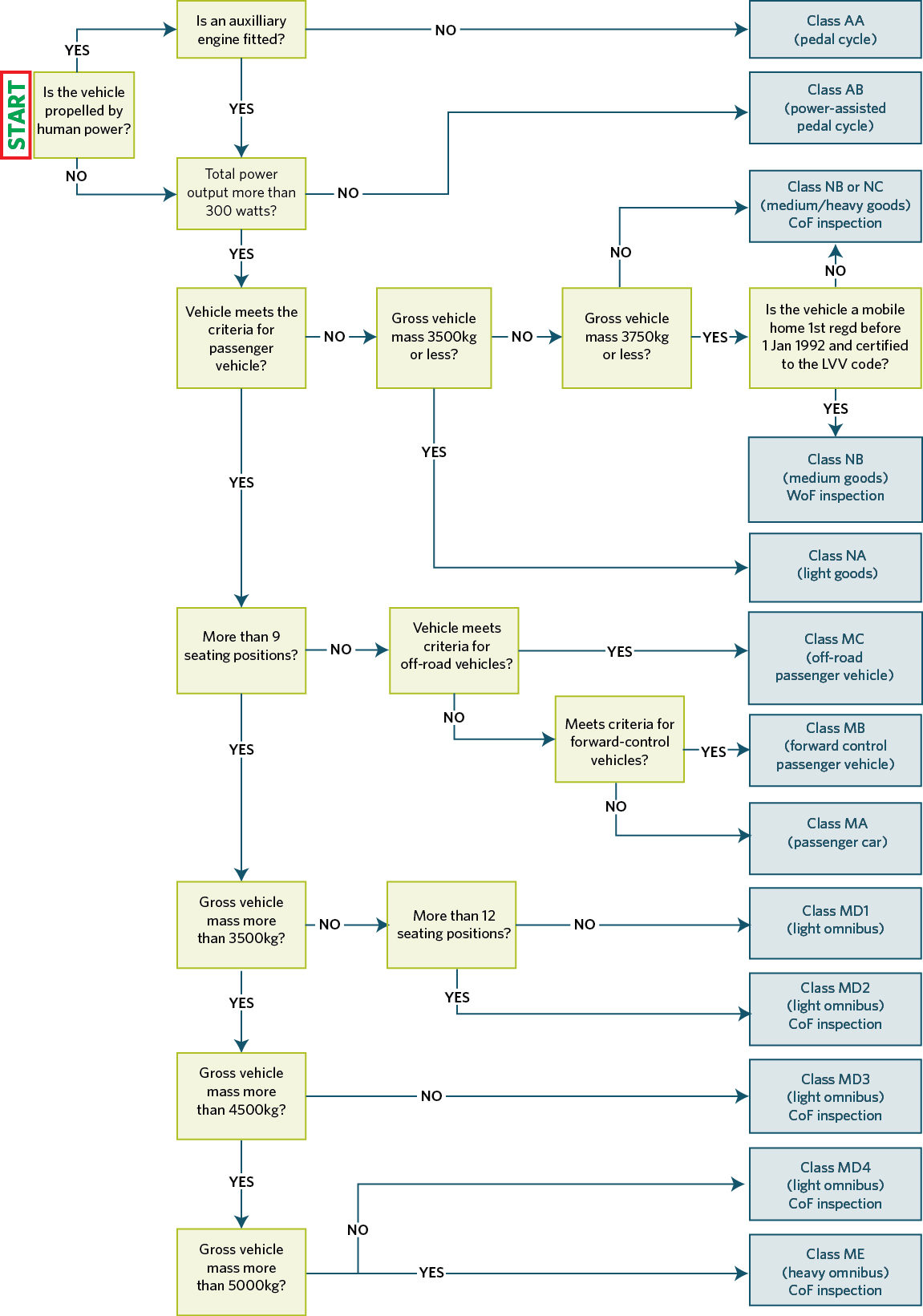
Figure 3-2-2. Vehicle class logic chart – three-wheeled vehicles
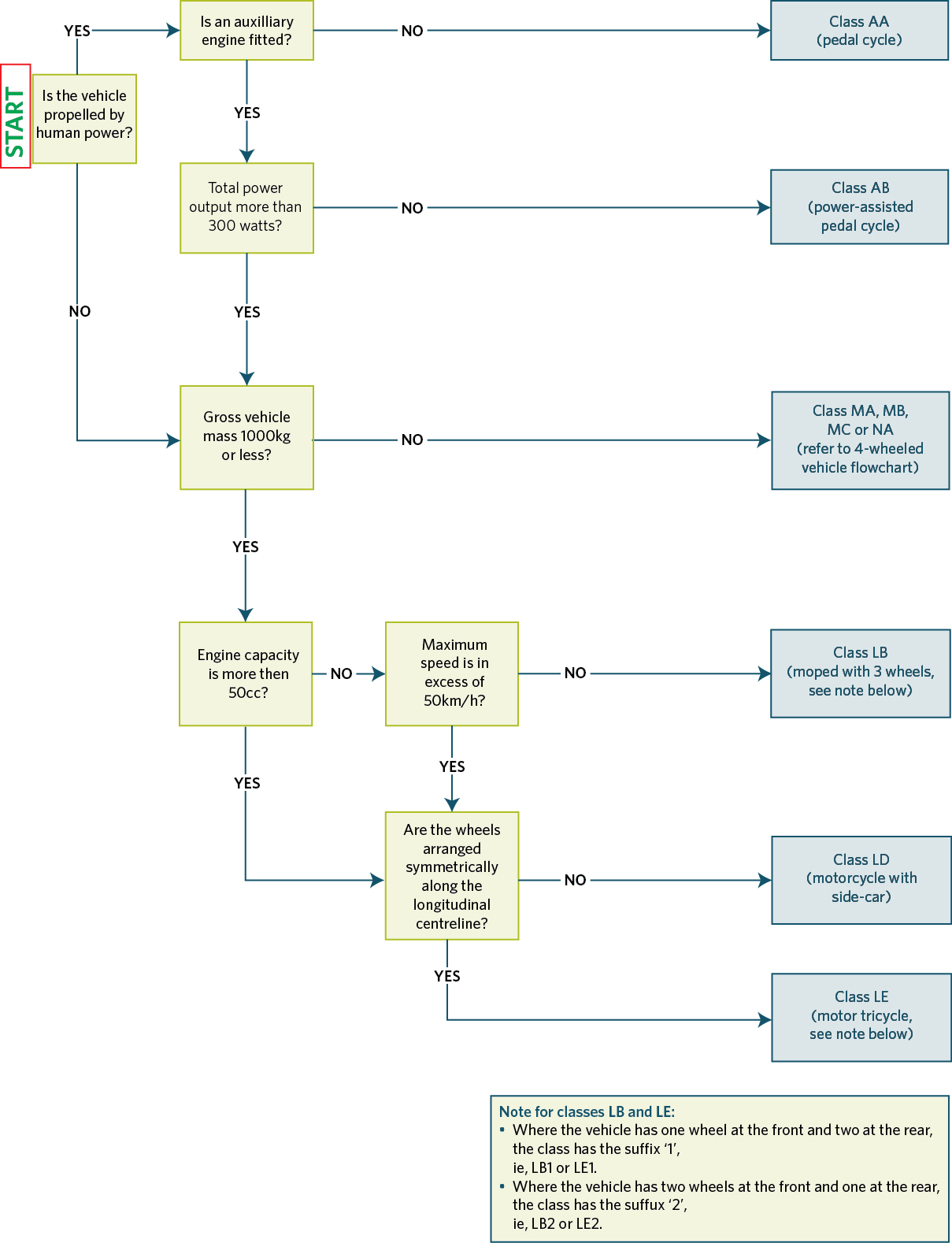
Figure 3-2-3. Vehicle class logic chart – two-wheeled vehicles
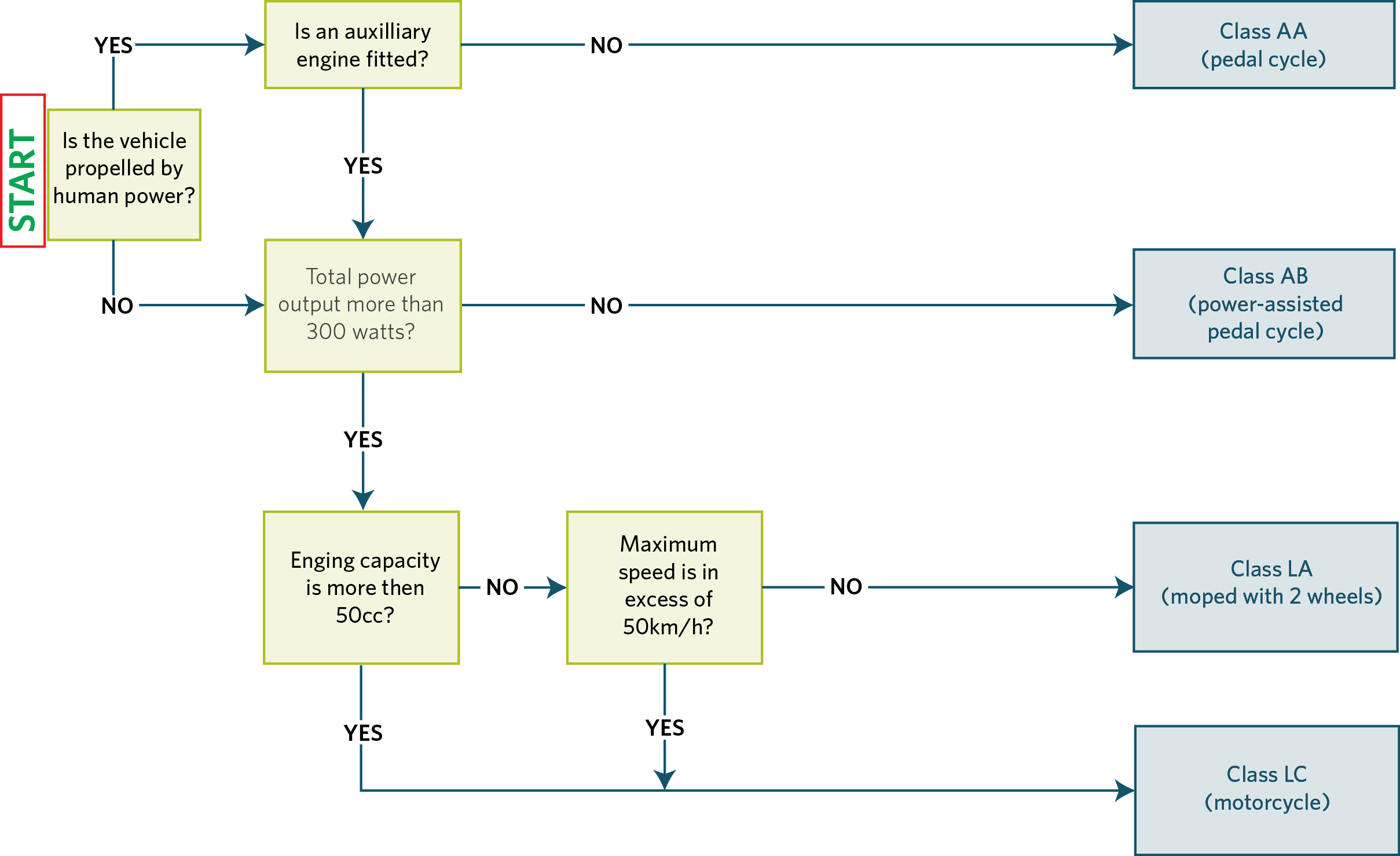
Figure 3-2-4. Vehicle class logic chart – trailers
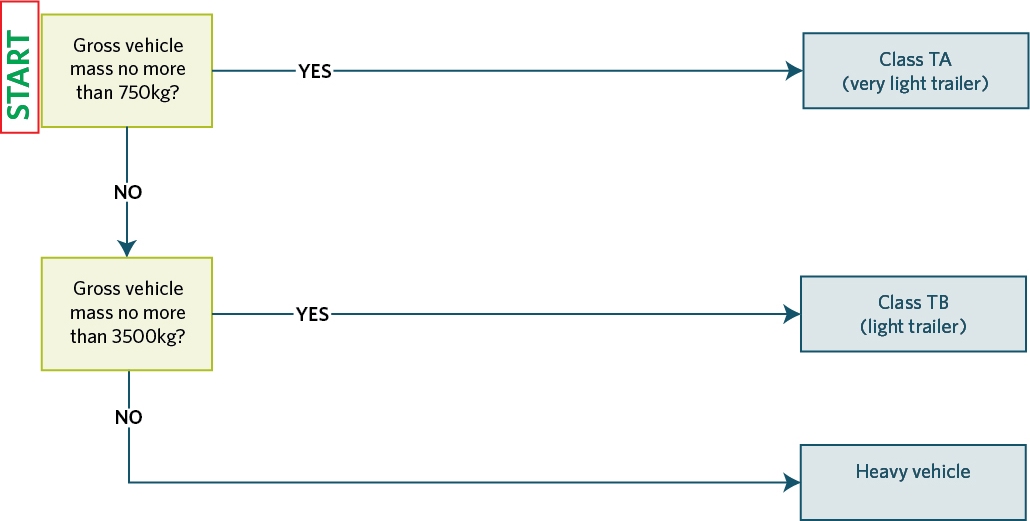
- Download 3-2-4. Vehicle class logic chart – trailers (PDF | 309KB)
3-3 Establishing whether the vehicle requires a WoF or CoF
The lists below show the type of inspection and certification (WoF or CoF) that is required for the different types of vehicles.
3.3.1 Certificate of Fitness (CoF)
(see Note 1)
A CoF is required for the following vehicles:
- Heavy vehicles, other than those listed under WoF below.
- Passenger service vehicles (including MD2 vehicles), other than those listed under WoF below.
- Rental service vehicles (except light rental trailers – these only require a WoF).
- Vehicle recovery service vehicles.
3.3.2 Warrant of Fitness (WoF)
A WoF is required for the following vehicles:
1. Vehicles that are not listed under certificate of fitness (section 3.3.1) or that are not listed as a vehicle not requiring a WoF or CoF (section 3.3.3).
2. Tractors (other than agricultural tractors), or machines used solely in non-agricultural, land management or roading operations, whether for traction or otherwise, that are operated at a speed exceeding 30km/h.
3. Class MA, MB or MC vehicles that, in the carriage of passengers for hire or reward:
a) are used solely for transporting not more than seven schoolchildren, and
b) do not exceed the designed adult passenger capacity of the vehicle by more than two schoolchildren.
4. Vehicles that are lawfully affixed with and operated under the authority of trade plates.
5. Vehicles used by the New Zealand Defence Force that are being used to convey persons who would otherwise use public transport during a period in which any public transport in New Zealand is suspended.
6. Motor caravans that:
a) have an original manufacturer’s rating of 3750kg or less, and
b) were registered in New Zealand as motor caravans before 1 January 1992.
7. Vehicles that are used on a public highway only in connection with the inspection, servicing or repair of the vehicle or for the purpose of allowing any person to sit a practical driving test in that vehicle.
8. Vehicles used on roads only in road construction zones in accordance with notices declaring those zones.
9. Vehicles that are used on a road only when crossing or proceeding along a section of the road where the vehicles have been authorised to operate by an authorisation of a road-controlling authority that requires:
a) a written agreement by the vehicle’s operator or the person for whom the vehicle is being operated, to construct, reconstruct, maintain or restore to the satisfaction of the road-controlling authority all or part of the road used by the vehicle, and
b) the erection and maintenance of warning devices, signs or control devices as required by the road-controlling authority and the NZTA, and
c) where the use of the road does not consist solely of the direct crossing of the road, the prior approval of the NZTA.
10. Light rental trailers.
11. Motor vehicles designed exclusively or principally as part of the armament of the New Zealand Defence Force.
12. The vehicles listed in the table below - these vehicles require a WoF only as far as is practicable for their design or type:
|
a) vehicles propelled and supported solely by self-laying tracks |
|
b) motor vehicles exclusively designed and used on a road for driving, carrying or propelling any of the following, which must be permanently attached to the vehicle: i. aerodrome runway sweepers ii. electrical substations iii. filters for transformer oil iv. log haulers that are stationary when hauling logs v. aeroengine test benches |
|
c) tractors owned by a local authority and used exclusively for the construction, maintenance or mowing of stopbanks and the banks of rivers, streams, drains, canals or other watercourses |
|
d) mobile or movable huts, galleys or similar vehicles that are used on a road solely in connection with the construction or maintenance of roads |
|
e) tractors used exclusively for shunting railway rolling stock |
|
f) forklifts |
|
g) aerodrome crash fire tenders that are used on a road only in emergencies |
|
h) trailers while being drawn by a vehicle as stated in (b) to (g) above |
|
i) motor vehicles used exclusively in connection with the embarking and disembarking of ships’ passengers or for loading and unloading ships’ mails, cargo and passengers’ baggage, and used on a public highway only when proceeding unladen from one wharf to another wharf or from their usual place of storage to a wharf and returning to that place of storage |
|
j) cable jinkers |
|
k) front-end loaders |
|
l) log skidders |
|
m) tractor cranes |
|
n) rough-terrain cranes |
|
o) mobile crushing and screening plant machines which are mounted on trailers |
|
p) motor graders |
|
q) motor scrapers |
|
r) trailer scrapers |
|
s) plant for servicing oil-filled cables |
|
t) post debarkers |
|
u) saw bench apparatus |
|
v) forestry chippers (designed and used exclusively in the operation or management of a forest) |
|
w) tree feller bunchers |
|
x) trench diggers and excavators |
|
y) vehicles that are always used unladen on the road and that are designed exclusively for carrying earth or other bulk materials |
|
z) mobile concrete mixers that are mounted on tractors |
|
aa) a vehicle that is similar in design, construction or purpose to a vehicle listed above that cannot be categorised by vehicle class. |
| bb) an agricultural motor vehicle that is operated at a speed exceeding 40km/h. |
| cc) all-terrain vehicles (other than those listed in 3.3.3 Vehicles that do not require a WoF or CoF). |
3.3.3 Vehicles that do not require a WoF or CoF
The vehicles listed in the table below do not require a WoF or CoF:
|
a) a vehicle of class AB, LA or LB |
|
b) an armoured vehicle used exclusively as equipment of the New Zealand Defence Force |
|
c) a traction engine |
|
d) a mechanically propelled roller |
|
e) a crane fitted with self-laying tracks |
|
f) an excavator fitted with self-laying tracks |
|
g) a tractor (other than an agricultural tractor), or a machine used solely in non-agricultural, land management or roading operations, whether for traction or otherwise, that is not operated at a speed exceeding 30km/h, together with any trailer operated only while being towed by that tractor or machine |
|
h) a trailer designed exclusively for agricultural purposes and not operated except when being: i. delivered from a manufacturer to the manufacturer’s agent, or ii. taken to or from an agricultural show for display or demonstration purposes, or iii. delivered from a manufacturer or a manufacturer’s agent to a farm or an agricultural contractor iv. proceeding to or from a farm, or v. when being inspected, serviced or repaired. |
|
i) a vehicle normally propelled by mechanical power while it is being temporarily towed without the use of its own power |
|
j) an all-terrain vehicle used: i. in moving from the operator’s place of residence to a road that is not a public highway, when the distance travelled is less than 3km, or ii. in connection with its inspection, servicing or repair, or iii. as an agricultural vehicle. |
| k) an agricultural motor vehicle that is operated at a speed not exceeding 40km/h. |
| (l) a motor vehicle operated in circumstances where there is a defence to unregistered and unlicensed operation under the Land Transport (Motor Vehicle Registration and Licensing) Regulations 2011 |
Note 1
A vehicle that does not require inspection for regular use still does not need inspection if operated in a transport service (eg rental mopeds).
Page updated 21 August 2024 (see details).
3-4 Establishing whether the vehicle may be inspected for a WoF or CoF
Before a vehicle can be inspected for the purpose of issuing a WoF or CoF, it must meet one of the following requirements:
The vehicle is currently registered
The Vehicle Inspection and Certification (VIC) or LATIS system will validate this when the inspection is entered.
The vehicle is unregistered but has been certified for entry or re-entry into service within the last two years
The Vehicle Inspection and Certification (VIC) or LATIS system will validate this when the inspection is entered. The inspection must be entered using the VIN.
The vehicle is unregistered and listed in the table below
These do not require certification for entry or re-entry into service. These will need to be treated as an online transaction.
a) class TA or TB trailers |
b) tractors (other than agricultural tractors) or machines, including trailers, for use solely in non-agricultural, land management or roading operations, whether for traction or otherwise that are operated at a speed exceeding 30km/h |
c) pedestrian-controlled goods service vehicles |
d) vehicles used on roads only in road construction zones in accordance with notices declaring those zones |
e) vehicles that are used on a road only when crossing or proceeding along a section of the road where the vehicles have been authorised to operate by an authorisation of a road-controlling authority that requires: i. a written agreement by the vehicle’s operator or the person for whom the vehicle is being operated, to construct, reconstruct, maintain or restore to the satisfaction of the road-controlling authority all or part of the road used by the vehicle, and ii. the erection and maintenance of warning devices, signs or control devices as required by the road-controlling authority and the NZTA, and iii. where the use of the road does not consist solely of the direct crossing of the road, the prior approval of the NZTA |
f) all-terrain vehicles |
g) motor vehicles exclusively designed and used on a road for driving, carrying or propelling any of the following, which must be permanently attached to the vehicle: i. aerodrome runway sweepers ii. electrical substations iii. filters for transformer oil iv. log haulers that are stationary when hauling logs v. aeroengine test benches |
h) tractors owned by a local authority and used exclusively for the construction, maintenance or mowing of stopbanks and the banks of rivers, streams, drains, canals or other watercourses |
i) mobile or movable huts, galleys or similar vehicles that are used on a road solely in connection with the construction or maintenance of roads |
j) tractors used exclusively for shunting railway rolling stock |
k) forklifts |
l) aerodrome crash fire tenders that are used on a road only in emergencies |
m) trailers while being drawn by a vehicle as stated in (b) to (l) above |
n) motor vehicles used exclusively in connection with the embarking and disembarking of ships’ passengers or for loading and unloading ships’ mails, cargo and passengers’ baggage, and used on a public highway only when proceeding unladen from one wharf to another wharf or from their usual place of storage to a wharf and returning to that place of storage |
o) cable jinkers |
p) front-end loaders |
q) log skidders |
r) tractor cranes |
s) rough-terrain cranes |
t) mobile crushing and screening plant machines which are mounted on trailers |
u) motor graders |
v) motor scrapers |
w) trailer scrapers |
x) plant for servicing oil-filled cables |
y) post debarkers |
z) saw bench apparatus |
aa) forestry chippers |
bb) tree feller bunchers |
cc) trench diggers and excavators |
dd) vehicles that are always used unladen on the road and that are designed exclusively for carrying earth or other bulk materials |
ee) mobile concrete mixers that are mounted on tractors |
ff) a vehicle that is similar in design, construction or purpose to a vehicle listed above that cannot be categorised by vehicle class |
gg) a vehicle that is registered for use on a road in a country other than New Zealand and that is not going to be in New Zealand for a continuous period of more than 18 months. |
| hh) an agricultural motor vehicle. |
Page amended 1 October 2020 (see amendment details)
Page updated 1 November 2024 (see details)
3-5 Establishing whether the vehicle complies
2. Visually inspect the vehicle to determine whether the vehicle complies with the requirements set out in this manual (see clause 3.1.2.2 of the Introduction). Vehicle inspectors are not required to remove vehicle components during the inspection of the vehicle.
3. The vehicle inspector or inspecting organisation may refuse to inspect a vehicle which:
a) is presented in such a condition that inspection is unreasonably difficult or cannot be completed (components missing, covered in dirt, etc) or
b) has an insecure load.
4. Where the vehicle inspector determines that a Reason for rejection or clause 3.1.2.2 of the Introduction to this manual applies to a vehicle, the vehicle inspector must reject the vehicle for certification.
5. Where the vehicle inspector requires further information in order to determine compliance with the requirements, the inspector must reject the vehicle until the information has been obtained.
6. Where a vehicle has changed use to a passenger service vehicle since it was last certified for entry or in-service (ie the vehicle enters service as a passenger service vehicle), the vehicle inspector must have written confirmation (in the form of a PSV entry checksheet) that the vehicle complies with the PSV requirements in the VIRM: Entry certification before it can pass certificate of fitness inspection.
3-6 Check sheets
For information on rechecks and reinspections see 3-11 Rechecks.
Applicable legislation: Land Transport Rule: Vehicle Standards Compliance 2002, section 2.3.
1. A check sheet that has been approved by the NZTA must be used. To get a check sheet approved, see:
2. The check sheet must accurately record all applicable requirements for the vehicle class, the writing must be legible on all copies and be signed, either in writing or electronically (Note 1), by the vehicle inspector . The vehicle inspector must sign the check sheet once they have completed the inspection and determined that the vehicle has either passed or failed the inspection.
3. Where parts of a vehicle are inspected by different people, all those inspecting the vehicle must be vehicle inspectors. The check sheet must record the inspector who inspected each part of the vehicle. One vehicle inspector must take overall responsibility for the inspection of the vehicle and that vehicle inspector must sign the check sheet (either in writing or electronically (Note 1)).
4. A vehicle inspector can determine one of two outcomes:
a) Passed inspection: record the ‘determination’ as stated in section 3-7 and issue a WoF label or CoF label or temporary permit
b) Failed inspection: record the ‘determination’ as stated in section 3-7 . The reasons for the failed inspection must be clearly stated on the check sheet.
5. The customer copy (usually the original) of the completed check sheet must be supplied to the vehicle owner or operator if a fail is recorded or the customer requests it. The agent copy (usually the duplicate) is retained by the inspecting organisation.
Note 1
For electronic check sheets, an electronic signature can be:
- a digital signature
- PDF e-signature
- initials for digital check sheets.
Page amended 10 March 2025 (see amendment details).
3-7 Recording the inspection outcome (‘determination’)
Applicable legislation:
Land Transport Rule: Vehicle Standards Compliance 2002, section 7.6
1. The inspection outcome is recorded in either the Vehicle Inspection and Certification (VIC) or LATIS system.
2. The inspection details must be entered into the system before the vehicle leaves the inspecting organisation’s premises or on the day of inspection (whichever comes first). This ensures that:
a) the vehicle can be relicensed by the vehicle owner
b) the correct inspection frequency can be ascertained
c) any restrictions placed on the vehicle are identified before issuing a WoF or CoF, such as a ban flag or a pink or green sticker
d) any vehicle issued with a 28 day conditional permit must have the fail determination entered into LATIS first, then the 28 day permit must be entered with the fault codes and any conditions imposed. Refer to sections 7.9 and 7.10a.
3. Inspection details entered into the system must be accurate at the time the vehicle was inspected. This includes updating the odometer and hubodometer readings when a vehicle is re-presented for inspection.
4. For vehicles required to operate under a TSL, vehicle inspectors must also collect and record in the system the TSL number for both passed and failed inspections, and when issuing temporary permits.
3.7.1 Vehicle Inspection and Certification (VIC)
1. When an inspection has been carried out, whether the result is a pass or fail, the inspection details must be entered into the VIC system.
There are NZTA guides for inspecting organisations that show how to use VIC.
Guide: VIC - Record WoF outcome
2. Where the inspecting organisation wishes to issue WoFs but is unable to obtain the necessary authorisation numbers from VIC, several options are available:
a) The NZTA computer system is not working: the vehicle inspector or inspecting organisation must use the checksheet number as the system authorisation number. The OFF-LINE box on the reverse side of the WoF label must be ticked.
b) The inspecting organisation’s computer terminal is not working: the inspecting organisation must contact the NZTA Help Desk (0800 804 580) who may grant permission for the inspecting organisation to continue to issue offline WoFs.
c) VIC goes down during WoF entry: the vehicle inspector needs to ask the customer if they intend to relicense the vehicle in the next 24 hours. If NO, the WoF details should be keyed in as soon as possible. If YES, the vehicle inspector must email a copy of the checksheet directly to the Transport Agency (email inspections@nzta.govt.nz) with a covering note of explanation. When the system is working again they must check to see if the WoF information is in the system. If not, the vehicle inspector must key the WoF in themselves to minimise any inconvenience to the customer. If it is, they must make a record of the system authorisation number, to cross reference on their copy of the checksheet.
3. To check whether or not a vehicle has a current WoF, search for the vehicle. Here are some scenarios that may occur:
|
Case 1: |
|
Screen message: This plate is not attached to a vehicle. If the plate number is incorrect, overtype with the correct plate number and click on the Search button. If the plate number is correct, advise owner that a plate must be attached before a WoF can be issued. This can be done at an NZTA Plate Agent. The error message means that: The vehicle is not currently registered (never registered, registration cancelled, or registration lapsed because the licence label has been expired for more than 12 months). Action: A WoF must not be issued. The vehicle should be referred to an entry inspecting organisation for entry or re-entry inspection and certification. |
|
Case 2: |
|
Screen message (as at 28/10/2024): Vehicle details Plate Number: AHQ136 Year: 2001 Make: Holden Model: VX Commodore Body type: Saloon Previous inspections Type: WoF Date: 27/10/2023 Odometer: 120345 Result: Pass System authorisation number: 2863 Expiry date: 28/10/2024 The screen message means that: The vehicle is currently registered, licenced and has a current WoF. Action: A new WoF may be issued, or, if necessary, a duplicate WoF may be issued. |
|
Case 3: |
|
Screen message: This vehicle does not have a current WoF. The error message means that: The vehicle has a registration plate attached, but the licence label has been expired for less than 12 months, and the WoF has expired. Action: A WoF may be issued. |
|
Case 4: |
|
Screen message: Plate (XXXX) is a trade plate. The error message means that: The vehicle is unregistered and presented for inspection operating on trade plates. Action: The vehicle must match the description on either:
|
4. The WoF expiry date is automatically calculated as specified in clause 3.8.1
3.7.2 LATIS
The procedures for keying inspections into LATIS are given in the LATIS users’ manual.
Page amended 1 October 2023 (see amendment details)
Page updated 1 April 2025 (see details)
3-8 Issuing the WoF or CoF label - ‘evidence of vehicle inspection’ - or temporary permit
Applicable legislation: Land Transport Rule: Vehicle Standards Compliance 2002, sections 7.9 and 9
3.8.1 Expiry dates
Expiry date of the WoF
The WoF expiry date is calculated from the reference date. The reference dates are:
- For a vehicle with an expired WoF or without a previous WoF: the date the vehicle passes the inspection
- For a vehicle with a current WoF expiring in 14 days or less after the vehicle passes the inspection: the expiry date of the current WoF
- For a vehicle with a current WoF expiring in more than 14 days after the vehicle passes the inspection: the date that is 14 days after the vehicle passes the inspection
- For a vehicle that has been issued with a pink or green sticker (other than a ‘G2’ green sticker) or that has its WoF revoked: the date the vehicle passes the inspection.
The WoF expiry date must be determined as follows:
|
Vehicle |
Date of first registration anywhere or vehicle age |
WoF expiry |
|---|---|---|
|
Light motor vehicle |
Never registered anywhere previously and not yet registered in New Zealand |
3 years from reference date |
|
Any WoF issued within 2 years from date of first registration anywhere |
Third anniversary of date of first registration anywhere |
|
| First registered anywhere on or after 1/1/2000 (other than a vehicle listed above) | 12 months from reference date | |
|
First registered anywhere before 1/1/2000 and less than 40 years old |
6 months from reference date |
|
| Vintage vehicle | Manufactured on or after 1 January 1919 and is at least 40 years old | 12 months from reference date |
| Veteran vehicle | Manufactured before 1 January 1919 | 12 months from reference date |
|
Heavy motor vehicle (CoF exempt) |
Never registered anywhere previously |
12 months from reference date |
|
Less than six years old from date of first registration anywhere |
12 months from reference date |
|
|
Six years or older from date of first registration anywhere |
6 months from reference date |
|
|
Agricultural motor vehicle |
Any age |
12 months from reference date |
| Important note: A vehicle’s date of first registration anywhere is generally not available to the WoF inspector. Where it is important to know the exact date to determine the correct expiry date, the vehicle inspector must identify the correct expiry date on Landata or Vehicle Inspection and Certification (VIC) BEFORE issuing a WoF label. |
Expiry date of the CoF
The CoF expiry date is calculated from the reference date. The reference dates are:
- For a vehicle with an expired CoF or without a previous CoF: the date the vehicle passes the inspection
- For a vehicle with a current CoF expiring in 28 days or less after the vehicle passes the inspection: the expiry date of the current CoF
- For a vehicle with a current CoF expiring in more than 28 days after the vehicle passes the inspection: the date that is 28 days after the vehicle passes the inspection
- For a vehicle that has been issued with a pink or green sticker (other than a ‘G2’ green sticker) or that has its CoF or temporary permit revoked: the date the vehicle passes the inspection.
The CoF expiry date must be either:
a) six months from the reference date, or
b) between three and 12 months from the reference date (for vehicles for which NZTA have specified an alternative CoF expiry date), or
c) for a class MA rental vehicle that was new when it was first registered in New Zealand as a rental service vehicle:
i. 12 months from the date the vehicle passes its first CoF inspection, then
ii. six months from the reference date for any subsequent CoF inspections.
d) 12 months for vehicle that meets the private heavy motorhome definition (Note 1). Where the vehicle does not meet this definition, the expiry date must be six months and inspection group 21 / 22 to be used.
| Important note: As a vehicle may be on a CoF frequency other than six months, the vehicle inspector must identify the correct expiry date BEFORE issuing a CoF label. |
Expiry date of a temporary permit (CoF vehicles only)
The expiry date is 28 days after the date of issue of the permit.
When a WoF, CoF or temporary permit ceases to be current
A WoF, CoF or temporary permit ceases to be current:
a) after its expiry date , or
b) if the vehicle has been green or pink stickered and a new WoF or CoF is required (note that a new WoF or CoF is not required for a ‘G2’ green sticker so the existing expiry date remains unaffected), or
c) if the WoF, CoF or temporary permit has been revoked by a person authorised by the NZTA.
Note 1
Private heavy motorhome means a motor vehicle that is:
(a) class MB, NB or NC,
(b) permanently equipped with fixed equipment intended to make the vehicle suitable as a dwelling place and must include at least:
(i) one sleeping berth,
(ii) cooking facilities, and
(iii) a toilet that is permanently fixed to the vehicle and usable within the vehicle,
(c) not used for the carriage of passengers for hire or reward,
(d) not operated under a transport service licence.
Where all requirements are met, use inspection group 27 or 28 for CoF expiry.
3.8.2 Completing and affixing the WoF or CoF label
Completing the WoF label
Figure 3-8-1. Warrant of fitness (WoF) label (for expiry dates from 2014 onwards)
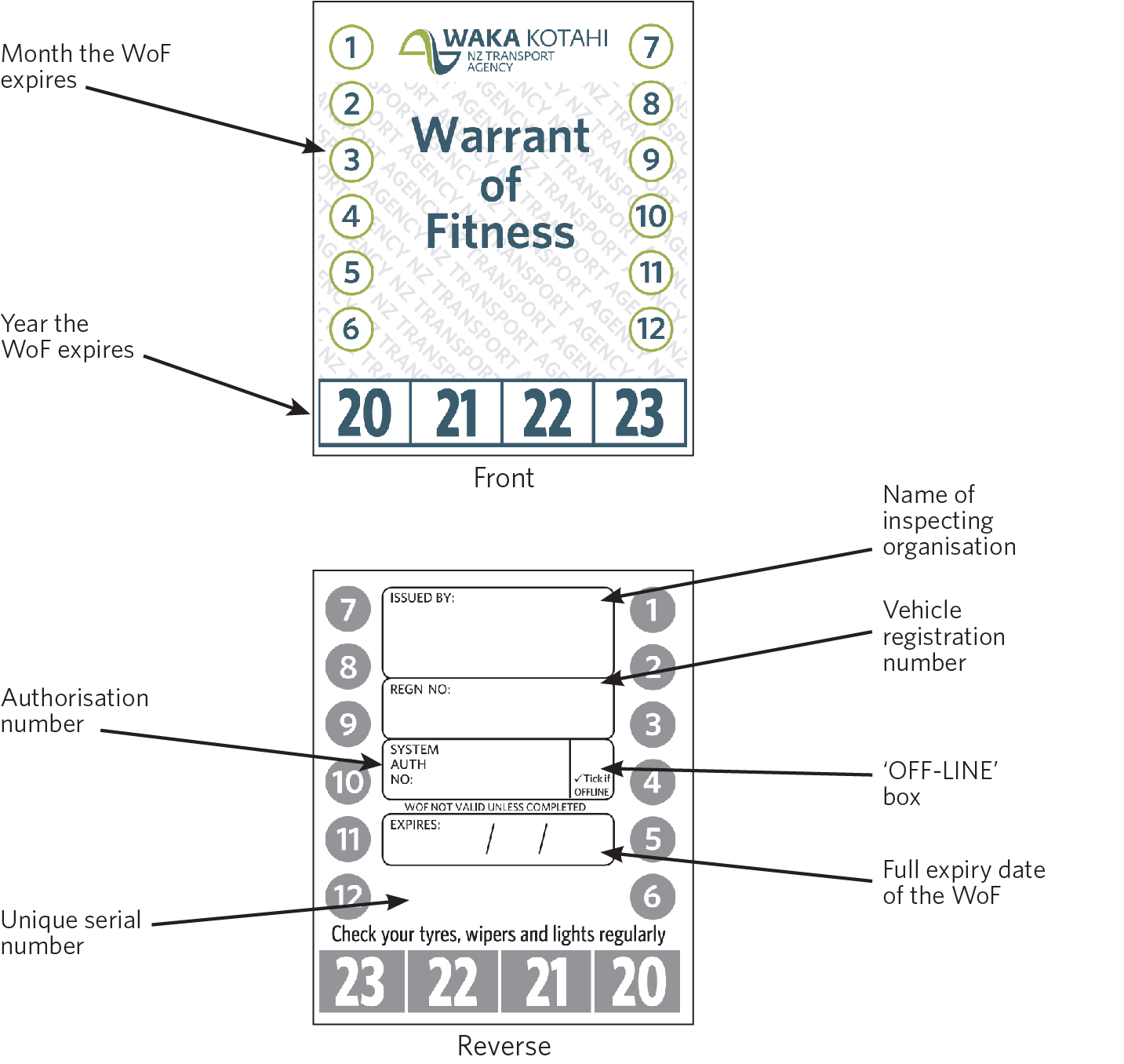
If the vehicle passes the WoF inspection, the new WoF label must be completed in the following manner:
a) Front side:
i. select the WoF label with the correct year of expiry of the WoF, and
ii. using a hole punch of at least 6mm diameter, punch out the appropriate numbers representing the month and year of the WoF expiry date.
b) Reverse side: record the:
i. name of the inspecting organisation (a business stamp is acceptable), and
ii. vehicle registration number, and
iii. system authorisation number, and
iv. full expiry date of the WoF.
Each WoF label has a unique serial number printed on three places of the reverse side. The serial number is provided for cross referencing of the inspection documentation. The vehicle inspector must:
- (for paper check sheets) remove both serial number stickers and attach one to the customer copy and the other to the file copy
- (for electronic checksheets) record the serial number on all copies.
Affixing the WoF label
The WoF label must be affixed by the vehicle inspector or a delegated employee of the inspecting organisation in one of the following positions:
a) if the vehicle is fitted with a windscreen:
i. to the inside of the windscreen facing outwards on the same side as the steering wheel, and
ii. as close as possible to the edge of the windscreen where it is clearly visible from the outside and is not obscured by an anti-glare band or sticker
b) for a trailer, on the back of the vehicle near the registration plate, or on the right-hand side of the vehicle at the rear, or if this is impracticable, in a position where it can readily be seen
c) for any other vehicle, in a position where it can readily be seen.
Not more than one WoF label may be displayed at one time. When issuing a new WoF label, the vehicle inspector or a delegated employee of the inspecting organisation must remove the existing label.
Completing the CoF label
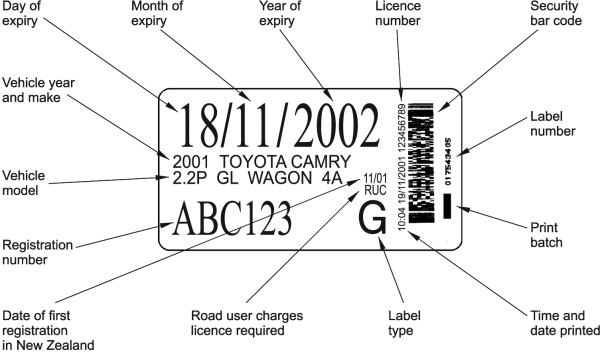
Figure 3-8-2. Certificate of Fitness (CoF) label details
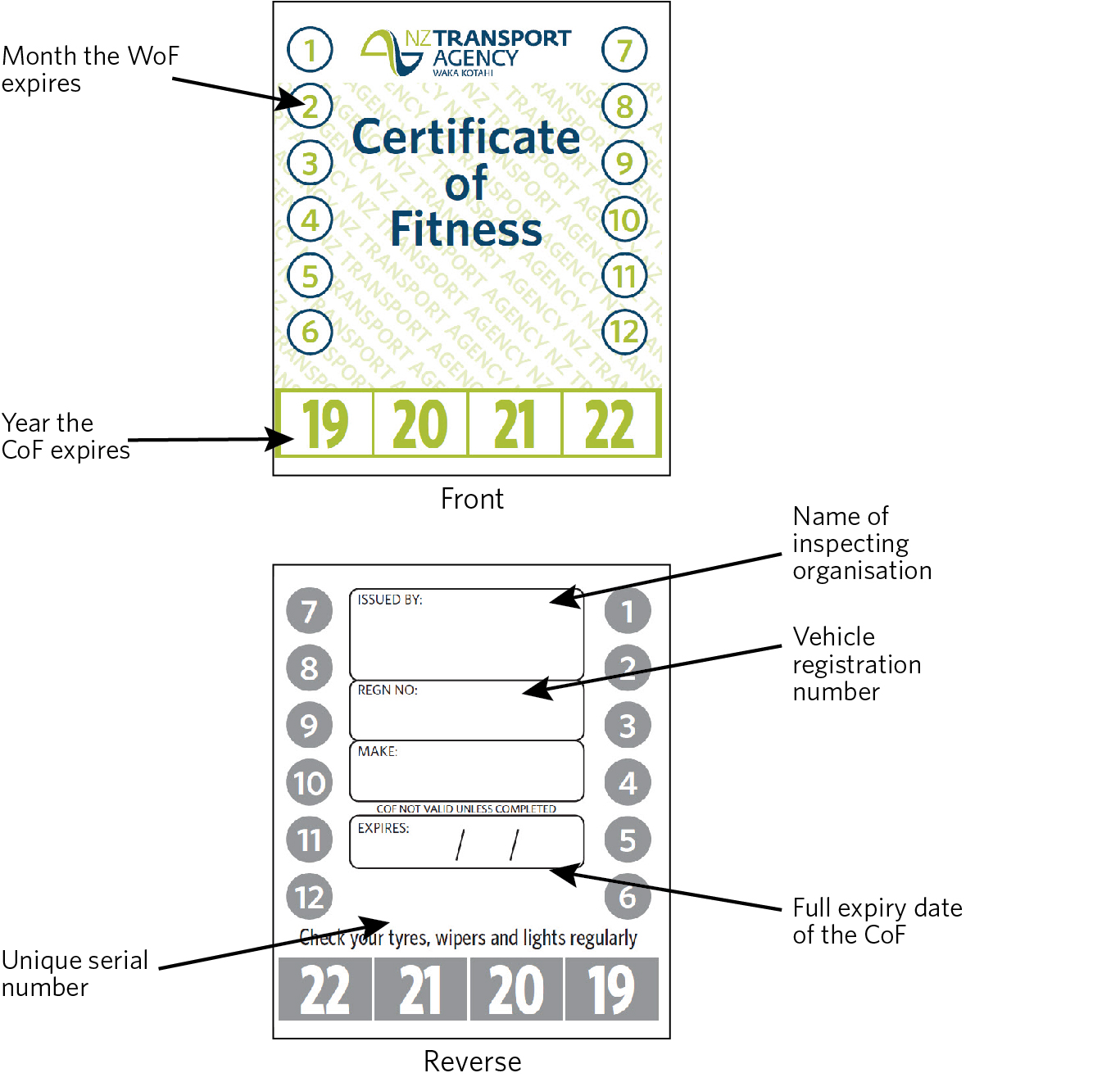
If the vehicle passes the CoF inspection, the new CoF label must be completed in the following manner:
a) Front side:
i. select the CoF label with the correct year of expiry of the CoF, and
ii. using a hole punch of at least 6mm diameter:
-punch out the appropriate numbers representing the month and year of the CoF expiry date if using the CoF label in Figure 3-8-2.
b) Reverse side: record the:
i. vehicle registration number, and
ii. vehicle make, and
iii. full expiry date of the CoF, and
iv. name of the inspecting organisation.
c) Label record (butt): record the:
i. vehicle registration number, and
ii. date the CoF is issued, and
iii. full expiry date of the CoF, and
iv. signature of the vehicle inspector.
Each CoF label has a unique serial number which must be recorded on both copies of the checksheet.
Affixing the CoF label
The CoF label must be affixed by the vehicle inspector or a delegated employee of the inspecting organisation in one of the following positions:
a) if the vehicle is fitted with a windscreen:
i. to the inside of the windscreen facing outwards, on the same side as the steering wheel, and
ii. as close as possible to the edge of the windscreen where it is clearly visible from the outside and is not obscured by an anti-glare band
b) for a trailer, on the back of the vehicle near the registration plate, or on the right-hand side of the vehicle at the rear, or if this is impracticable, in a position where it can readily be seen
c) for any other vehicle, in a position where it can readily be seen.
Not more than one CoF label may be displayed at one time. When issuing a new CoF label, the vehicle inspector must remove the existing label.
3.8.3 Completing the temporary permit (’28 day permit’ for CoF vehicles only)
Figure 3-8-3. Temporary permit (28 day permit for CoF vehicles)
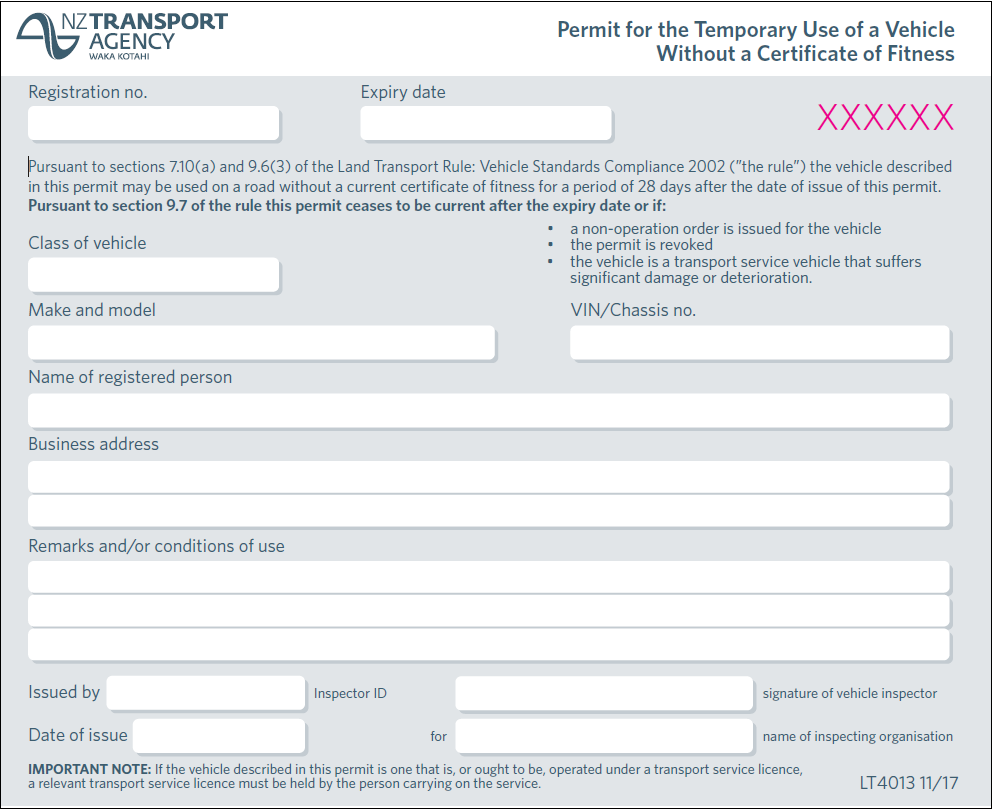
This permit may be issued by an inspecting organisation in the case of a vehicle that does not comply with all applicable requirements, but is safe to be operated subject to specified conditions. The completed permit must be carried in the vehicle.
To assist with minimising delays, temporary permits may be issued to vehicles that have had a minor fault repaired by a manufacturing certifier but that have not yet had an LT400 issued. The manufacturing certifier must issue the CoF inspector a written professional opinion stating the repair is carried out to industry best practice. The professional opinion should be on the HV manufacturing certifier company letterhead and must contain:
- vehicle details
- HV manufacturing certifier details
- details of the fault
- a statement stating that it has been repaired to industry best practice and is safe to operate on the road for up to 28 days
- the date the professional opinion was issued
- HV manufacturing certifier signature.
The permit must be completed in the following manner:
Record the:
1. vehicle registration number, and
2. expiry date of the permit, and
3. validity period of 28 days, and
4. class of the vehicle, and
5. make and model, and
6. VIN or chassis number, and
7. name of the registered owner, and
8. registered owner’s business address, and
9. specified conditions relating to the vehicle’s operation, and
10. date of issue of the permit, and
11. signature of the vehicle inspector.
- These details must be clearly legible on both copies of the permit.
- Each permit has a unique serial number which must be recorded on both copies of the checksheet.
- Any vehicle issued with a 28 day conditional permit must have the fail determination entered into LATIS first, then the 28 day permit must be entered with the fault codes and any conditions imposed. Refer to sections 7.9 and 7.10a of Land Transport Rule: Vehicle Standards Compliance 2002.
Page amended 10 September 2025 (see amendment details)
3-9 Collecting fees
Applicable legislation: Land Transport (Certification and Other Fees) Regulations 2014.
3.9.1 Application for inspection and certification of vehicles for in-service
The fee to be paid by an applicant for inspection and certification of a vehicle for in-service (WoF, CoF or permit) is the amount fixed by the inspecting organisation that is reasonable, having regard to:
a) the time spent in inspecting the vehicle to ascertain whether it complies with the relevant requirements, and
b) any fees payable to the NZTA, and
c) any standard or usual rate at which the inspecting organisation imposes charges for other work carried out in respect of motor vehicles.
Where a vehicle fails a WoF inspection, no additional fee is payable for any subsequent inspection by the same inspecting organisation for the purpose of the same certification, if such application is made within 28 days of the first inspection for the issue of the evidence of vehicle inspection. A fee is payable for an inspection if the vehicle is presented after the 28 days have lapsed.
- For more information on rechecks and reinspections see 3-11 Rechecks.
3.9.2 Duplicate evidence of vehicle inspection
The inspecting organisation or vehicle inspector may charge a reasonable fee for providing a duplicate of an evidence of vehicle inspection.
When issuing a duplicate WoF or CoF label, the same requirements apply as for the original label as specified in section 3.8, that is, it must be attached by the vehicle inspector or delegated employee, and only one label may be attached to the vehicle at any time.
Page amended 1 June 2018 (see amendment details).
3-10 Operating a vehicle without a current WoF or CoF
A person must not operate a vehicle on the road unless it has a current WoF/CoF and complies with WoF/CoF requirements.
A person may legally operate a vehicle with an expired WoF/CoF ONLY if the vehicle is being operated SOLELY for the purpose of bringing it into compliance, and provided the vehicle is safe to be operated for that purpose.
The 28 days given after a failed WoF/CoF only relate to the payment of inspection fees and when a new inspection starts, see sections 3.6.6 and 3.9. The 28 days do NOT allow a person to continue using the vehicle for a purpose other than for bringing the vehicle into compliance.
Where a vehicle still has a current WoF/CoF when it is failed, it must be brought up to compliance before it can again be operated for other purposes up to the date the WoF/CoF expires.
3-11 Rechecks
If a vehicle fails a WoF inspection, there is no fee for any subsequent inspection as long as it is done:
- within 28 days of the first inspection where the vehicle failed, and
- at the same inspecting organisation (does not have to be the same site if the inspecting organisation operates at more than one site).
Notes
- In the case of split testing for heavy vehicle brakes at CoF, the 28 days start from the completion of the second phase of the split test.
- If a vehicle has passed a performance test but has been failed for condition and has then been repaired, the performance should be re-tested as part of the recheck (for example brakes where the pads have been replaced.
- A fee may be charged for CoF re-inspections.
A fee is payable, and a new WoF or CoF inspection is required if the vehicle is presented after the 28 days have passed.
Legislation
Land Transport (Certification and Other Fees) Regulations 2014
Page added 1 April 2022 (see amendment details).
Page updated 4 March 2024 (see update details).
4 Complaints
Customers should be encouraged to direct any complaints to the inspecting organisation in the first instance.
To ensure all written complaints received are investigated, the inspecting organisation must maintain an effective complaint management process, which must meet the following requirements:
1. a clear and concise statement that recognises the positive value of complaints
2. clear and concise instructions to all customers on how to register a complaint. This can be accomplished in several ways, for example:
a) a conspicuous notice on the workplace wall, or
b) a clear statement on any receipt or invoice issued, or
c) a clear statement on the inspecting organisation’s checksheet
3. a straightforward explanation of the expected standards for resolution and the customer’s right to appeal to the NZTA if they are dissatisfied with the proposed resolution
4. documentation of any investigation into a complaint prepared in accordance with the QMS requirements so that details of the investigation can be readily checked
5. acknowledgment of all written complaints in writing within three working days, and the investigation completed and a resolution proposed to the complainant within 20 working days of the complaint being made
6. a record of all complaints, both verbal and written, in accordance with the QMS requirements
7. directions for any customer who wishes to make a complaint or appeal a decision made by an inspecting organisation to contact the NZTA Helpdesk (0800 699 000).
Dealing with disputed failed CoF inspections for vehicles subject to the Operator Rating System (ORS)
Where the operator of a vehicle subject to ORS queries a failed inspection, please follow the Operator issue resolution process – disputed failed inspections in section 3-9-3 of the LATIS manual (password required).
Vehicle operators may be referred to the Transport Agency website for more information about querying failed CoF inspection results.
Page amended 1 November 2014 (see amendment details).
5 Inspection premises and equipment
5.1 General requirements
- The inspecting organisation must continue to comply with the applicable requirements in this section.
- The inspecting organisation must maintain their premises and equipment in a good state of repair at all times while conducting inspection and certification activities.
- The inspecting organisation must use any specified equipment when inspecting a vehicle, where appropriate.
- Inspection equipment must meet equipment manufacturer’s requirements and have current calibration.
- Brake performance testing equipment must be calibrated at least every 12 months, or more frequently if required by the equipment manufacturer, or following any maintenance that may alter the calibration.
- Inspections must take place in the inspection area, using the approved or specified equipment, unless otherwise permitted by NZTA.
- It is the IO’s responsibility to ensure that the inspection premises and equipment it uses comply with occupational health and safety requirements, and any other relevant Acts, regulations and local bylaws.
5.2 Administration requirements
Feature | Minimum requirement | Examples and things to consider |
|---|---|---|
Administration |
| To connect to our computer systems you must use one of:
Approved browsers :
Note: VIC can be accessed through any computer system that has at a minimum the above approved browser versions. |
5.3 Inspection site requirements
| Feature |
Minimum requirement |
Examples and things to consider |
|---|---|---|
|
Access to and exit from inspection area |
No requirements; however, if the site has access restrictions for a particular standard legal size vehicle, that vehicle will not be able to be inspected at the site. |
A standard legal size vehicle is one that either:
|
|
Inspection area |
The inspection area needs to be situated within a building that has a roof, sides and doors made of permanent materials, and a solid and level floor so that a vehicle or vehicle combination remains stationary when parked in neutral with all brakes off, and there must be sufficient clearance (width, length and height) to allow doors to be fully opened and all inspection actions to be carried out. |
Room for suspension test bars, room to view roof structure for corrosion/damage and raise vehicle, room to check headlamps. |
|
Lighting |
|
Required for vehicle exterior, interior and underbody inspections. (If you meet AS/NZS 1680 that will be suitable.) |
|
Underbody examination, including running gear |
Ability to carry out inspection of the underside of the vehicle, including structure, running gear, steering, brake systems and suspension by means of a pit, hoist, fixed ramp, or other equipment enabling adequate inspection of the underbody of the vehicle. |
Examples:
Note: Axle stands and creepers will not be approved for use as part of the vehicle inspection of standard vehicles unless specifically for use at a specified site. Steel test bar or similar for steering and suspension, or a steering or suspension test machine. |
5.4 Inspection equipment requirements
| Feature | Minimum requirement | Examples and things to consider |
|---|---|---|
Vehicle dimensions | Measuring device(s) appropriate for the vehicle being inspected. The measurement must be taken with a single measure. | Required to confirm interior and exterior vehicle dimensions, e.g. overall length, width or height or passenger service vehicle (PSV) seat spacing. A 3m and a 25m measuring tape will be appropriate for most vehicles. |
Tyres | Device for measuring tyre tread depth. | Graduated tyre tread depth gauge. |
Brake testing |
| Level access either side of a roller brake machine: such that the vehicle or vehicle combination remains stationary when in neutral with the brakes off; and that allows the vehicle to enter and exit the RBM in a straight line so that all axles can be tested correctly. Where a road test is carried out on a class LC, LD, or LE, motorcycle the vehicle inspector must have access to, and wear an approved motorcycle helmet. |
Headlamps | Commercial-quality optical headlamp beam tester (or for motorcycles, forklifts and tractors only, a graduated light board). | Size of light board and location within the compliance facility. |
Vision | Equipment optional. If checking light transmission through glazing using a light transmission measuring device, it must be calibrated. | A 35% VLT tint sample or a calibrated light transmission meter. |
Heavy vehicle towing connections |
| Steel test bar for ball-race turntables or similar. |
PSV door test | Test bar and spring force scale for checking power-operated door closing force (refer to Technical bulletin 5 for test bar technical specifications). | |
Taximeter testing |
| Not part of CoF inspection but required if you also want to carry out taximeter calibration checks. |
5.5 Approved brake test equipment (WoF)
Note The vehicle inspector must use an approved brake tester when carrying out the brake test. Should the tester break down, or a vehicle cannot reasonably be tested with that tester, the vehicle must be tested with another approved brake tester or undergo the brake distance test.
|
Manufacturer |
Models |
Gazette notice details |
|---|---|---|
|
AECS |
STT10 |
15 December 2016, No 118 |
| STT10e | 10 September 2021, 2021-au3935 | |
| STT10w | 2024-au2922 | |
| STT30 | 2021-au5065 | |
| STT45 | 20 April 2018, 2018-au1907 | |
|
Anzen |
BS52FL Roller brake testing machine |
26 October 1989, No 189, p 5299 |
|
Auto Test Products |
AutoStop Mini 1.0 |
5 December 2000, No 164, p 4262 |
|
AutoStop Micro Plus |
3 March 2011, No 23, p 623 |
|
|
Banzai |
BBT51S Roller brake testing machine |
26 August 1989, No 189, p 5299 |
|
Bear |
450, 451, 452, 4510 and 4511 |
7 March 1957, No 20, p 449 |
|
BM Autoteknik |
Portable truck brake testing machine Model No BM20200 |
30 January 1997, No 8, p 190 |
|
Model No BM8010 (with or without the facility to test the brakes on dedicated 4WD vehicles) |
2 May 1996, No 41, p 1182 |
|
|
BMX200 Roller brake testing machine |
12 November 1998, No 184, p 4350 |
|
|
BMX010 Turbo roller brake testing machine |
14 January 1999, No 246, p 65 |
|
|
BM17200 |
1 August 2000, No 89, p 2184 |
|
|
BM7010 |
31 October 2000, No 150, p 3866 |
|
|
BM30200 (upgraded Crypton EB30) |
5 December 2000, No 164, p 4262 |
|
|
BM63200 (upgraded Crypton 630) |
12 March 2002, No 28, p 626 |
|
|
BM3010, BM9010, BM12200 |
5 April 2001, No 37, p 829 |
|
|
14200 series |
17 April 2008, No 73, p 2055 |
|
|
BM4010 |
14 December 2006, No 172, p 5032 |
|
|
BM18200 |
6 April 2017, No 37, 2017-au1651 |
|
|
Bowmonk |
Brake Check Model 801 |
25 May 2006, No 46, p 1232 |
|
Bowmonk |
Brake Check Model 803 |
25 May 2006, No 46, p 1232 |
|
CEMB |
DCA 3 Roller brake testing machine |
10 June 1999, No 67, p 1549 |
|
DCA5-FN3 |
25 June 2009, No. 94, p 2117 |
|
|
Circuitlink |
Brake Check |
22 May 2003, No 53, p 1380 |
|
Brake-Testa Model BT1 |
25 May 1995, No 50, p 1282 |
|
| Cosber | C-BTP 10 Plate Brake Machine | 2 July 2025, 2025-au3604 |
|
Crypton |
Crypton Bradbury E10 dynamic brake tester |
16 March 1967, No 16, p 384 |
|
Crypton Models 630 and 660 Roller brake testing machine |
26 October 1989, No 189, p 5299 |
|
|
Crypton 690A brake tester |
14 August 2003, No 101, p 2689 |
|
|
Hammar |
Dynometer 54 |
21 March 1968, No 15, p 474 |
|
Hartridge |
MkII Brake tester |
3 September 1970, No 53, p 1574 |
|
Hoffman Werkstatt |
Brekon 131-3 |
25 September 2001, No 135, p 3469 |
|
Brekon 141-3 and 141-4 |
9 November 2006, No. 132, p 3837 |
|
|
HPA |
Models 2302, 2303, and 2313-MK Roller brake testing machine |
22 March 1973, No 23, p 524 |
|
Model 5023 Roller brake testing machine |
29 June 1995, No 64, p 1733 |
|
|
Model LX5004.138.009 Roller brake testing machine |
21 March 1996, No 28, p 867 |
|
|
Hunter |
B400 Plate Brake Tester |
19 September 1991, No 140, p 2992 |
|
B404 Plate Brake Tester |
22 August 1991, No 126, p 2727 |
|
|
Intertech |
Model No HH650 EV |
7 March 1996, No 23, p 735 |
|
Jevol |
Model BT3900 |
20 April 2018, 2018-au1916 |
|
Model BT2200 |
20 April 2018, 2018-au1916 |
|
|
Model PBT3900 |
20 April 2018, 2018-au1916 |
|
|
Model PBT2200 |
20 April 2018, 2018-au1916 |
|
|
Model RRT-2500 |
2 June 2016, No 50 |
|
|
Model RRT-2500W |
2 June 2016, No 50 |
|
|
Model RRT-7500 |
21 August 2014, No 96, p2732 |
|
|
Model RRT-7500M |
27 November 2014, No 143 |
|
|
Model RRT-9500 |
5 February 2015, No 13 |
|
|
Kismet |
Model Nos KBT 300, 301 and 302 |
22 March 1973, No 23, p 524 |
|
MAHA |
MAHA PP2 Platform brake tester (digital and analogue) |
6 October 1988, No 170, p 3973 |
|
MAHA Platform brake tester Model Junior-Check 2P |
14 September 1995, No 99, p 3102 |
|
|
MAHA Platform brake tester MPP 2240 |
9 June 2011, No 81, p1909 |
|
|
MAHA Roller brake testing machine MBT2000 series (was Model IW 2 Series) |
24 February 1994, No 16, p 914 |
|
|
MAHA Roller brake testing machine Model IW 4 |
21 March 1996, No 28, p 867 |
|
|
MAHA Roller brake tester Model IW 7 Mobile |
15 June 2006, No 52, p 1430 |
|
|
MAHA Roller brake tester Model MBT 2100 |
17 December 2009, No 188, p4524 |
|
|
MBT 5250 and MBT 4250 Eurosystem (was Model IW 4) |
17 October 2013, No 143, p 3914 |
|
| MBT 7250 | 5 February 2021, No 2021-au394 | |
|
MTL 5250 |
16 February 2017, No 2017-au642 |
|
| W220 Connect | 15 June 2022, 2022-au2398 | |
| W250 Connect | 15 June 2022, 2022-au2399 | |
| Muller Automotive |
43850 43350 44700 44750 50500 56400 |
27 Nov 2025 au6890 27 Nov 2025 au6891 27 Nov 2025 au6892 27 Nov 2025 au6894 27 Nov 2025 au6895 27 Nov 2025 au6896 |
|
Muller BEM |
Billanmatic series 45200, 43300, 44800, 44700 |
5 December 2000, No 164, p 4262 |
|
Nepean |
Model Barbie 14104 Vehicle inspection trailer |
11 June 1998, No 79, p 1760 |
|
Nissalco |
Model IM2581 Roller brake tester |
3 December 1981, No 145, p 3661 |
|
Model M2581 Super-Combi Tester |
24 June 1999, No 75, p 1696 |
|
|
PlateTronic (also known as SafeTstop) |
Models Pitstop 2P Eco (also known as Short Track Ultima), Pitstop 4P Platebrake tester (also known as Long Track Ultima) |
9 April 2009, No 48, p 1177 21 August 2014, No 96, p 2732 12 March 2015, No 24 |
| Ravaglioli |
RT102/6 GLFP RT102/6 GPE |
4 November 2020, 2020-au5085 |
| Rymw Worldwide SA | FRL | 2024-au2412 |
| FRL 5.5 | 2024-au2411 | |
| FRU 4 (lifting bed version) | 2024-au4472 | |
|
Shenzhen Cosber Industrial Co Ltd |
Model Cosber KZD-3 series of roller brake testing machines |
25 September 2008, No 143, p 3901 |
|
Sherpa |
BPS Twin ZT-18115 | 27 Nov 2025 au6897 |
|
BS Kompact 3.5 |
27 November 2014, No 143 |
|
|
PBT-24-4757 |
11 May 2017, No. 49, 2017-au2196 |
|
| PPS-101-ECO (plate brake tester) | 2023-au592 | |
|
Simaret |
Models Simaret BrakeSafe, Simaret 3000, Simaret F |
12 November 1998, No 184, p 4350 |
|
Triangle |
Brake testing instruments Commercial Vehicle Model and Standard Model (Ref. DBT2) |
5 May 1966, No 25, p 737 |
| Turnkey | G-meter decelerometer | 11 June 2025, 2025-au3176 |
|
Vamag |
RBT-C |
2 June 2016, No 50 |
|
RBT3500 C7 |
16 March 2017, No 29, 2017-au1231 |
|
|
RBT3500 XS |
16 March 2017, No 29, 2017-au1232 |
|
|
Van Leeuwen Test Systems B.V. |
VLT 423 roller brake machine |
16 January 2014, No 4, p129 |
|
Vehicle Inspection Systems Pty Ltd |
VIS-Check, VIS-TF-RL and VIS-VE-RL |
4 March 2010, No 25, p 580 |
|
Vericom |
Model VC2000 and VC2000PC brake testing computers |
26 October 1995, No 122, p 3775 |
|
Model VC3000 |
27 March 2003, No 30, p 847 |
|
|
Vipac |
Model VBT101 brake-tester |
23 June 1994, No 62, p 2089, or |
|
VTEQ S.L. (Spain) |
VTEQ 3080 |
14 August 2003, No 101, p 2689 |
|
VTEQ 2080 |
17 February 2004, No 17, p 372 |
|
|
VTEQ 6000 (analogue) VTEQ 7000 (digital) |
9 November 2006, No. 132, p 3837 |
The following mechanical decelerometers cannot be used by inspecting organisations that are authorised to operate after 1 June 2023. Inspecting organisations that were authorised to operate before 1 June 2023 have until 1 June 2024 to phase out their use and be replaced by an approved electronic decelerometer.
Table 5.5.1. Mechanical decelerometers being phased out June 2024
|
Manufacturer |
Models |
Gazette notice details |
|---|---|---|
|
Bowmonk |
Model MkIII Dynamometer |
25 August 1960, No 54, p 1281 |
|
Tapley |
Tapley portable brake tester |
7 March 1957, No 20, p 449 |
|
Tecalemit |
Model No DE 5000 CU Roller brake testing machine |
22 February 1996, No 15, p 508 |
|
Vane |
Vane Bowmonk dynometer |
16 March 1967, No 16, p 384 |
|
Weaver |
WY-25, WY-30, WY-40S, WY-55, WY-60, WY-70S, WY-75 and WY-76 |
7 March 1957, No 20, p 449 |
5.6 Approved brake test equipment (CoF – light vehicles)
Note The vehicle inspector must use an approved brake tester when carrying out the brake test. Should the tester break down, or a vehicle cannot reasonably be tested with that tester, the vehicle must be tested with another approved brake tester (including a decelerometer listed above) or undergo the brake stopping distance test.
|
Manufacturer |
Models |
Gazette notice details |
|---|---|---|
|
AECS |
STT10 |
15 December 2016, No 118 |
| STT10e | 10 September 2021, 2021-au3935 | |
| STT10w | 2024-au2922 | |
| STT30 | 2021-au5065 | |
| STT45 | 20 April 2018, 2018-au1907 | |
|
Anzen |
BS52FL Roller brake testing machine |
26 October 1989, No 189, p 5299 |
|
Banzai |
BBT51S Roller brake testing machine |
26 August 1989, No 189, p 5299 |
|
BM Autoteknik |
Portable truck brake testing machine Model No BM20200 |
30 January 1997, No 8, p 190 |
|
Model No BM8010 (with or without the facility to test the brakes on dedicated 4WD vehicles) |
2 May 1996, No 41, p 1182 |
|
|
BMX200 Roller brake testing machine |
12 November 1998, No 184, p 4350 |
|
|
BMX010 Turbo roller brake testing machine |
14 January 1999, No 246, p 65 |
|
|
BM17200 |
1 August 2000, No 89, p 2184 |
|
|
BM7010 |
31 October 2000, No 150, p 3866 |
|
|
BM30200 (upgraded Crypton EB30) |
5 December 2000, No 164, p 4262 |
|
|
BM63200 (upgraded Crypton 630) |
12 March 2002, No 28, p 626 |
|
|
BM3010, BM9010, BM12200 |
5 April 2001, No 37, p 829 |
|
|
14200 series |
17 April 2008, No 73, p 2055 |
|
|
BM4010 |
14 December 2006, No 172, p 5032 |
|
|
BM18200 |
6 April 2017, No 37, 2017-au1651 |
|
|
CEMB |
DCA 3 Roller brake testing machine |
10 June 1999, No 67, p 1549 |
|
DCA5-FN3 |
25 June 2009, No. 94, p 2117 |
|
| Cosber | C-BTP 10 Plate Brake Machine | 2 July 2025, 2025-au3604 |
|
Crypton |
Crypton Bradbury E10 dynamic brake tester |
16 March 1967, No 16, p 384 |
|
Crypton Models 630 and 660 Roller brake testing machine |
26 October 1989, No 189, p 5299 |
|
|
Crypton 690A brake tester |
14 August 2003, No 101, p 2689 |
|
|
Hammar |
Dynometer 54 |
21 March 1968, No 15, p 474 |
|
Hartridge |
MkII Brake tester |
3 September 1970, No 53, p 1574 |
|
Hoffman Werkstatt |
Brekon 131-3 |
25 September 2001, No 135, p 3469 |
|
Brekon 141-3 and 141-4 |
9 November 2006, No. 132, p 3837 |
|
|
HPA |
Models 2302, 2303, and 2313-MK Roller brake testing machine |
22 March 1973, No 23, p 524 |
|
Model 5023 Roller brake testing machine |
29 June 1995, No 64, p 1733 |
|
|
Model LX5004.138.009 Roller brake testing machine |
21 March 1996, No 28, p 867 |
|
|
Hunter |
B400 Plate Brake Tester |
19 September 1991, No 140, p 2992 |
|
B404 Plate Brake Tester |
22 August 1991, No 126, p 2727 |
|
|
Intertech |
Model No HH650 EV |
7 March 1996, No 23, p 735 |
|
Jevol |
Model BT2200 |
20 April 2018, 2018-au1916 |
|
Model BT3900 |
20 April 2018, 2018-au1916 |
|
|
Model PBT2200 |
20 April 2018, 2018-au1916 |
|
|
Model PBT3900 |
20 April 2018, 2018-au1916 |
|
|
Model RRT-2500 |
2 June 2016, No 50 |
|
|
Model RRT-2500W |
2 June 2016, No 50 |
|
|
Model RRT-7500 |
21 August 2014, No 96, p2732 |
|
|
Model RRT-7500M |
27 November 2014, No 143 |
|
|
Model RRT-9500 |
5 February 2015, No 13 |
|
|
Kismet |
Model Nos KBT 300, 301 and 302 |
22 March 1973, No 23, p 524 |
|
MAHA |
MAHA PP2 Platform brake tester (digital and analogue) |
6 October 1988, No 170, p 3973 |
|
MAHA Platform brake tester Model Junior-Check 2P |
14 September 1995, No 99, p 3102 |
|
|
MAHA Platform brake tester MPP 2240 |
9 June 2011, No 81, p1909 |
|
|
MAHA Roller brake testing machine MBT2000 series (was Model IW 2 Series) |
24 February 1994, No 16, p 914 |
|
|
MAHA Roller brake testing machine Model IW 4 |
21 March 1996, No 28, p 867 |
|
|
MAHA Roller brake tester Model IW 7 Mobile |
15 June 2006, No 52, p 1430 |
|
|
MAHA Roller brake tester Model MBT 2100 |
17 December 2009, No 188, p4524 |
|
|
MBT 5250 and MBT 4250 Eurosystem (was Model IW 4) |
17 October 2013, No 143, p 3914 |
|
| MBT 7250 | 5 February 2021, No 2021-au394 | |
|
MTL 5250 |
16 February 2017, No 2017-au642 |
|
| W220 Connect | 15 June 2022, 2022-au2398 | |
| W250 Connect | 15 June 2022, 2022-au2399 | |
| Muller Automotive |
43850 43350 44700 44750 50500 56400 |
27 Nov 2025 au6890 27 Nov 2025 au6891 27 Nov 2025 au6892 27 Nov 2025 au6894 27 Nov 2025 au6895 27 Nov 2025 au6896 |
|
Muller BEM |
Billanmatic series 45200, 43300, 44800, 44700 |
5 December 2000, No 164, p 4262 |
|
Nepean |
Model Barbie 14104 Vehicle inspection trailer |
11 June 1998, No 79, p 1760 |
|
Nissalco |
Model IM2581 Roller brake tester |
3 December 1981, No 145, p 3661 |
|
Model M2581 Super-Combi Tester |
24 June 1999, No 75, p 1696 |
|
|
PlateTronic (also known as SafeTstop) |
Models Pitstop 2P Eco (also known as Short Track Ultima), Pitstop 4P Platebrake tester (also known as Long Track Ultima) |
9 April 2009, No 48, p 1177 21 August 2014, No 96, p 2732 12 March 2015, No 24 |
| Ravaglioli |
RT102/6 GLFP RT102/6 GPE |
4 November 2020, 2020-au5085 |
| Ryme Worldwide SA | FRL | 2024-au2412 |
| FRL 5.5 | 2024-au2411 | |
| FRU 4 (lifting bed version) | 2024-au4472 | |
|
Shenzhen Cosber Industrial Co Ltd |
Model Cosber KZD-3 series of roller brake testing machines |
25 September 2008, No 143, p 3901 |
|
Sherpa |
BPS Twin ZT-18115 | 27 Nov 2025 au6897 |
|
BS Kompact 3.5 |
27 November 2014, No 143 |
|
|
PBT-24-4757 |
11 May 2017, No. 49, 2017-au2196 |
|
| PPS-101-ECO (plate brake tester) | 2023-au592 | |
| Turnkey | G-meter decelerometer | 11 June 2025, 2025-au3176 |
|
Vamag |
RBT-C |
2 June 2016, No 50 |
|
RBT3500 C7 |
16 March 2017, No 29, 2017-au1231 |
|
|
RBT3500 XS |
16 March 2017, No 29, 2017-au1232 |
|
|
Van Leeuwen Test Systems B.V. |
VLT 423 roller brake machine |
16 January 2014, No 4, p129 |
|
Vehicle Inspection Systems Pty Ltd |
VIS-Check, VIS-TF-RL and VIS-VE-RL |
4 March 2010, No 25, p 580 |
|
VTEQ S.L. (Spain)au2412 |
VTEQ 3080 |
14 August 2003, No 101, p 2689 |
|
VTEQ 2080 |
17 February 2004, No 17, p 372 |
|
|
VTEQ 6000 (analogue) VTEQ 7000 (digital) |
9 November 2006, No. 132, p 3837 |
The following mechanical decelerometers cannot be used by inspecting organisations that are authorised to operate after 1 June 2023. Inspecting organisations that were authorised to operate before 1 June 2023 have until 1 June 2024 to phase out their use and be replaced by an approved electronic decelerometer.
Table 5.6.1. Mechanical decelerometers being phased out June 2024
|
Manufacturer |
Models |
Gazette notice details |
|---|---|---|
|
Tecalemit |
Model No DE 5000 CU Roller brake testing machine |
22 February 1996, No 15, p 508 |
|
Weaver |
WY-25, WY-30, WY-40S, WY-55, WY-60, WY-70S, WY-75 and WY-76 |
7 March 1957, No 20, p 449 |
5.7 Approved brake test equipment (CoF - heavy vehicles)
Note A decelerometer from the WoF list under 5.5 may be used only under special circumstances, such as the roller brake machine breaking down unexpectedly, or being presented with a vehicle that cannot be reasonably tested on the roller brake machine. Refer to Heavy vehicle brake testing protocol for detailed requirements.
An approved qualified persons list is also available.
|
Manufacturer |
Models |
Gazette notice details |
|---|---|---|
|
AECS |
STT 45 |
20 April 2018, 2018-au1907 |
| STT 30 | 2021-au5065 | |
|
BM Autotecknik |
Portable truck brake testing machine Model No BM 20200 |
30 January 1997, No 8, p 190 |
|
BM12200 |
5 April 2001, No 37, p 829 |
|
|
BM14200 |
13 December 2017, No 138, p 3622 |
|
|
BM17200 |
1 August 2000, No 89, p 2184 |
|
|
BM18200 |
6 April 2017, No 37, 2017-au1650 |
|
| Energotest | EnergoSM Decelerometer | 2021-au5214 |
|
ESPI.ME |
ESPI-VIS roller brake machine |
16 January 2014, No 4, p128 |
|
Jevol |
Model RRT-7500 |
21 August 2014, No 96, p2732 |
|
Model RRT-7500M |
27 November 2014, No 143 |
|
|
Model RRT-9500 |
5 February 2015, No 13 |
|
|
MAHA |
MAHA Roller brake testing machine Model IW 4 |
21 March 1996, No 28, p 867 |
|
MAHA Roller brake tester Model IW 7 Mobile |
15 June 2006, No 52, p 1430 |
|
|
MBT 5250 and MBT 4250 Eurosystem (was Model IW 4) |
17 October 2013, No 143, p 3914 |
|
|
MBT 7250 EUROSYSTEM |
29 May 2018, No 2018-au2604 |
|
|
MTL 5250 |
16 February 2017, No 2017-au642 |
|
|
Nepean |
Model Barbie 14104 Vehicle inspection trailer |
11 June 1998, No 79, p 1760 |
| Ryme Worldwise DA | FRU 4 | 2024-au2413 |
| FRU P | 2024-au2414 | |
| Sherpa | BPS Twin-XT-18115 | 2024-au2924 |
| BPS-Mobile-18.0 | 2024-au2924 | |
|
Simaret |
Models Simaret BrakeSafe, Simaret 3000, Simaret F |
12 November 1998, No 184, p 4350 |
|
Triangle |
Brake testing instrument Commercial Vehicle Model |
5 May 1966, No 25, p 737 |
|
Vamag |
RBT-C |
2 June 2016, No 50 |
|
RBT/CMS FW |
20 April 2018, No 2018-au2606 |
|
|
RBT/C MS |
7 June 2019, No. 2019 au2677 |
|
| RBT/CP | 4 February 2021, No 2021-au371 | |
|
Van Leeuwen Test Systems B.V. |
VLT 14033 and VLT 140033 roller brake machines VLT 16033 and VLT 160033 roller brake machines |
16 January 2014, No 4, p 129 |
|
Vehicle Inspection Systems Pty Ltd |
VIS-Check, VIS-TF-RL and VIS-VE-RL |
4 March 2010, No 25, p 580 |
|
Vericom |
Model VC2000 and VC2000PC Brake testing computers |
26 October 1995, No 122, p 3775 |
|
Model VC3000 |
27 March 2003, No 30, p 847 |
|
|
VTEQ S.L. (Spain) |
VTEQ 7000 (digital) |
November 2006, No 132, p3837 |
Page updated 18 December 2025 (see details)
6 Appointments
Information on applying to be a vehicle inspector (VI) or inspecting organisation (IO) can be found in the Vehicle Inspection Portal Applications section.
Maintaining your vehicle inspector appointment
Appointment as a vehicle inspector is for a 3-year term.
To maintain your appointment you must complete a minimum of 25 inspections per 12-month period, including at least one inspection in each category you hold.
Inspection categories are:
- WoF
- CoF A
- CoF B.
Your appointment or an inspection category may be revoked or it may expire if it’s not used within a 12-month period.
7 Definitions and abbreviations
means an articulated vehicle towing a full trailer. | ||||||||||||||||||||||||||||||
Affix | in relation to a vehicle identifier, means stamp, emboss, etch or engrave onto a) the permanent structure of a motor vehicle, or b) a plate affixed to the permanent structure of a vehicle. | |||||||||||||||||||||||||||||
Agricultural | in relation to purposes or operations, means connected directly with the operation or management of a farm. | |||||||||||||||||||||||||||||
| Agricultural motor vehicle |
a) means a motor vehicle that is designed, constructed or adapted for agricultural purposes, and includes:
i) an agricultural trailer, and ii) an agricultural tractor, but b) does not include any vehicle that is: i) of a class specified in section 3-2 of the Introduction, and ii) designed or constructed for general road use. | |||||||||||||||||||||||||||||
| Agricultural purpose |
includes:
a) land cultivation b) growing and harvesting crops (including horticulture and viticulture) c) rearing livestock d) any land management operation undertaken in connection with the operation or management of a farm.
| |||||||||||||||||||||||||||||
| Agricultural tractor |
means a vehicle that is designed and constructed principally for the purposes of:
a) towing an agricultural trailer, or b) drawing, or powering, an implement ordinarily used for an agricultural purpose. | |||||||||||||||||||||||||||||
means: a) a trailer that is used exclusively for agricultural purposes, and b) includes a wheeled agricultural implement, the wheels of which are in contact with the road when the implement is being towed; but c) does not include a trailer that is i. designed for the carriage of goodsoperated at a speed exceeding 40km/h, or ii. a logging trailer. | ||||||||||||||||||||||||||||||
Air brake | means a brake, the operation of which requires the use of compressed air. | |||||||||||||||||||||||||||||
means a vehicle, with or without motor cycle controls and equipment, that: a) is principally designed for off-road use, and b) has three or more wheels, and c) has an engine capacity exceeding 50 ml, and d) has a gross weight of less than 1000 kg. | ||||||||||||||||||||||||||||||
Alley lamp | means a work lamp designed primarily to provide a fixed or movable beam of light to the side of a vehicle to which it is fitted. | |||||||||||||||||||||||||||||
Alternative fuel inspection certificate | means evidence of vehicle inspection relating to the periodic in-service inspection and certification of an LPG or CNG fuel system. | |||||||||||||||||||||||||||||
Alternative fuel installation certificate or compliance plate | means an inspection and certification document relating to the installation of an LPG or CNG fuel system. | |||||||||||||||||||||||||||||
Alternative fuel system | means a fuel storage and conducting system that is used to provide liquid petroleum gas, compressed natural gas or any other pressurised liquid or gaseous fuel (other than petrol or diesel) for the purpose of propulsion of a vehicle. | |||||||||||||||||||||||||||||
Alternative fuel system inspection and certification | means inspection and certification of an LPG or CNG fuel system comprising either a) specialist inspection and certification required for the issuing of an alternative fuel installation certificate or an alternative fuel installation compliance plate, or b) in-service inspection and certification required for the issuing of an alternative fuel inspection certificate. | |||||||||||||||||||||||||||||
Ambulance | means a motor vehicle designed and used principally for the carriage of sick or injured persons. | |||||||||||||||||||||||||||||
Ambulance service | means a service that complies with the requirements in NZS 8156:2002 Ambulance Sector Standard, and is generally a vehicle marked and identified as an ambulance. | |||||||||||||||||||||||||||||
Anti-glare band overlay | means a tinted overlay that is transparent and that is applied along the top edge of the windscreen for the purpose of reducing glare from the sun. | |||||||||||||||||||||||||||||
Antilock braking system (ABS) | means a system that senses wheel slip and automatically modulates the pressure producing the braking forces at the wheel or wheels to limit the degree of wheel slip. | |||||||||||||||||||||||||||||
Applicable requirement | means any requirement specified or incorporated in an Act, regulation, code or rule that applies to the design, construction, condition, equipment, modification, repair or maintenance of a specific vehicle. All applicable requirements for in-service inspection and certification are contained in this manual. | |||||||||||||||||||||||||||||
Approved | in relation to an appliance, apparatus, device, system, component, equipment or fitting, means approved by NZTA. | |||||||||||||||||||||||||||||
Articulated bus | means a bus consisting of two or more rigid sections that: a) articulate relative to each other, and b) have interconnecting passenger compartments that allow passengers to move freely between them, and c) are not easily detachable from each other without specialist equipment. | |||||||||||||||||||||||||||||
Articulated vehicle | means any motor vehicle with a semi-trailer attached, so that part of the semi-trailer is superimposed upon the motor vehicle and a substantial part of the weight of the semi-trailer and of its load is borne by the motor vehicle. | |||||||||||||||||||||||||||||
Asymmetric dipped-beam headlamp | means a dipped-beam headlamp that emits a beam of light with a distinct horizontal cut-off from at least the centre to the edge of the beam. | |||||||||||||||||||||||||||||
At a height not exceeding | in relation to lighting equipment fitted to a vehicle, means the height above which no part of the illuminated area of the equipment extends when the vehicle is at its gross vehicle mass and when each tyre with which the vehicle is fitted is inflated to the pressure recommended by the vehicle manufacturer. | |||||||||||||||||||||||||||||
Auxiliary brake | means a device, other than a service brake or parking brake, fitted to a vehicle to enable the driver to control its speed, whether or not it is suitable to stop the vehicle. | |||||||||||||||||||||||||||||
Average deceleration | means the average deceleration during braking, which is either the mean value of deceleration during braking or the deceleration calculated from the distance travelled during the period when the deceleration occurred and the difference between the speed immediately before and after that. | |||||||||||||||||||||||||||||
Axle | means one or more shafts, spindles, or bearings in the same vertical transverse plane by means of which, in conjunction with wheels mounted on those shafts, spindles, or bearings, a portion of the weight of the vehicle is transmitted to the roadway, and: a) if two or more wheels of a motor vehicle are substantially in the same line transversely and some or all of them have separate axles, the axles of all those wheels are to be treated as one axle; b) if the longitudinal centre-line of an axle of a motor vehicle is less than 1m distant from the longitudinal centre-line of another axle, the two axles are to be treated as one axle (“a dual axle”); c) for the purposes of measuring the distance of a dual axle from any other axle, the measurement is taken from the longitudinal centreline of the axle that is nearer to the axle from which the distance is to be measured. | |||||||||||||||||||||||||||||
Axle set | means a single axle set, a tandem axle set, a twin-steer axle set, a tri-axle set or a quad-axle set. | |||||||||||||||||||||||||||||
Axle stop device | means a device to control the movement of the axle in the event of suspension failure. | |||||||||||||||||||||||||||||
B-train | means a motor vehicle comprising a towing vehicle and two semi-trailers connected at two points of articulation where the forward distance of the longer trailer divided by the forward distance of the shorter trailer does not exceed 1.4. | |||||||||||||||||||||||||||||
Ballrace turntable | means a device incorporating a low friction ball bearing fitted between two substantial structural components of a vehicle to enable rotational motion between those components about a vertical axis. | |||||||||||||||||||||||||||||
Beacon | means a warning lamp comprising one or more light sources designed to emit a flashing light or a revolving beam of light. | |||||||||||||||||||||||||||||
Body | means the part of the vehicle that is designed for the use and accommodation of the occupants or to hold any goods, and (for PSVs) includes all of the portion of the vehicle that is designed for the use and accommodation of the occupants and their luggage, and to hold any goods that may be carried. | |||||||||||||||||||||||||||||
Body transfer vehicle | means a motor vehicle that is used primarily for the transportation of deceased persons. | |||||||||||||||||||||||||||||
Bolster Attachment Code | means the Bolster Attachment Code of the Log Transport Safety Council, approved by the NZTA. | |||||||||||||||||||||||||||||
Brake | means a system to reduce the speed of a vehicle, to stop the vehicle or to keep the vehicle stationary. | |||||||||||||||||||||||||||||
Brake circuit | means the combination of components that functionally links the brake control and the foundation brake. The circuit may be mechanical, hydraulic, pneumatic, electrical or a mix of these. | |||||||||||||||||||||||||||||
Brake coupling | means the device for connecting the control and supply lines of the towing vehicle to the control and supply lines of the trailer. | |||||||||||||||||||||||||||||
Brake friction material | means a brake component having a friction surface that is designed to be preferentially sacrificed. | |||||||||||||||||||||||||||||
Brake friction surface | means any surface of a brake component that is designed to convert kinetic energy to heat. | |||||||||||||||||||||||||||||
Brake lining | means a brake lining in the case of a drum brake, and a brake pad in the case of a disc brake. | |||||||||||||||||||||||||||||
Brake lining assembly | means a component of a friction brake, including a brake lining and its backing plate or a brake lining and its brake shoe, that is pressed against the brake disc or drum to produce friction force. | |||||||||||||||||||||||||||||
Brake pedal assembly | means an assembly containing the brake pedal and pedal pivot, pedal bracket, pedal return spring and associated components. | |||||||||||||||||||||||||||||
Brake reservoir | means a device designed and constructed to store fluid, compressed air, compressed gas or vacuum; does not include pipes, valves, hoses or booster cylinders operated by vacuum or compressed air. | |||||||||||||||||||||||||||||
Braking force | means the retarding force generated by a brake assembly. | |||||||||||||||||||||||||||||
Breakaway brake | means a service brake or parking brake fitted to a trailer that ensures, under all conditions of use, that, if the trailer is unintentionally disconnected from its towing vehicle, the brake will automatically and immediately apply and will remain applied for at least 15 minutes. | |||||||||||||||||||||||||||||
means a structure attached to a vehicle that provides protection to the cab occupants from the effects of load impact, and may include a headboard. | ||||||||||||||||||||||||||||||
Caravan trailer | means a trailer that is permanently equipped with features intended to make the vehicle suitable as a person’s dwelling place, and must include at least one sleeping berth and one table, both of which may be of a design that allows them to be retracted or folded away. | |||||||||||||||||||||||||||||
Central tyre inflation system | means a type of tyre pressure control system that adjusts tyre pressure for the purpose of inflating and deflating tyres to improve tyre adhesion and reduce road surface damage and which is under the central control of the driver or an automated system, or a combination of both the driver and an automated system (commonly known as ‘CTI’). | |||||||||||||||||||||||||||||
Certificate of fitness (CoF) | means evidence of vehicle inspection issued to vehicles listed under 3.3.1 of the Introduction. | |||||||||||||||||||||||||||||
Certificate of fitness inspection and certification | means periodic in-service inspection and certification of a vehicle listed under 3.3.1 of the Introduction. | |||||||||||||||||||||||||||||
Certificate of loading (CoL) | means a certificate issued to a vehicle that requires verification of its loading and weight limits. | |||||||||||||||||||||||||||||
Certificate of loading inspection and certification | means inspection and certification of a vehicle, required for the issuing of a certificate of loading. | |||||||||||||||||||||||||||||
Certify | means a) in relation to a vehicle, or specific aspect of a vehicle, to make a record of determination that confirms that the vehicle inspector or inspecting organisation has determined that the vehicle or specific aspect of the vehicle complies with the applicable requirements, or b) in relation to a vehicle’s loading and weight limits, to make a record of determination of a vehicle’s loading and weight limits. | |||||||||||||||||||||||||||||
Chassis | means the structural lower part of a vehicle to which the running gear and, as applicable, engine, transmission, steering system and body may be attached. | |||||||||||||||||||||||||||||
Chassis assembly | means a chassis with running gear attached and, as applicable, engine, transmission and steering system attached. | |||||||||||||||||||||||||||||
Child restraint | includes child seats, booster seats and seatbelts designed specifically to fit children. | |||||||||||||||||||||||||||||
Child safety lock | means a safety device installed during the manufacture of the vehicle to prevent a door from being opened from inside of the vehicle. | |||||||||||||||||||||||||||||
Class | in relation to vehicles, means a category of vehicle of one of the Groups A, L, M, N and T, as specified under 3.2 of the Introduction. | |||||||||||||||||||||||||||||
CNG | means compressed natural gas. | |||||||||||||||||||||||||||||
Coaming rail | means a raised frame boarder around the load platform of a vehicle. | |||||||||||||||||||||||||||||
| Code of conduct | means the code that provides the minimum ethical and behavioural standards that are expected of all vehicle inspectors appointed by the Transport Agency to deliver vehicle inspection and certification services. | |||||||||||||||||||||||||||||
Combination vehicle | means a towing vehicle in combination with one or more trailers or other motor vehicle that is being towed. | |||||||||||||||||||||||||||||
| Combined brake system | means:
| |||||||||||||||||||||||||||||
Compliance label | means an attachment to a vehicle in the form of a label that confirms compliance of the vehicle or a specific aspect of the vehicle with applicable requirements. | |||||||||||||||||||||||||||||
Compliance plate | means an attachment to a vehicle in the form of a plate that confirms compliance of the vehicle or a specific aspect of the vehicle with applicable requirements. | |||||||||||||||||||||||||||||
Conditional permit (or permit, including temporary permit or 28-day permit) | means inspection and certification document that confirms that a determination has been made that the vehicle is safe to be operated under specified conditions. | |||||||||||||||||||||||||||||
| Conflict of interest | A conflict of interest means where there is, could be, or may be perceived to be, a conflict between the financial or professional interests or obligations of the inspecting organisation or vehicle inspector and their obligations under the terms of the IOs Notice of Appointment. It means that the impartiality, independence or objectivity of the IO and/or VI may be called into question. The conflict may be (a) actual: where the conflict currently exists; (b) potential: where the conflict is about to happen or could happen; (c) perceived: where other people may reasonably think a person is compromised. | |||||||||||||||||||||||||||||
Construction (vehicle) | means the manufacture, assembly, reassembly or modification of a vehicle, and includes all acts and activities related or incidental to the construction of a vehicle. | |||||||||||||||||||||||||||||
Construction (tyre) | means: a) for a pneumatic tyre, the type of tyre carcass (including ply orientation and ply rating or load index), or b) for any other tyre, characteristics relating to size, shape and material. | |||||||||||||||||||||||||||||
Control | means the part of the brake actuated directly by the driver to regulate the operation of the brake. | |||||||||||||||||||||||||||||
| Controlled document | means a document you must use and complete as part of your inspection and certification work, such as a WoF or CoF label, WoF or CoFchecksheet, or a certificate of loading | |||||||||||||||||||||||||||||
Control (service) line | means the part of the brake circuit that transmits the service brake signal within a vehicle and also between vehicles being operated as a combination vehicle. | |||||||||||||||||||||||||||||
Converter dolly | means an individual trailer unit with a fifth-wheel coupling used to convert a semi-trailer to a full trailer. A dolly must have either a) a rigid drawbar associated with an oscillating fifth wheel and a single axle or a tandem axle set, or b) a tandem axle set with a hinged drawbar with a fixed fifth wheel. | |||||||||||||||||||||||||||||
Cornering lamp | means a lamp designed to emit light at the front of the vehicle to supplement a vehicle’s headlamps by illuminating the road ahead in the direction of the turn. | |||||||||||||||||||||||||||||
Corrosion damage | is where the metal has been eaten away, which is evident by pitting. The outward signs of such corrosion damage is typically displayed by the lifting or bubbling of paint. In extreme cases, the area affected by the corrosion damage will fall out and leave a hole. | |||||||||||||||||||||||||||||
Coupling | means that part of a vehicle that is specifically designed to enable it to be connected to another vehicle, and does not include a structural member of the towing or towed vehicle. | |||||||||||||||||||||||||||||
Cosmetic lamp | means a lamp that is not a headlamp, stop lamp, direction-indicator lamp, position lamp, rear registration plate illumination lamp, reflector, fog lamp, daytime running lamp, cornering lamp, reversing lamp, reflective material, interior lamp, work lamp, flashing or revolving beacon or illuminated vehicle-mounted sign. | |||||||||||||||||||||||||||||
Crew | in relaton to a PSV, means the person or group of persons in control or having responsibility for the operation of the vehicle or the well-being of the passengers. | |||||||||||||||||||||||||||||
Cross-ply | means a pneumatic tyre structure in which the ply cords in the tyre carcass extend to the beads and are laid at alternate angles, which are substantially less than 90 degrees, to the centreline of the tread. This tyre structure is also referred to as ‘bias ply’ or ‘diagonal ply’. | |||||||||||||||||||||||||||||
Cut-off | means that part of a dipped beam that marks a separation between areas of higher and lower luminance. | |||||||||||||||||||||||||||||
means a lamp designed to emit a low-intensity light forward of a vehicle to make it more easily seen in the daytime. | ||||||||||||||||||||||||||||||
Deceleration | means the rate of speed reduction over time. | |||||||||||||||||||||||||||||
Dedicated combination | 8 Sample certification documents
Figure 8-1-1. LVV certification plates
Figure 8-1-2. Modification declaration
Note: Modification declarations were phased out in the early 1990s and totally replaced by LVV plates or authority cards in 1995. Figure 8-1-3. LVV Authority cards (can only be issued by MotorSport NZ and the NZ Hot Rod Association)
Figure 8-1-4. Vintage Car Club identity card
The Vintage Car Club of New Zealand (Inc.) is recognised by the NZTA as the historic motor vehicle authority in New Zealand. They issue a vehicle identity card that can be used to confirm:)> b) that the vehicle is a genuine historic motor vehicle and not a replica. Historic vehicles that do not meet normal requirements for lighting equipment must present a vehicle identity card with a lighting endorsement at an in-service inspection. To pass the inspection the vehicle must meet the conditions of the endorsement. A historic vehicle may also have an endorsement for not meeting the normal requirements for visible smoke emissions. Vehicle owners who would like more details should contact: The National Vehicle Registrar Figure 8-1-5. Vehicle licence label
Figure 8-1-6. LT400 Heavy vehicle specialist certificate
1 HV specialist certifier categories
Figure 8-1-7. Sample LVVTA electronic data plate
Page amended 1 April 2021 (see amendment details). |